
For the second time in a row, Katrin got the award for the best lecture at ISAL2025 for her studies about Homogeneity evaluation of signaling functions.
Congratulation Katrin and thank you for the resumé you share this week to DVN readers
By Dr.-Ing. Katrin SCHIER, Research Specialist Visual perception, Forvia Hella
Automated objective evaluations of the homogeneity of light distributions have proven to be truly challenging in the past. Although multiple promising procedures have been proposed in recent years, these have the drawback that they were designed for a specific lighting function or product and do not offer a generic approach.
Most evaluation methods are built on analyzing and comparing single luminance values. There are, however, many complex effects that contribute to the perception of homogeneity. The same luminance values can be evaluated as inhomogeneous or homogeneous depending on the surrounding and the shape of the device under test. Figure 1 shows an example of such a phenomenon. The simple circular object can be perceived as inhomogeneous if the circle is separated and the object is shown on a black and white background (left image). In this case an effect named brightness induction makes the part of the circle on the white background look slightly darker than the part of the circle on the black background. Once the circle is closed another effect changes the perception of the brightness of the circle (right image). Now the circle parts are grouped together, and we perceive the complete circle as homogeneous. The observed effect is due to the perceptual grouping of the object as one connected part. The example shows that the shape of the object changes the perception.
Our automotive lighting devices today are also often used as dedicated signature or as decorative elements. Thus, many different shapes of luminaires can be found. This means that the effect of shape is highly relevant for an analysis of homogeneity.

An algorithm which is designed to evaluate the homogeneity of an object thus needs to take regard to such effects. If only the luminance is evaluated the result of the evaluation will not always correlate with our perception.
Schier and colleagues developed a computational model that resembles early stages of human visual contrast processing. To clarify the model’s modular structure, Figure 3 presents a flowchart outlining its main components: optical simulation, neural processing, and local threshold calculation. This model can take the effects of the surrounding into regard []. It simulates essential functional processing of the primary visual cortex, which is known to contribute greatly to contrast vision and brightness perception. However, perceptual grouping cannot be simulated by the model.
Perceptual grouping is known to originate from signals that are processed in higher regions of the visual cortex and then fed back to the primary visual cortex (V1). The model of Schier et al. [1] is purely feedforward. In order to simulate feedback, the structure of the model needs to be changed. An additional processing step is needed as well as feedback of the processed signal.
The additional processing step which is added to the model should connect regions of areas that are grouped together as one element. We use filters that are very similar to the so called bipole filters that Neumann & Sepp [2] use. They simulate the behavior of the secondary visual cortex (V2) which is essential for the grouping mechanism [3].
In addition to the filters, we also use a very similar feedback structure of signal processing as proposed by Neumann & Sepp [2]. The processed V2 signal is fed back to the simulated complex cells of V1. This loop is repeated a couple of times until the output signal of V1 is then analyzed further.
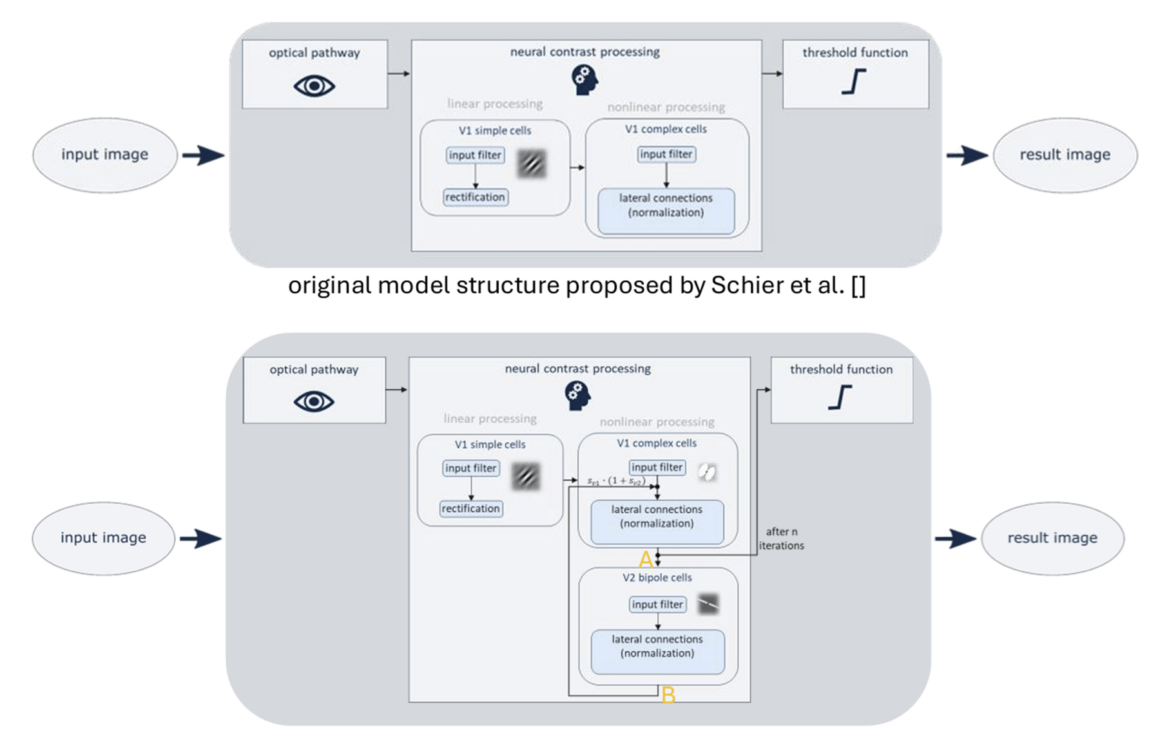
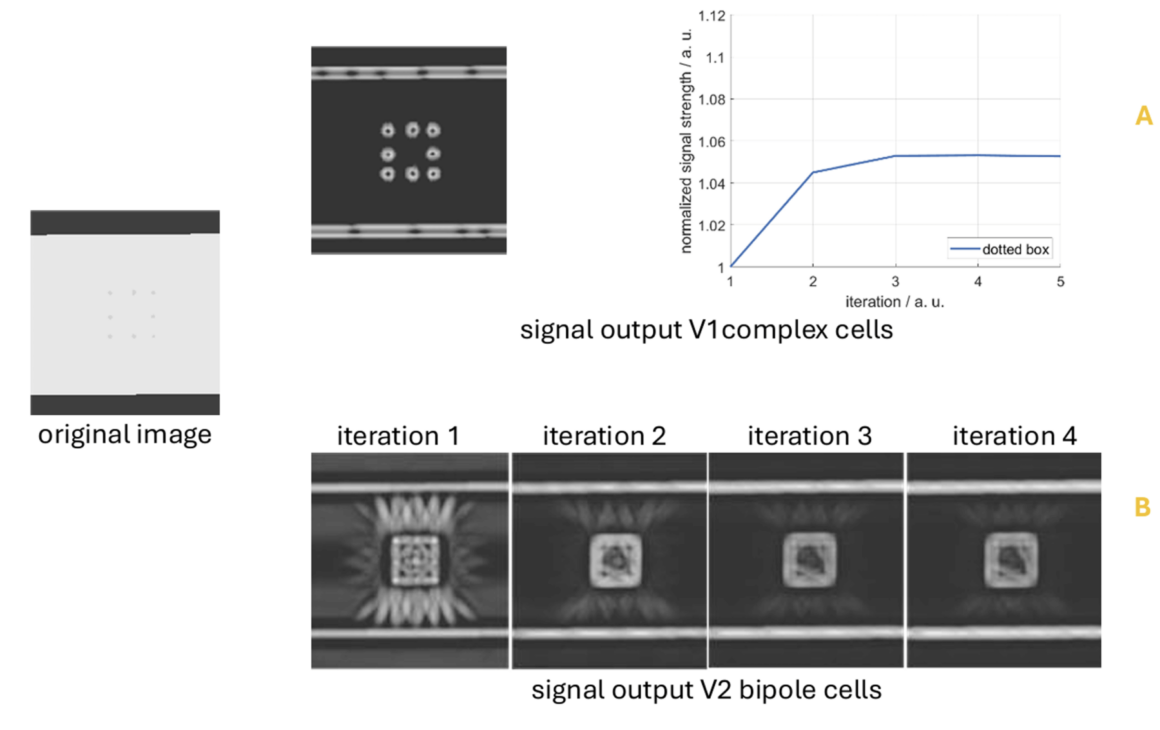
To test the behavior of the model an image indicating a rectangle by showing some dots on the contour of a rectangle is fed into the model. Figure 3 shows the output of the V1 (indicated by the orange letter A in Figure 2) complex cells and the V2 bipole cells (yellow letter B in Figure 2) . The value of the V1 cell increases with each feedback loop until it saturates. The shape of the output image of the V1 cells does not change with an increasing number of feedback cells. This is due to the gain control feedback mechanism. A signal cannot be invoked by feedback in the V1 cells. It can only be enhanced if already existing in V1. The V2 signal on the other hand changes in shape with additional feedback loops. The single dots are connected to one rectangle that is grouped together.
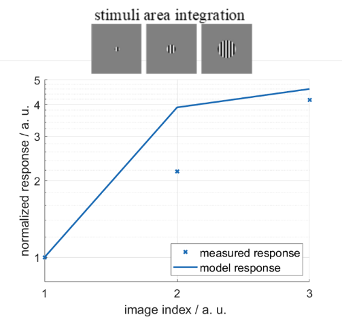
In order to test if the model also works for other known behavior of the human visual system (hvs) a dataset showing area integration is tested. With increased area of a stimulus the stimulus is easier to detect (until the effect starts to saturate). The model results (Figure 4) show a good qualitative behavior. With increased area the value of the signal increases. The quantitative behavior however can be improved. This is possible by adapting the filter sizes of the model.
The first tests show that the model has the capability simulate several effects of the human visual system which are known to significantly influence the homogeneity perception. It delivers good qualitative results for different types of effects. In the future the quantitative behavior will need to be improved. Additional psychophysically measured data will need to be compared to the model results to deliver a thorough analysis of the model’s capabilities. If the results show a good correlation with the data it offers the first truly generic approach for repeatable and automized homogeneity evaluations.
References
[1] K. Schier and C. Schierz, “Digital correlations for visual quality criteria of headlamp light patterns,” 2513-1656, vol. 24, doi: 10.22032/dbt.66075.
[2] A. Thielscher and H. Neumann, “Neural mechanisms of cortico–cortical interaction in texture boundary detection: a modeling approach,” Neuroscience, vol. 122, no. 4, pp. 921–939, 2003, doi: 10.1016/j.neuroscience.2003.08.050.[3] A. Thielscher, M. Kölle, H. Neumann, M. Spitzer, and G. Grön, “Texture segmentation in human perception: A combined modeling and fMRI study,” Neuroscience, vol. 151, no. 3, pp. 730–736, 2008, doi: 10.1016/j.neuroscience.2007.11.040.


