As the automotive industry moves deeper into the age of digitalization, ISAL 2025 reflects this shift with a program that places intelligent, adaptive lighting and V2X communication at the centre of the conversation. With 65 oral and 20 poster presentations selected from 127 submissions, this year’s symposium exceeds the number of submissions for ISAL 2023.
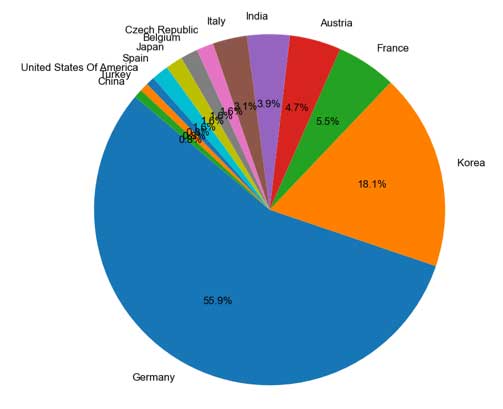
Contributions come from 13 countries, with strong representation from Germany, France, South Korea, China and the United States as countries with a vibrant automotive industry and research culture. Notably, 22 of the submitting authors are women, marking a clear increase in gender diversity.
A major focus of the program is the growing integration between lighting systems and driver assistance technologies. The main session on Lighting for ADAS and ADAS for Lighting highlights how deeply embedded headlamp systems have become in the vehicle’s sensor and software architecture. From camera-based pitch detection to zone-based light distribution, the line between sensing and illumination continues to blur.
This theme continues in the second main session, Future Lighting and Intelligent Lighting Functions, which explores advances in matrix beam logic, energy-optimized lighting strategies, and context-aware virtual sensing — all pointing toward lighting systems that are smarter, more flexible, and more globally compliant. Another area gaining traction is light-based vehicle communication. Two full sessions are dedicated to external HMIs, symbolic projection, and on-ground signalling for automated vehicles. Whether through motion-capture studies or VR simulations, researchers are asking how vehicles can clearly and intuitively communicate intent to pedestrians and other road users — without relying on traditional signals. The answers are becoming more technical, more urgent, and increasingly interdisciplinary.
While these innovations look to the future, ISAL 2025 remains grounded. Issues such as glare and the various causes of glare on the road at night, visual performance, and night-time visibility are as relevant as ever. Several sessions address discomfort glare, visual fatigue, and contrast-based object detection — combining technical optics with human-centric design.
Headlamp design, optical concepts, and new light sources also remain core pillars of the event. This year, ams Osram — winner of the 2024 Deutscher Zukunftspreis (German Future Prize) — will contribute an impulse presentation on the evolution of HD lighting modules, underscoring the high level of innovation in this field.
The program also reflects a growing awareness of environmental responsibility. Sustainability has become a critical design factor: from circular lighting design and recycled materials to lifecycle analysis and climate-aware system architecture. This systems perspective aligns naturally with the rise of software-defined vehicles, where modularity and adaptability are essential.
For the first time in its history, ISAL 2025 will publish all accepted papers in an open-access format. Each contribution will receive its own DOI and be hosted on the TU Darmstadt publishing platform — a significant step forward in scientific transparency, visibility, and impact.
With record participation, a growing diversity of voices, and sessions ranging from adaptive lighting and V2X signalling to optical technologies and emotional interior concepts, ISAL 2025 captures a field in transition. It is a symposium that balances engineering depth with system-level vision — illuminating not just the road ahead, but the evolving role of light in the future of mobility.


