By Michael Hamm, DVN senior advisor
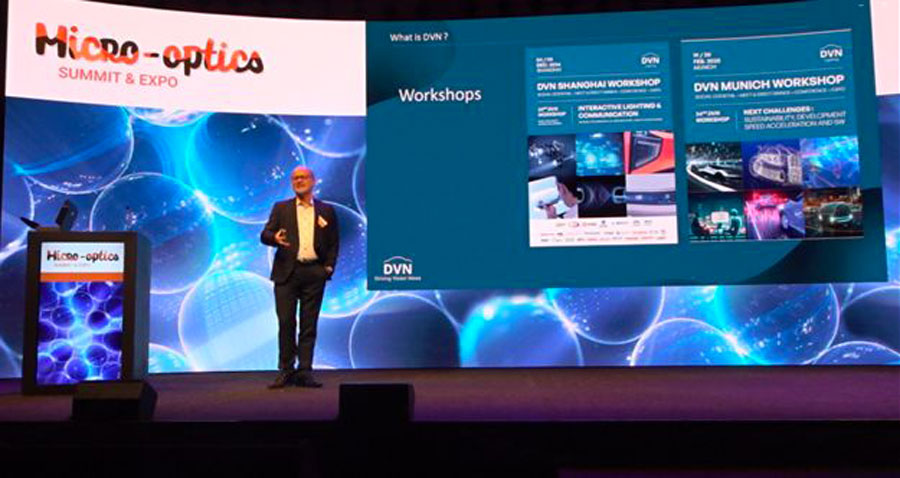
PHABULOuS organized its first edition of the Micro-Optics Summit & Expo at the Beurs van Berlage in Amsterdam on 2 and 3 December, 2024. PHABULOuS is a part of the European Photonics Funding. It has received funding from the European Union’s Horizon 2020 research and innovation program. For about 5 years the objective is to accelerate the validation of technologies and processes, to validate the services of a pilot line, and to establish a unique legal entity as one-stop shop.
During the research various elements of microöptics have been in focus, including:
- Automotive functional lighting: headlamps with uniform appearance in their on/off states, yielding a high beam and an asymmetric low beam with a homogenous light distribution and low stray light, low installation space, and low weight;
- Transport interior lighting: large-area direct-lit LED luminaires with improved luminance uniformity, thinner form factor and lower cost;
- Freeform microöptics: the ability to create (or even print) microöptical components designed with no symmetry constraints gives new chances. New ultraprecision machining in micrometre dimensions will enable new functionalities like non-symmetric illumination and especially miniaturization & integration.
- Micro-OLED: a new dimension to consumer’s experience by providing the world’s highest pixel density AMOLED microdisplays. The technology provides brightness enhancement and control of angular light emission, e.g. in see-through optical systems for wearable AR (augmented reality).
- Virtual and augmented reality: thin, freeform optical lenses with improved image resolution and reduced volume and field of view for VR/AR headsets.
- Solid-state lighting: LED downlights with tunable white light sources creating uniform light distributions in a very compact shape.
Here’s a look at some of the research results presented at the conference:
Automotive Applications
DVN Senior Advisor Michael Hamm started the automotive session with an outlook on markets and technology. Especially this conference on microöptics with many startups and companies active in nanostructures, microöptical elements in 3D printing, roll-to-roll processes, and carving with femtosecond laser machines are part of the innovation process for new automotive applications. The market development shows interesting options for micro technology. Small and miniaturized functions would enable more design flexibility. New functions (small enough to integrate into the car body) will be enabled to improve safety. Especially ground projections—welcome lights, door-opening warnings, turn indicator projection, warning symbols, reversing lamp improvements, and more—will be possible with the help of microtechnology.

Only possible with microöptic technology: new safety contributions via lighting. In this case the idea is to warn cyclists about the turning intention of a large truck. Even when the truck driver has the obligation to take care, it is for sure better the cyclist should clearly see the truck’s intent to turn.

Microöptics for automotive applications
For the research project, the target was to combine primary and secondary lenses and shutters in one microöptical component. At the same time, the process of the pilot-line is being tested from design to replicated components.
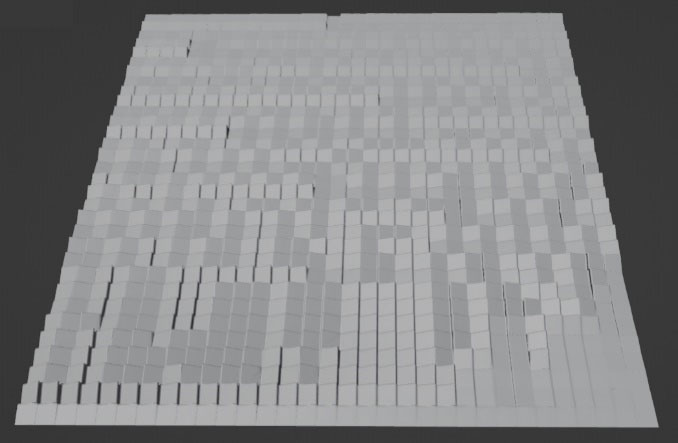
The idea of the Helladesign is to use the light input side of the component as primary optics and the light output side as secondary optics to shape the light distribution. High- and low-beam distributions were investigated with different optical structures as part of the project. In initial testing, a micro-Fresnel lens was used on the first surface and a freeform facet structure on the second surface. The figure below shows an example of a facet structure for generating a low beam distribution:
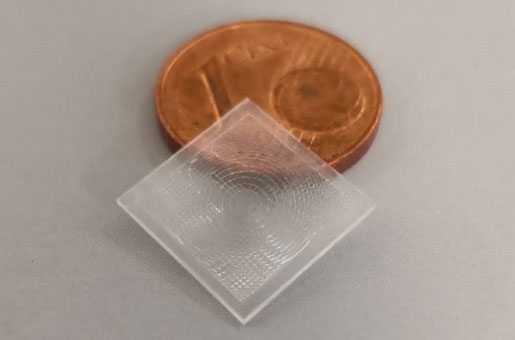
Project partner UPMT took over generation of the master of the Fresnel lens, and PowerPhotonic the mastering of the freeform microstructure. With their ultra-precise machining technique, UPMT produced an excellent shape and surface finish.
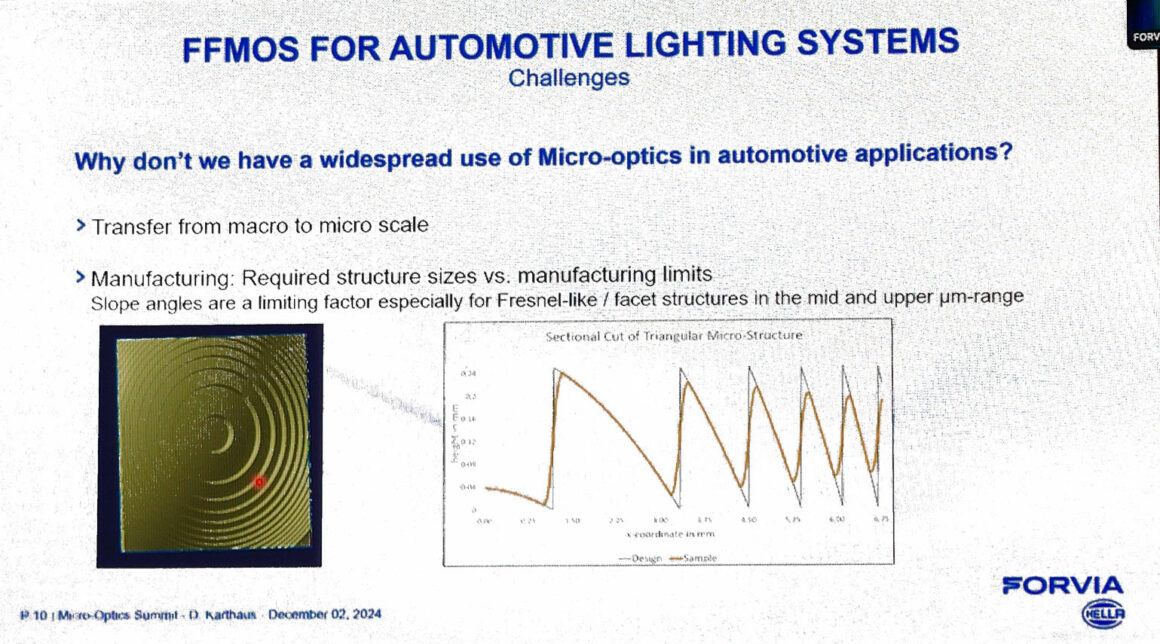
Hella’s partners for the replication are Suss MicroOptics and Nanocomp. A special aspect of the replication was the combination of the two masters into one component. Even though the Fresnel lens generates theoretically parallel light, a high precision in the alignment of the optical surfaces to each other is required to avoid scattered light and a reduction of efficiency. This seems to be the biggest challenge in optical design.
New Applications: Freeform microöptics and roll-to-roll process
In many presentations the advantage of creating a mass production process was addressed. Freeform microöptics are extremely small, complex optical elements that enable precise control over light distribution and intensity. These optics are designed with non-symmetric surfaces, allowing for greater flexibility in shaping the light output.
In the context of lighting for mobility interiors, freeform microöptics play a crucial role in creating innovative lighting designs, enhancing passenger comfort, and improving safety. Joanneum Research, CSEM, Seisenbacher, Morphotonics, Nanocorp, Zumtobel, Swarovski showed their interesting approaches.

The large-area roll-to-roll (R2R) and roll-to-plate (R2P) replication technologies offered by the PHABULOμS line are very interesting for large-area products (for e.g. interior walls). The microstructures can be replicated cost-effectively with high quality. Results presented by Zumtobel.


‘Smart’ transport interior lighting, combined with microöptics, can be used in various modes of transportation such as airplanes, trains, buses, and other vehicles. This is a significant gain for the entire industry, which, thanks to advanced LED technology, is also energy-efficient and environmentally friendly.
3D Printing and microöptical display structures
Another application is highly precise nanoprinting solutions. Maybe they will not be applicable in large-scale automotive applications, but the precision is worth a look.
A laser optic with outer size of some 100µm was demonstrated. The inner optical elements showed to be much smaller. For displays, the optical output elements were in a range of 2 to 5 microns.


