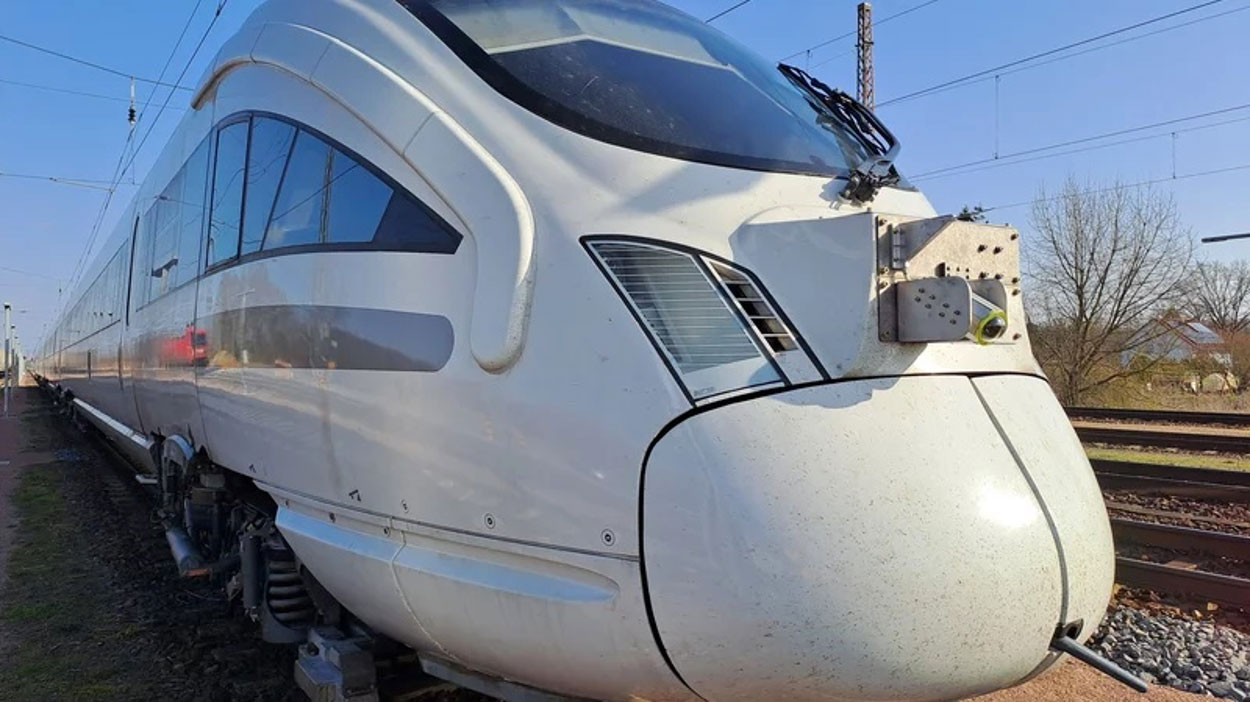
Aeva has been chosen to participate in an automated and driverless train initiative in Germany. Leveraging their frequency-modulated continuous wave (FMCW) technology, which is unique from traditional lidar by being chip-scale silicon photonics-based, Aeva joins forces with a consortium of ten companies including the likes of Siemens Mobility and Bosch Engineering.
This collaboration, known as “AutomatedTrain” and spearheaded by a Deutsche Bahn subsidiary, receives backing from the German Federal Ministry of Economic Affairs and Climate Action under its Digitale Schiene Deutschland program. The aim is to equip two regional trains with the types of intelligent sensors used in autonomous vehicles, to achieve full automation including dispatch and parking functions without drivers by 2026.
The FMCW method, which employs a frequency-chirped laser source, can enhance both the position and velocity of objects, making it ideal for autonomous transportation, albeit more complex and nascent compared to conventional time-of-flight lidar tech. Market analysts at Yole Intelligence predict its influence within automotive applications will become significant around 2028, with earlier implementations likely in industrial domains.
Christian Hauswald of Digitale Schiene Deutschland highlights that the decision to engage Aeva was driven by the superior resolution and compact design of its lidar sensor, alongside its advanced readiness level. Jakub Zimny of Aeva reciprocates the enthusiasm, noting the critical role of their partnership in revolutionizing rail industry standards across Europe with sensing solutions. A key benefit of the FMCW sensor offered by Aeva is its swift identification of stationary versus moving objects near railway tracks, enhancing safety through early detection of possible obstructions.
DVN comment
Aeva previously mentioned last year that Railergy, a German rail automation company, chose their FMCW tech for train coupling tasks. More recently, Aeva announced that its FMCW sensors are set for extensive use by Daimler Truck, planning to integrate the technology in 2026, with a significant increase in production expected in 2027.


