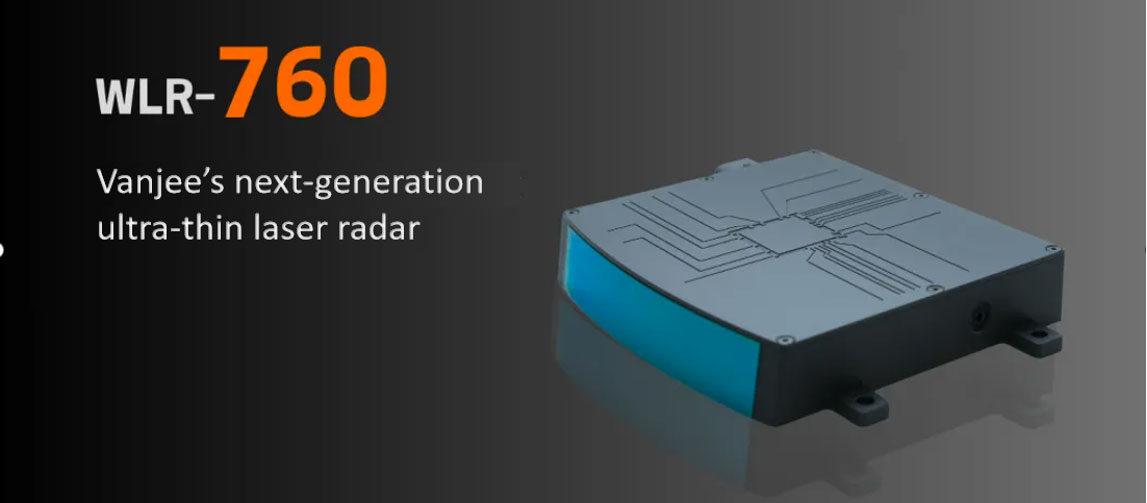
VanJee has officially released new automotive lidar, the WLR-760. It achieves all-around strength in an ultra-thin body, with ultra-clear vision; ultra-low power consumption, and ultra-low cost thanks to new transceiver technology.
It’s just 24 mm high, for a slimmer profile than other lidars for versatile integration. It has low power consumption of only 12 W due to advanced transceiver technology, which keeps it cool even after 8 hours of use in nearly 30°C heat, as demonstrated at the Beijing Automotive Exhibition. Its compact size and minimal power needs allow for flexible and aesthetic placement on vehicles, like the roof, windshield, or bumper, contributing to lower wind resistance and more smart sensor integration options.
Lidar point cloud quality is assessed using three key metrics: angular resolution, field of view (FOV), and detection range. The WLR-760 has a 192-line high-definition point cloud harness, achieving up to 300 meters in detection distance with a FOV of 120°H × 25°V. It excels in ranging performance by detecting objects 200 meters away at just 10 per cent reflectivity, aiding in complex driving environments.
The WLR-760’s ROI is engineered for 80°H and 12.5°V to optimize point cloud efficiency. This scanning capability strengthens the resolution to 0.15° × 0.08° for better object recognition at greater distances. It incorporates a cutting-edge VCSEL+SPAD design, paired with VanJee’s proprietary FOC vector control algorithm and a multi-channel VCSEL driver. This integration markedly increases the performance of the product while streamlining its structure.
By simplifying and integrating the structure of the product, there will be a considerable increase in the production efficiency of the lidar. The WLR-760 reduces component types by over 60 per cent, lowers the quantity of components needed by more than 80 per cent, and shortens the manufacturing process by 30 per cent compared to conventional methods.
DVN comment
The integration of VECSEL smart control algorithms could significantly improve the performance of the lidar while simplifying its internal structure. That can allow important gains in production processes, facilitating low dispersions among units, high volumes and consequently a lower unit cost.


