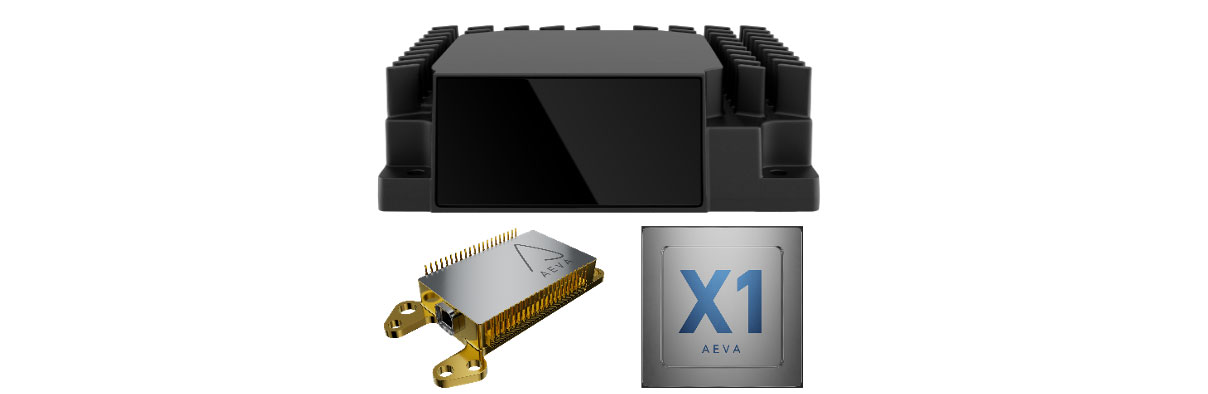
Aeva says their new Atlas is the first 4D lidar sensor designed for mass production automotive applications.
It is powered by Aeva’s innovations in custom silicon technology including the CoreVision lidar-on-chip module and X1, a powerful new SoC lidar processor.
Aeva cofounder and CTO Mina Rezk calls the Atlas “the key development that will enable OEMs to equip their vehicles with advanced safety and automated driving features at highway speeds by addressing challenging use cases that could not be solved before. Importantly, we believe it will accelerate the industry’s transition to FMCW lidar technology, which we believe is increasingly considered to be the end state for lidar, offering greatly enhanced perception solutions that leverage its unique instant velocity data”.
The CoreVision is Aeva’s fourth-generation lidar-on-chip module, incorporating all key lidar elements including transmitter, detector, and a new optical processing interface chip in an even smaller module. Built on Aeva’s proprietary silicon photonics technology, it replaces complex optical-fiber systems found in conventional ToF lidar sensors to ensure quality and enable mass production at affordable costs.
The X1, Aeva’s powerful new FMCW lidar SoC, seamlessly integrates data acquisition, point cloud processing, scanning system and application software into a single mixed-signal processing chip. It is designed for dependability with automotive-grade functional safety and cybersecurity.
These innovations allow the Atlas to be over 70 per cent smaller and consume one-fourth the power of Aeva’s previous lidar sensor, enabling operation without active cooling and allowing for seamless integrations behind the windshield, on the vehicle’s roofline, or in the grille.
Using Aeva’s FMCW 4D lidar technology, AVs can detect objects faster, farther away, and with higher confidence – instantaneously discriminating between static and dynamic points, and finding the precise velocity of dynamic objects. The Atlas delivers critical requirements for highway-speed driving with a 25-per-cent greater detection range for low-reflectivity targets and a maximum detection range of up to 500 meters. Atlas sensors are immune to interference from direct sunlight, signals from other lidar sensors, and from retroreflective objects like street signs.
Atlas sensors work with Aeva’s perception software, which uses advanced machine learning-based classification, detection and tracking algorithms. Incorporating the additional dimension of velocity data, Aeva’s perception software provides unique advantages over conventional ToF 3D lidar sensors including:
- Aeva Ultra Resolution: a real-time, cameralike image that provides up to 20 times the resolution of conventional 3D lidar sensors;
- Road hazard detection: small objects on the roadway are detected with greater confidence at up to twice the distance of conventional 3D lidar sensors;
- Dynamic object detection discriminates, determines the velocity of, and tracks all dynamic objects with high confidence at up to twice the distance of high-performance 3D lidar sensors;
- Vehicle localization estimates vehicle motion in real time with six degrees of freedom, for accurate positioning and navigation without the need for additional sensors like IMU or GPS
- Semantic segmentation divides the scene into drivable lanes and non-drivable regions, pedestrians, vehicles and other elements such as traffic signs, vegetation, road barriers and infrastructure;
- Pedestrian detection detects, classifies, and tracks pedestrians to improve safety where pedestrians are on the roadway or close to curbs.
Aeva expects to release the Atlas range for production consumer and commercial vehicles starting in 2025, with samples available to some automakers and mobility customers earlier.
DVN comment
Doppler point cloud clustering is a good way to accelerate the segmentation of road scenes and objects. With their CoreVision lidar-on-chip module, Aeva could be, the first lidar supplier to offer a compact LoC architecture in large volumes.


