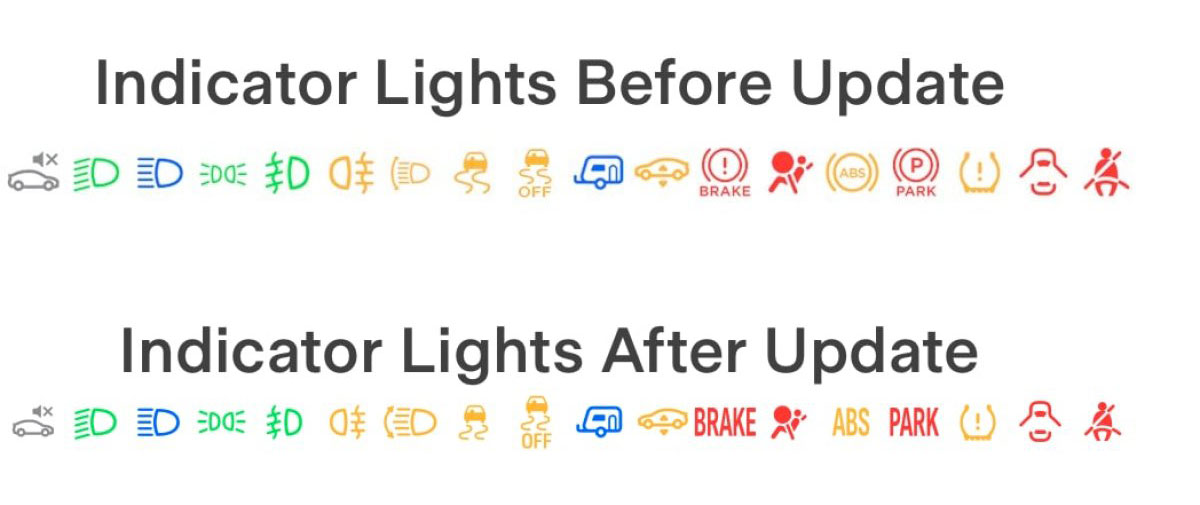
Tesla has been forced—again—to recall and fix cars that don’t meet applicable safety standards. This time, it’s because they failed to make every single one of their US-specification cars in accord with one of the easier-to-meet aspects of the Federal Motor Vehicle Safety Standards.
The noncompliance involves the brake system fault, ABS fault, and parking-brake-applied telltales. In most of the world, symbols are used for these telltales: an uppercase P; an exclamation point, and the letters ABS in the centres of pictograms meant to look like a wheel brake.
But in the U.S., the word BRAKE is required for the brake system fault telltale. If a separate telltale is used to inform the driver that the parking brake is applied, it must use the word PARK. And the one for the antilock brakes must read ANTILOCK, ANTI-LOCK, or ABS. All these must be in letters at least 3.2 mm tall. Symbols are allowed, too, but they’re optional; the words must be present, and they must be sized according to the regulation.
As has become customary, Tesla enthusiasts have been quick to dismiss the fix as a non-recall, because the fix involves an over-the-air software update rather than time and hassle taking the car in for hands-on service at a dealer—a quibble at best, but this time it’s an actual, real, old-fashioned recall, at least for four model years’ worth of cars. No Tesla sold from 2012-2015 can be updated over the air; they must be taken to a repair centre for a software reflash. That’s because even though 4G/LTE was in common use in 2012, Tesla chose to use a 3G cellular radio for data service on their 2012-’15 models—AT&T’s 3G service, specifically, which was permanently shut down in December 2022, making all those Teslas unreachable.
They do have Wi-Fi, but the recall requires updating even those vehicles not parked near a Wi-Fi hotspot overnight—and that means Tesla must mail out paper notices and make service centre appointments.


