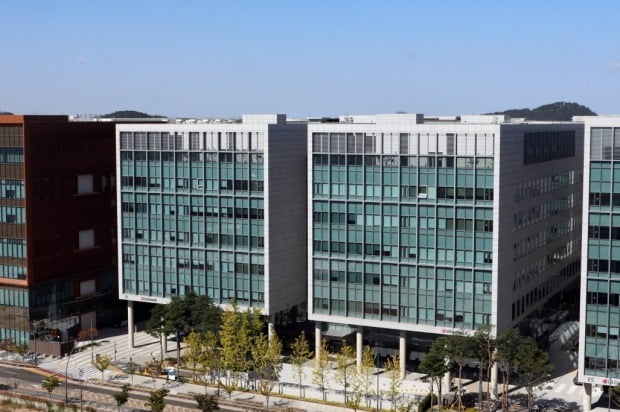
LG Innotek, founded in 1970, is Korea’s first comprehensive electronic component company. They have secured global leadership in areas including semiconductor substrates; autonomous driving sensing modules; automotive communication modules; motors; power; lighting; and display power/electronic components, as well as the № 1 position in the global camera module market. They achieved USD $13bn in sales in 2021, a year-on-year growth of more than 60 per cent.
They’re headquartered in Korea; have some 19,000 employees and have sales subsidiaries in Germany; the United States; China; Japan, and Taiwan and production subsidiaries in China; Vietnam; Indonesia; Mexico, and Poland.

Mooryong Park is the company’s Director of Lighting Solution Development. After completing his master’s degree in display chemical engineering in 2003, he joined LG and took charge of developing display materials and optical structures. In 2012 he began working on vehicle lamp module R&D, and his work has been commercialised for global customers. He graciously talked with us about his company, his work, and his perspectives:
DVN: What is the link of LG Innotek with LG?
Mooryong Park: LG Group has 65 subsidiaries—including nine in electronics; nine in chemicals, and 47 in communication & services. LG Innotek is one of the electronics subsidiaries and is growing into a global material parts company.
DVN: Can you tell us about your products?
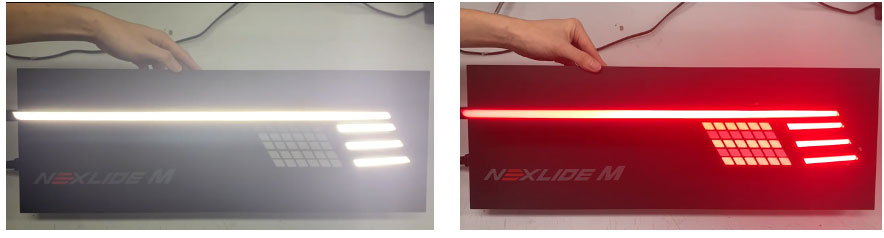
M.P.: Among automotive components, Nexlide is a surface lighting module that is a differentiated product consisting of ultra-thin structure through precise optical design and highly-reliable material design.
DVN: What are LG Innotek’s strengths?
M.P.: It is based on various automotive components business and provides total engineering service. Based on our experience in display technology, we propose differentiated engineering solutions for customers’ technical limitations with electronic circuit components, optical design and highly-reliable material design technology. In addition, based on analysis of lamp design trends, it is possible to respond to prior technology development and mass production within a short time of a year. With past experience in the display business, a delivery response system has been established, so we can respond quickly from development to mass production.
DVN: and the challenges?
M.P.: Based on differentiated Nexlide technology, we are expanding from surface lighting module to pixels and displays, and growing into the global № 1 lighting solution company that supplies multiple customers.
DVN: What do you see as the main challenges in the lighting industry?
M.P.: With the trend of vehicle electrification, the energy efficiency of lamps is also becoming more and more important. Nexlide will bring differentiated surface and line lighting modules to market through the development of optical structures and materials that can increase light efficiency. We also want to add optical film technology for Dynamic images to increase design freedom. We will always prioritise what our customers want and pursue the task of collaborating and improving.
DVN: How do you balance CO2 reduction (less power) and safety increase (more power)?
M.P.: LG Innotek has declared 2030 RE100, 2040 carbon neutral. Vehicle lighting products also focus on maximising light efficiency by improving the module structure to minimize CO2 emissions. In addition, we are improving performance with reliable products that can maintain brightness in accordance with unlit and legal regulations. Nexlide’s quality can be testified to its excellent quality by the fact that there has not been a single claim from the customer since mass production started in 2013.
DVN: Are you working on new functions—road projections, illuminated grilleboards, lit logos…)?
M.P.: New lamps (road projection, grille, logo) applied to vehicles require uniform light distribution in a small space. In order to meet the required performance, a lamp structure of 10mm or less is essential, and Nexlide’s simple optical and mechanical structure can be designed, providing customers with design convenience.
DVN: And what about communication functions—V2drivers; V2pedestrians, etc?
M.P.: We are leading the development of technologies and products that meet the evolution of vehicle communication technology to increase connectivity between vehicles, and V2X modules are expected to become our flagship products in the future. Also, we are examining concepts that can be applied to lamps for transmitting signals to drivers or pedestrians through automotive lamps (pixel composition, various colours, etc).
DVN : What do you think of the OLEDs Audi have presented recently?
M.P.: I think OLED is a good enough solution for finished cars that value lamp design with the advantage of high-resolution displays. In order to be applied to automotive lamps that require various designs, the mass production of OLED is expected to continue to improve. However, since organic materials are less reliable than inorganic LEDs, it is expected that there will be limitations in their application to external lamps that require high reliability.
DVN: What can you tell us about the radar you developed for in-cabin safety?
Mooryong Park: LG Innotek has an In-cabin radar solution for passenger safety. The RF antenna design can realise high resolution, so up to 1~5 people can be individually located with one radar, and the self-developed software can detect fine signals to quickly check whether an infant is on board.
DVN: Your company sold their LED patents to Suzhou Lekin, a Chinese semiconductor and electronics company, and announced plans to exit the LED business. What about vehicle lighting?
M.P.: It’s true that we’re going out of our LED package business. However, Nexlide’s LED module for automotive lamps and LDM (LED Driver Module) business are continuously expanding. LEDs are supplied by specialised companies to design modules with differentiated structures and provide total engineering including LDM.
DVN: Your Nexlide-E is a thin module that produces bright and uniform light. What else can you tell us about it?
M.P.: Nexlide E can meet the luminosity requirements of stop and DRL functions by improving the luminosity by 40 per cent with a microoptical film (concentrating the direction of light to H-V) in Nexlide A, which integrates reflector, light guide, and hot spot control into a thin structure. Currently, it is being applied to many models of tail and stop and is in mass production, and DRL is scheduled for mass production in Q2-2023.
DVN: Any closing comments on front and rear lights?
Mooryong Park: Headlamp [work] will focus on developing new optical structures and high-efficiency materials for low power consumption, while [for] rear lamps [we] will continue to develop and mass-produce solutions with competitive cost. In addition, due to its ultra-thin structure, high efficiency and high degree of design freedom, it is expected that many solutions will be applied that can easily differentiate lamp designs.


