
Audi’s designers have reinvented the front lamps on the new R8, with an array of 25 LEDs providing headlight beams; fog lamps; turn signals, and previously impossible decoration. Audi’s head of lighting design, Cesar Muntada, was involved in transforming the vehicle lighting design alongside the likes of Wolfgang Huhn and Stephan Berlitz.
Herewith, his thoughts:
“We brought light design into the car industry. There’s been a revolution in the technology. Headlights are taking radical new forms. In the latest concept cars as well as production vehicles designers are creating headlights and taillights that do far more than simply light up the road.
“There are adaptive driving beam headlights that can automatically shadow out and avoid shining in the eyes of oncoming drivers, and spotlights that can detect pedestrians and cyclists on the side of the road. There are animated displays that sparkle up when an owner approaches their car, and taillights using more finely controllable OLEDs that can boost their brightness when an approaching vehicle comes up close behind”.
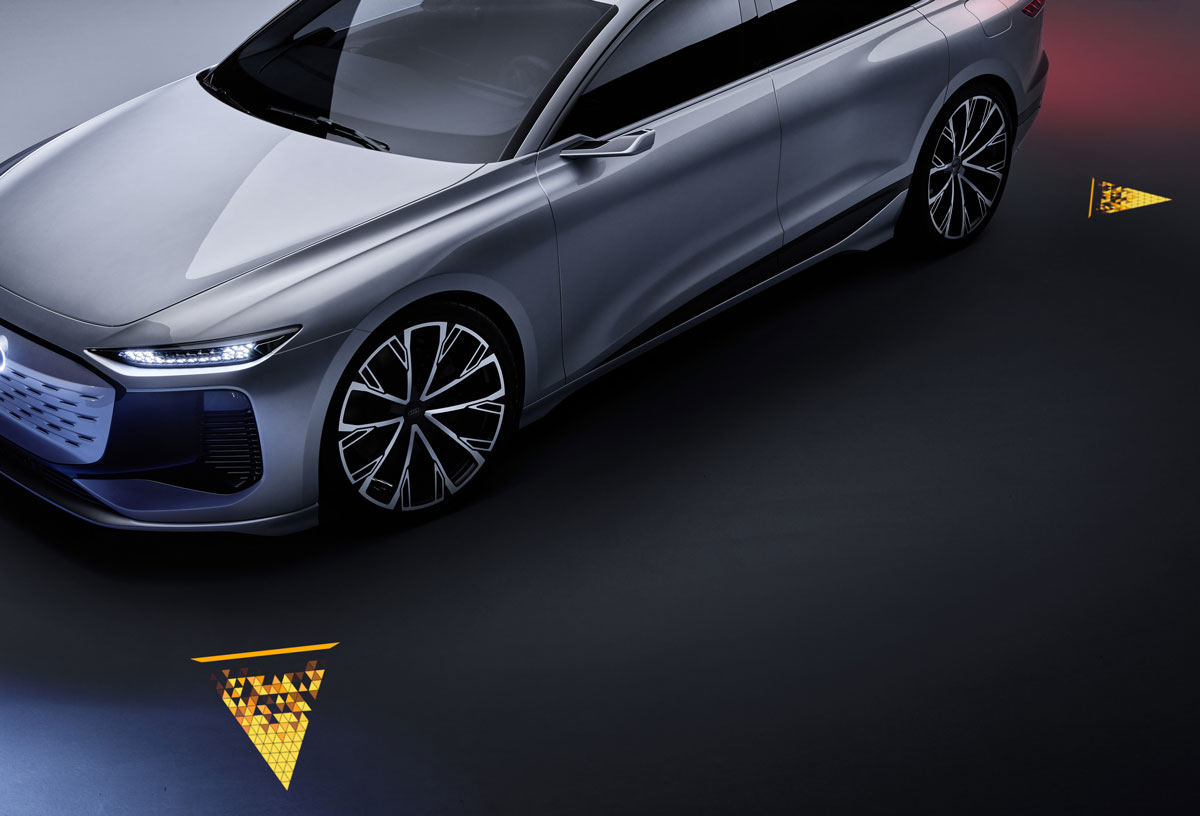
“Audi’s A6 e-tron concept turns headlamps into a kind of entertainment, allowing parked cars to project videos or even playable video games onto the ground or a nearby wall. While some regulations won’t allow us to do things while the car is in motion, there’s a lot more freedom when the car is stationary.
Now, as the motor vehicle industry shifts its focus to electric vehicles, and eventually to autonomous vehicles, that’s opening an abundance of opportunities for designers and leading to an industrywide rethinking of what lights can do, from upstart brands to the long-established leader in lighting design, Audi. “We created the first revolution,” Audi’s Muntada says. “I think we might now be in the second revolution.”
The mainstream shift to EVs is an overarching theme:
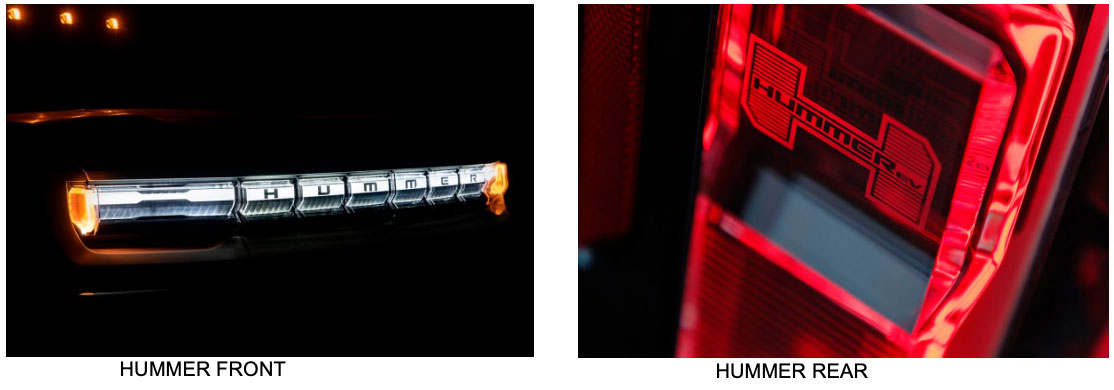
At the front of GM’s new Hummer EV, in the space where the grille of a combustion-engine vehicle would be, hummer is spelt out in lights. The light band spans across this space, no longer needed for airflow and so now available for branding, messaging, and new designs. The LED taillights have a hummer callout as well.
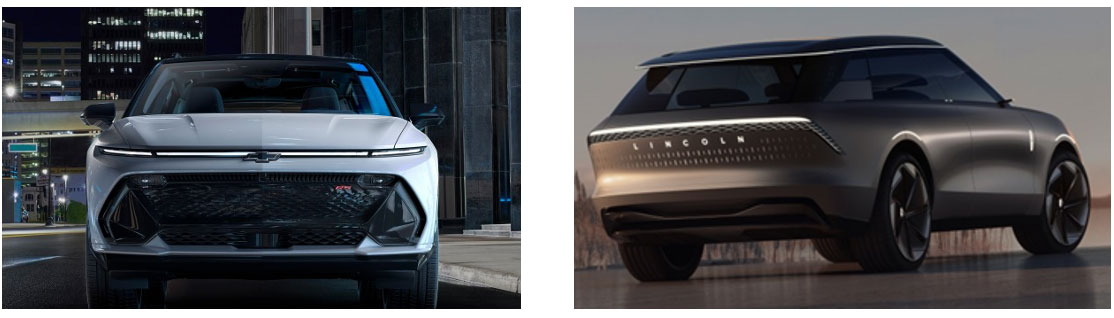
“In the old days if you wanted something to sell for a higher price, you’d just slather chrome on it because that’s what the customer can really see; lighting is the new chrome,” says Raphael Zammit, chair of the graduate transportation design program at the College of Creative Studies in Detroit, one of the top schools for automotive design. Zammit spent years working on design and concept teams at automakers including Porsche; Hyundai, and General Motors, and he says lighting design is becoming one of the main differentiating factors among competitors. It’s why companies like Audi have put such intense focus on lighting design.
Zammit says lighting has become such a central part of the marketing of cars because, like the chrome of the past, it’s readily leveraged to differentiate one brand from another: “A lot of car companies can show a car driving around really fast. But it’s a lot clearer if you can compare this special effect against that special effect. It’s more concrete”.
When Audi moved into LEDs, lighting was no longer considered a discrete element of the car, or just a jewelry item that designers could tack on to grab the eye. Muntada says new and emerging technologies are making it possible for lighting to better blend into the shape of the car, or even be embedded in windshields. These advancements have meant a smoother overall form. Looking forward, Muntada says lights could be integrated in ways that blur the lines between the body and the lights. “We are part of the whole design,” he says. “We are in the line, the message, the character, the personality of these cars. It’s not true anymore that I have lights to see in the front and lights to be seen on the rear and that’s it”.
Emerging technologies make this blurring of body and light even more possible, according to Stephan Berlitz, head of Audi’s lighting development. Digital micromirrors in Audi’s matrix LED headlamps use 1.3 million tiny mirrors to precisely shape and project light, making it possible to sculpt the lighting enclosures without sacrificing lighting performance.

And the digital OLED rear lights on some new Audi models have a flexible substrate that allows them to wrap around three-dimensional surfaces. “That not only sharpens the form, but it also makes it possible to integrate digital light design within the exterior of the lights, enabling symbol displays for additional communication with the outside world,” says Berlitz.
Lighting will still be needed on autonomous vehicles—not least so humans without the benefit of radar or lidar or night vision can see them.
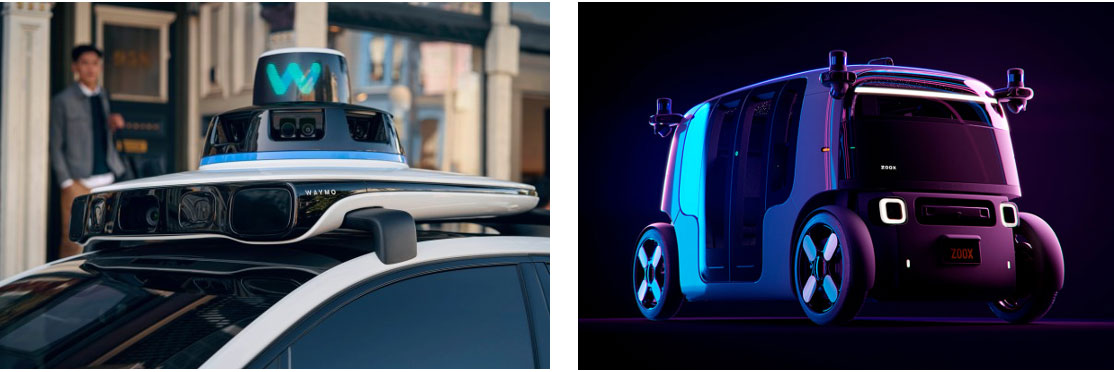
It’ll be part safety, part branding, according to Paul Snyder, a former car designer for Honda who now chairs the undergraduate transportation design program at the College of Creative Studies: “You’re going to have lighting that still signifies here’s the Zoox autonomous taxi bot, and you’ll recognize it when it’s coming down the road versus whatever the Waymo taxi bot or the Cruise taxi bot looks like,” Snyder says. “Pedestrians on the street will definitely need to see these very quiet vehicles cruising around”.
Audi’s Muntada is already thinking about the role lighting can play in this future communication. Cars will need to have an entirely new ‘light language’, he says. There will need to be a systematic reimagining of car lights from merely lighting the road or indicating turning and braking to communicating driving states; directional intentions; acceleration and deceleration; road hazards, and the service status of taxi cars operating autonomously. “It’s something that doesn’t exist at the moment. We started already but creating a designed light language needs to understand this language in a fraction in a second”, he says. For lighting designers, the floodgates are opening. Whether it’s animated light sequences in the conventional eyeball-like headlights or embedded LEDs turning entire vehicles into signs announcing your taxi has arrived, lighting technology is enabling bold new functions for light on cars.
If Muntada’s right, lights are going to become a critical way for cars and humans to interact more smoothly and safely. Beyond just making it possible for people to drive at night or adding value to a luxury vehicle, lights may soon be vital mechanisms for the way we let robot cars coexist with humanity. “We believe this is the biggest challenge that we’ve had so far,” Muntada says, “because it’s trying to put the whole world together in a new way.”


