1) Osram ADB HR Mockup: 2 Eviyos Make 100k Pixel Performance
The target of the prototype was to demonstrate that two micro-LEDs Eviyos from Osram having 25k each can deliver a performance equivalent to a unique 100k micro-LED system.
The main principle is to use these two Eviyos with two different magnification, one illuminating a large field from -20° to +20°, and the other more central from -10° to +10°.
This distribution is like the one necessary for headlamp with more intensity in the center. Similarly, for HD application such as road projection, it is mainly the center part of the beam that is used, so where the highest definition is useful.

The MicroLED used for this prototype is the next generation of Osram Eviyos with 25600 pixels, with a reduced pitch of 40µm.
To allow these two magnifications, two different optical systems are used: one with a field of view of +/-12° and the other with +/- 20°. Six lenses are used for each, 5 spherical in glass and one aspherical in Zeonex, the last one having a diameter of 50mm. The system length is 100mm, and the numerical aperture 0,6.
2) Stellantis Strategy for the integration of ADB headlamps and HD headlamps
Whilk Goncaves presented the PSA strategy (defined before the merge with FCA) for the integration of ADB headlamps oriented to the needs of the many brands of the company.In this strategy, every kind of ADB, single row with 10-20 px, two rows with 50 px, three rows with 84 px, HD high definition with 10kpx and very high definition with 1 Mpx could have some applications in the company, each brand having specific needs.
For instance currently, Opel is looking at HD systems, Peugeot and DS are using two rows systems and Citroen one row system.
However, the trend is to progressively increase the number of pixels for each brand.
Stellantis has different requests on the style:
– Very thin modules for lit signatures till 5mm for ADB and LB that could be linear or curved
– Reduced depth particularly for EE cars with reduced energy consumption
– Towards Multifunction systems, meaning in a first step the integration of LB and ADB in the same module, and later the HD, boost, bending light in the same module
– Optimized power consumption necessary for all types
About new functionalities with guiding lines and pictograms, they will have to achieve Security and Comfort, Augmented reality, and Danger Alert targets.
3) Stanley ADB from MEMS Laser
Stanley has defined the main specifications of his system for each of these conditions of use:
– On straight road: a minimum light distribution angle of 1° to avoid glaring the other users
– At high speed, a high-luminosity narrow distribution with a visibility distance two times higher than traditional LED HL
– At low speed, a spread of light of +/- 45° to see pedestrians more quickly
– On curves, a high intensity area following the curve with no brightness change and with no mechanical system.

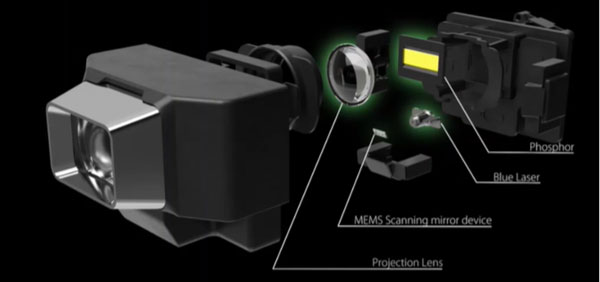
To achieve these targets with a laser scanning system, Stanley has developed a prototype including a blue laser, a MEMS Scanning mirror, a phosphor layer in reflective mode, and a projection lens.
Features of MEMs
– at high speed
• High-luminosity narrow distribution simply by narrowing the scanning angle of the mirror.
• Recognition an obstacle with a reflectance of 10% that has fallen 185 m away
• Approximately two times visible distance of conventional LED headlamps
– at low speed
• Light distribution up to 45° right and left when driving at low speed
• Flushing the pedestrian to recognize the pedestrian more quickly.
– at curve
High-intensity area is swiveled without changing the brightness
• It is possible to swivel without mechanically moving the optical unit


