Interview with W. L. Gore’s Ronald Szewczyk
Ronald Szewczyk (“Chef-chik”) is an application engineer in automotive venting at W. L. Gore. He started his career as a design engineer in the pharmaceutical industry, then transitioned into an application engineering role supporting the designs he had created. In his position at Gore, he supports automotive venting for exterior lighting and powertrain applications. His primary focus is on lighting and the CMD, that is AML’s Condensation Management Device, enabled by Gore products. Szewczyk works with automakers and suppliers, and tests products on cars in real-world conditions, as well as in controlled lab environments.
DVN: Tell us about W.L. Gore, won’t you please?
Ronald Szewczyk: We are a global materials science company dedicated to transforming industries and improving life. For the automotive industry, we work in close collaboration with industry leaders to enable their applications exterior lighting, electronics and powertrains, and data transmission cables and fuel cells—all to be safer, cleaner, more productive, reliable, durable, and efficient. Gore employs approximately 9,500 associates, and generates annual revenues that exceed $3bn.
DVN: The pandemic has affected the whole automotive industry. What has been its effects on your sales?
RS: Our sales were certainly impacted earlier in the pandemic, as has been true for many in the automotive industry, but we are seeing a robust recovery in both our venting and fuel cell portfolios.For venting, we think that is because our portfolio continues to offer up new solutions based on our advanced membrane technology and other proprietary developments that are welcomed by the market.
DVN: Gore make vents which manage internal pressure and humidity in headlamps. Could you describe this activity?

RS: For headlamps, Gore technology has led to two excellent solutions, both of which provide life-of-vehicle performance and protection: One of course is our innovative portfolio of adhesive vents. The other is a truly unique device that actively removes—not just reduces, but removes condensation from headlamps. It’s an industry first.
Our adhesive vent portfolio is based on diffusive venting technology, which incorporates our proprietary Gore membrane to provide continuous moisture diffusion and pressure venting whether the vehicle is moving or parked. This enables ongoing condensation reduction, and equalises pressure differentials that could stress seals or threaten the integrity of the sealed enclosure. At the same time, this membrane protects against ingress of fine dust, dirt, water, splashes or sprays, and common automotive fluids.
A truly unprecedented innovation for headlamps, jointly developed with AML, leverages their actuator expertise with our diffusive technologies and unique regenerable desiccant material. This CMD (Condensation Management Device) actively removes humidity from inside the headlamp, to significantly reduce the risk of condensation forming.
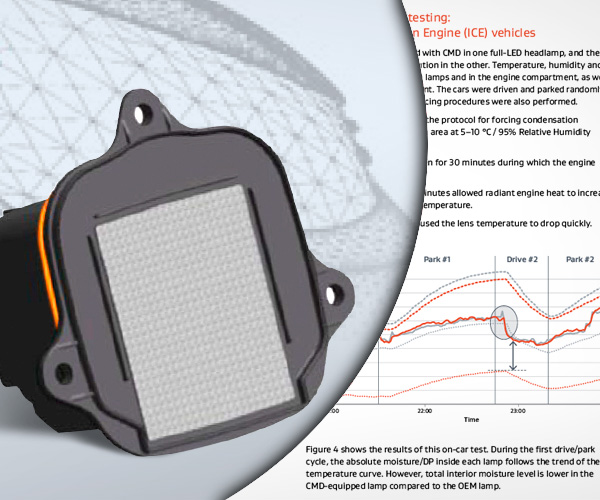
It’s an electromechanical device, installed on the headlamp housing. Equipped with a breathable membrane and a radial seal, it allows the headlamp to remain completely sealed while providing pressure equalisation and ingress protection. The CMD incorporates proprietary Gore technology including a unique regenerable desiccant material. This desiccant adsorbs moisture from the inner headlamp. Then, as the desiccant is regenerated, it desorbs (releases) that moisture to the external environment. These adsorb/desorb cycles lower the lamp’s internal dew point (DP). As the internal lamp DP drops, the difference between the internal lamp DP and the lens temperature increases, reducing the risk of condensation occurring inside the lamp. Active moisture removal is what makes CMD such an innovative solution to condensation challenges!
DVN: Could you give some details of the CMD technology to convince customers?
RS: At the core of CMD is the Gore microporous desiccant tape. It was specifically designed for the robust performance the auto industry requires: It has a high absorptive capacity and is engineered for repeated cycling over the life of the vehicle. During a short active cycle, the CMD quickly and reliably desorbs and expels the moisture it absorbed from the internal headlamp environment, including surface moisture and moisture within the plastics, into the external atmosphere. This active moisture removal technology functions effectively, even in extremely humid weather conditions. We credit the CMD’s functionality in varied environments to our collaboration with AML. By combining our respective areas of expertise—AML’s in actuating devices and Gore’s in condensation and ePTFE (expanded Teflon) membranes—we were able to tackle the source of the problem, which was: just remove the moisture from the enclosure before condensation can form. It sounds simple, but it was a two-year collaborative effort to implement it in a way that would provide life-of-vehicle performance and reliability.
DVN: Have you already started delivering CMD to customers?
RS: AML is the supplier of CMD to the market, but yes, the CMD is commercialised, and since July of 2020 BMW has incorporated CMD as standard equipment on their 5 Series, with initial roll-out in China, where headlamp condensation an issue that is top-of-mind for many car owners. That’s because China offers some of the most challenging environmental conditions a headlamp can experience, in terms of levels of heat and humidity that consistently generate condensation.
DVN: How do you see the future of this technology?
RS: We see great promise for the future. The unique technology behind Gore condensation-management products has potential in a wide variety of applications. Automotive exterior lighting was our primary focus, because this technology is so well-aligned with some of the megatrends we see. Beyond the cosmetic and bottom-line benefits of clear lenses, we’re also exploring how this technology might support emerging applications where sensors are integrated into headlamps. Because of course those sensors would require clear lenses to function properly. This is an exciting area, and one we are eager explore further in discussion with our customers.
DVN: Do you foresee fogging in the lens disappearing in all headlamps?
RS: CMD shows it’s achievable. We know that consumers already feel lens condensation is a significant problem: many perceive it as a “failure of quality“ on the part of the automaker, and this can certainly affect brand reputation. As headlamp styling and design are increasingly important to brand image, solutions to sustainably protect headlamps from condensation are more urgently needed.
More information is available as an online resource from Gore.


