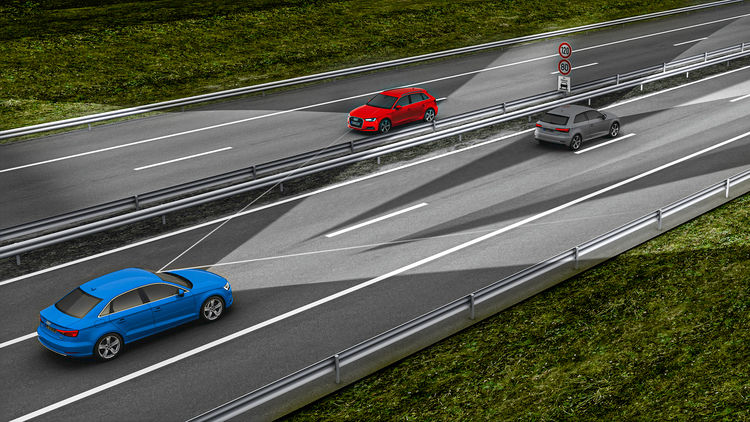
Popular German motoring magazine Auto Motor und Sport recently did a feature article in which the headlighting equipment and performance of a variety of cars was compared. Here are some highlights extracted and translated from the original German, along with a summary of the main conclusions.
“Our many years of experience with light tests shows that laboratory measurements can provide additional data, but the actual performance that is relevant in everyday life can only be seen in practice. That is why we evaluate the quality of the systems when driving on our proven, topographically demanding light test route. Thanks to crests and valleys, straights, curves, forest passages, crossings, roundabouts and traffic signs, it is perfectly suited for the evaluation of all criteria. This also includes the adaptation of the light output to other road users.
“In principle in all classes, thanks to LED headlamps, even small cars shine as brightly and efficiently as expensive ones in the past. That is why we think even a well-crafted halogen system is like someone put a candle on the front of the car. As a special guest: the Audi e-tron S Sportback, the first to be available in large-scale production with digital LED matrix headlamps. Mercedes-Benz is offering something similar in the previous Maybach and now in the S-Class.
So, it remains exciting.
“In our test, the adaptive systems show how far the technology has come. The test persons confidently illuminate even treacherous peaks and valleys, cut out oncoming and driving ahead from the high beam. Although there are definitely differences here: some work rather abruptly, almost hectically, others with a steady, glowing hand and generous cutoff. Strikingly bright: the BMW, thanks to laser support. Outstandingly gentle and skilful: the complex and very expensive digital matrix LED of the Audi. Opinions may be divided about its additional projections, but the regular illumination while driving is remarkably pleasant, efficient and fatigue-free with the e-tron. It couldn’t be better.
“The (expensive) digital light shows what the future could look like: at a distance of 100m, the shadow zone can be 2.5 centimetres wide; with good 84-pixel headlamps, it can be 1.8 by 2.4 m. Digital systems are not necessarily brighter than others but regulate extremely fine. Behind it is a DMD (Digital Micromirror Device), its micromirror with an edge length of only a few hundredths of millimetres; depending on their position, they either cast the light onto the street through lenses or in a light-absorbing material to generate fade-outs. It delivers clear projection, marks the driving lanes, or adjusts the light output according to the static and dynamic environment.
“BMW X5: The laser in the BMW supplements the swivel LEDs and significantly increases the range of the high beam. For an extra €2,000, the X5 combines LED modules with laser light for ranges of up to 500 metres. Overall, very high light output on the road and on the edge but slightly spotty in places. Cutoff is abrupt, but small shadow zones prevent reflections from signs. Very low risk of dazzling. Very bright, long-range light with a wide projection and fine adaptation. Slightly inhomogeneous.
“Mercedes A-Class: The A-Class shines with a multibeam LED (matrix) for an additional €1,488. Basically homogeneous, even illumination with a pale yellow colour, visible LED columns, and a decent range. Pleasantly calm, somewhat hesitant control with cutoffs that remain illuminated too long. No glare. Clean, conservatively designed matrix light with typical “LED curtain”.
“Ford Focus: For a different surcharge depending on the equipment line (€500 to €1,300), the Focus shines with a camera-controlled adaptive LED. Luminosity and range on the road are lower than those of the competition. Homogeneous, even colour and relaxed adaptive control that is reminiscent of a high beam assistant without a matrix function. Unspectacular, moderately long-range, uniform LED system with consistently smooth control.
“Porsche Cayenne: Matrix-LED systems can also dynamically shadow out several objects at the same time with high beam. The LED matrix with PDLS Plus for €1,950 extra shines brightly, homogeneously, and evenly without annoying bars or the like. It tends to be concentrated on its own lane, hardly dims when it comes to signs, and is generally accommodating and without hectic light movements. Practical, homogeneous light without interference from edge irradiation. Traffic signs can reflect too much.
“Volvo XC60: The “Thor’s Hammer” light package for €1,000 extra shines adaptively and at the same time bright and flat with a homogeneous white light colour and a decent range. The matrix control sometimes seems a bit hectic but also reliably prevents the glare of others due to its large shadows. Homogeneous basic illumination with beautiful light colour but not always adequate situational adaptation.
“Audi e-tron Sportback: The digital matrix LED impresses above all with its extremely fine dynamic light control. Aside from the clear projection on stage, the digital technology projects dynamic driving aids onto the road. In addition to the good matrix LED for €1,450, Audi (earlier than the Mercedes S-Class) offers digital matrix LED in large-scale production. Happily, the €4,500 extra bring show-worthy productions (coming home and leaving home), light-assisted predictive lane guidance and orientation aid, for example in narrow construction sites or when changing lanes through markings, as well as a flood of light in front of the car. Above all, however, the basics are convincing, with fine, sensible dynamic controls for changing topography, curves, signs, or other road users, which the digital system fades out gently and accurately based on the contours. Overall, the e-tron delivers a beautiful, bright, and homogeneous light output with not too white colour and minimal shadows (presumably from the headlight housing), no glare at others, and fine dimming prevents reflections from traffic signs.


