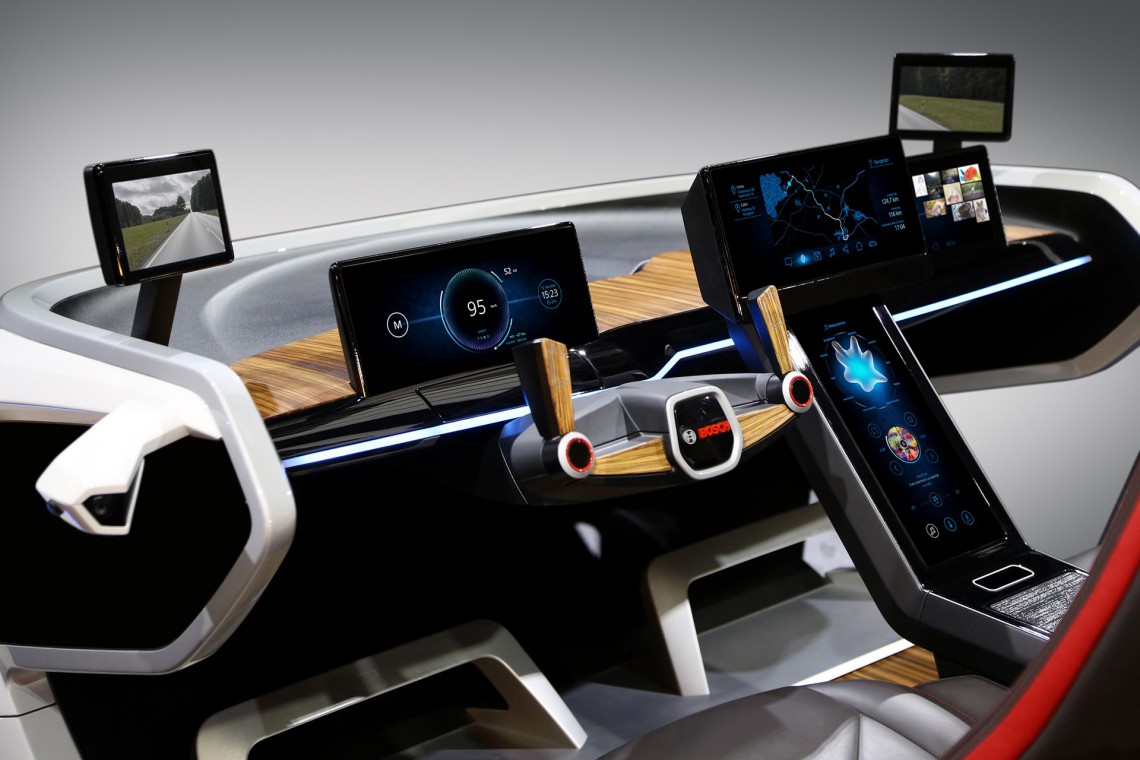
Recent surveys show convergent results on how car users are changing, and looking for smarter and simpler HMI to end up with a better and safer experience.
As described in almost any edition of DVN-I, a growing number of electronic systems and functions in the car are constantly adding to the driving experience, under the CASE megatrend umbrella (Connected, Autonomous, Shared, Electric). It is disrupting the entire automotive world—not just the vehicle itself, but also the driving and passenger experience. With increasing autonomy of the car, the passengers will have to focus less on the traffic, and so will have more time to spend on relaxation, work, and entertainment. We can expect the focus of buyers’ attention to shift from the long-dominant power and exterior styling towards the interior as a living space. In recent years, automakers and suppliers have presented a great variety of automotive interior concepts. Now, what are users really expecting from the auto interior of the future?
Last October, the European operations of Japanese chemical and material science specialists Asahi Kasei conducted a representative survey together with Cologne-based market research institute SKOPOS, interviewing a total of 1,200 car users in Germany, France, Italy, and the United Kingdom regarding their preferences in mobility and especially on the future automotive interior.
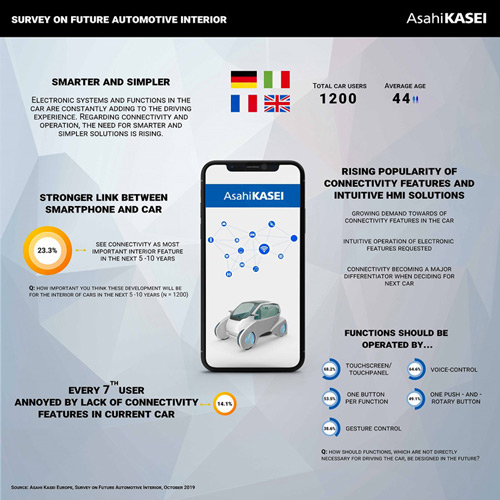
The key outcome of this survey: Even as power, fuel economy, and driving performance remain important drivers in the car purchase decision process, there is an obvious trend towards interior features catching up. Within the interior, HMI (human-machine interface) features are playing an increasingly important role—aided by the increasing autonomy of the cars, but mostly due to the fact that user expectations are changing. HMI solutions add significantly to comfort and safety of the car.
Connectivity is the major interior differentiator, with 56.9% of user’s considering connectivity features (starting with smartphone integration) will play an essential role when deciding on their next car. The trend is evident in all four major European automotive markets, notably in Italy (45.6% to 66.0%). The same growth, albeit at a lesser level, can be seen in France (42.1% to 53.3%), Germany (41.2% to 52.2%) and the United Kingdom (37.7% to 55.4%).
User are extending smartphone logic to intuitive control of infotainment, navigation, and other features. Difficult control of vehicle functions is an obvious safety hazard and annoyance, and can easily distract the driver. More than 10% of respondents mentioned difficult operation of features as the biggest annoyance in their current car, and 72.7% agree these kinds of features should be operable intuitively.
What’s the most-wanted new feature in their next car? 68.2% want a touchscreen or touch panel, closely followed by voice control (64.6%). In contrast, 49.1% favor one main rotary push button for all functions, the most common control interface in today’s cars. Gesture control is much less desired with only 38.6%.
Interior surfaces need to be attractive as well; 10.3% say poor-quality interior surface materials are the most annoying thing in their current car. Meanwhile, 44.8% of all respondents saw a benefit in surfaces that look and feel especially high quality—seats, dashboards and headliners—compared with just 11.4% who did not. And 32.5% would be willing to pay a reasonable price for extra-nice surfaces as an optional upgrade. About the surface material itself, 57% of the respondents felt that sustainable materials for seat covers and surfaces will become increasingly important in the next five to 10 years, while the need for real leather equipment will fall drastically.
The whole of the report can be downloaded.

outcomes were found in a study by the Experiences Per Mile (EPM) Advisory Council, a collaboration of automotive and technology stakeholders, including VW, Salesforce, Ford, Spotify, and Harman (sponsor). That report predicts built-in vehicle connectivity will grow sharply from 48% of all new global automobiles in 2020 to nearly 96% by 2030. Similarly, by 2030, 79% of vehicles shipped around the world will have L2 autonomy or higher.
Meanwhile, as new consumer values like the sharing economy and sustainability continue to take hold, US-based SBD Automotive, who conducted the research, estimates that 26% of mobility profits will be derived from new sources such as on-demand mobility, while 24% of all new cars sold by 2030 will be electric. The report emphasizes the shift, as connectivity proliferates, from simply being connected to more fulsome consumer experiences; as the authors phrase it, “from RPM to EPM (experiences per mile)”. And that’s where this survey complements the previous one, in that consumer are willing to get smart features and technology in their car, but want them to be really integrated to get a meaningful experience.
How to combine many technologies, complexity in a way, and creating a very smooth and simple user experience, that’s the challenge: how disparate technologies and services can come together to create coherent use cases. The report suggests three focus areas to bridge this gap between technology and experience:
• Reduce complexity, for example by integrating devices into a single digital experience;
• Increase focus on usability to help users safely access information while driving, and
• Prioritize the connectivity experience with practical services such as where’s the next fuel station, ETA, music, focused tips, etc.
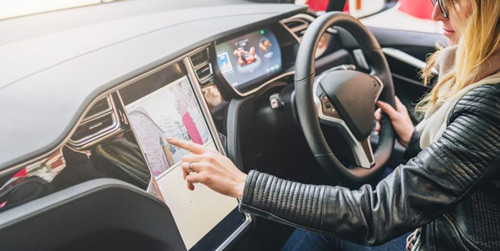
There’s still a long way to go, and a study run by the UK’s Transport Research Laboratory (TRL), IAM Roadsmart, FIA Road Safety, and the Rees Jeffreys Road Fund, found a detrimental impact of in-vehicle infotainment systems on driver response times—and not just a small effect, either; the research shows infotainment touchscreens can worsen driver response time more than being drunk!
So maybe we shouldn’t hurry to bury all the dashboard buttons yet, when voice-activated systems are not yet either the safest solution. TRL says further research is necessary to steer the use of spoken instructions as the safest method. They spoke about development of conversational artificial intelligence which enables speech interfaces to operate at a complex level. Voice control systems only understand a set of key commands when applying conversational AI could widen its capabilities to include all forms of dialogue to enable a versatile, natural and safe interaction.


