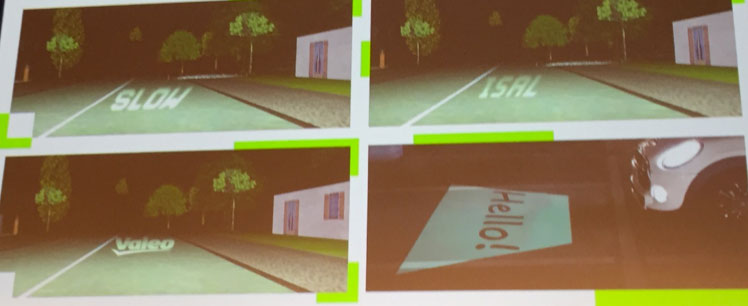
In his lecture «Road Marking Solutions with Pixelized Light Source», Benoit Reiss explains how few thousands of pixels are already offering nice features which improve safety for both drivers and other road users and how this kind of architecture is also compatible with Glare Free solutions, using similar Monolithic light source as well, making then an optimized global system
For many decades, front lighting functions in the automotive industry was just about low beam and high beam. Just recently, the introduction of Glare Free High Beam allowed an increased visibility for most driving conditions.
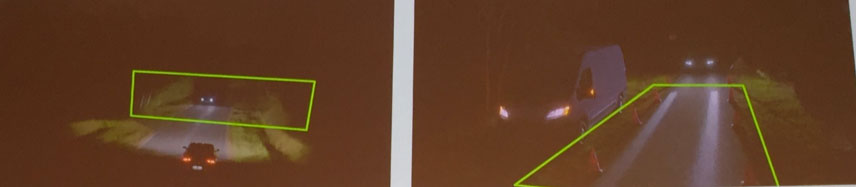
Until now, most of road marking functions
have been demonstrated with projection units using hundred thousands of pixel,
like DMD or LCD technologies, and discreet pixelized light source. Now it is possible to achieve with much more
affordable solution, composed of only a few thousands of Pixels.
– Functions which are directly addressed to the driver in “normal” driving
conditions, meaning driving conditions that do not include emergency
situations.
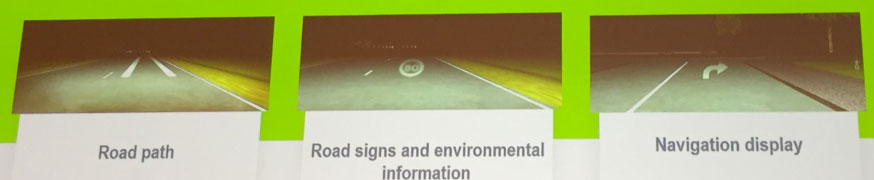
Examples with: Road path/Lane Marking, Road sign, Navigation display
– Safety alert functions require a high reaction speed from the complete system. Examples with Pedestrian illumination, Obstacle highlighting / No Go zone, Safety distance projection, or Safety for the other road users

– Welcome scenarios are seen just to show to people that the lighting system has many functionalities with its high definition lighting unit.
Among different solutions (matrix of micro-mirror, LCD screen, scanning system and high density matrix of LED), the high density matrix of LEDs, also called Monolithic technology, is the one being the most efficient when combining the different use-cases since it is a pure additive system.
One technical drawback of such a system is obviously the resolution of the projected images, especially when DLP technology and its 1.2 millions Pixels. In fact, what is important in such a projection system is the quality of the image on the road. Besides the source itself, the quality of this image is limited also by the the optical system, which has to correct from optical aberrations, as well as the road surface and other environmental effects.
In case of a HD lighting system, the Valeo solution consists in having a specific Electronic module interface, for Picture Control Module. In fact, this module and its associated software are directly creating the image so that the rendering fits perfectly with the driver’s needs.
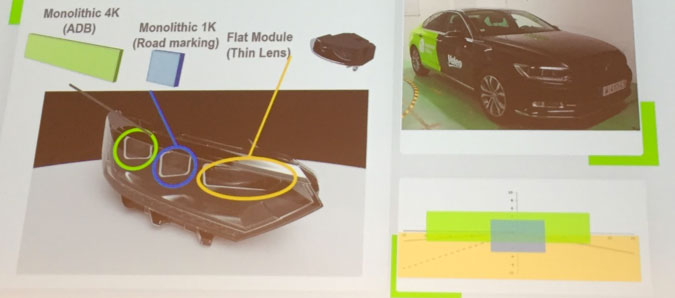
The developed system is flexible enough to
require only low adaptations between 1000 and 1 000 000 pixels solutions, and
to fit with most of OEMs architectures.


