We need two eyes to see the world in binocular vision, the capacity that enables us to calculate object sizes and distances and perceive longitudinal motion. Bosch engineers have now succeeded in using a new stereo video camera to give driver assistance systems the same capability. Thanks to its binocular vision, it can measure distances to other objects using the video signal alone. On the basis of this, Bosch are developing functions that can independently take evasive action or steer the vehicle through a construction site. And of course these will work in conjunction with existing assistance functions such as ACC adaptive cruise control and automatic emergency braking.
The new Bosch video camera supplies data for many different tasks. The information it provides can significantly reduce both the risk and the consequences of collisions with vehicles, pedestrians, and cyclists at speeds of up to 80 kilometers per hour. It thus offers the ideal basis for improving safety in urban traffic .
Functional comparison Stereo vs Mono + Radar: Stereo Video covers more functions than a combination of Video and Radar
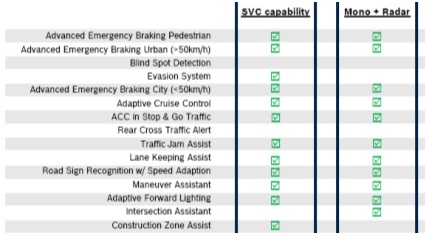
As a result, the stereo camera data alone can be used to trigger an automatic emergency braking process. If an accident cannot be prevented, the speed of impact and thus the severity of the accident can at least be minimized – and by priming the passenger restraint system, airbags and seat belt pretensioners can be deployed in the optimum way.
The stereo system can of course also perform all the tasks typically associated with a mono video camera, such as recognizing traffic signs, helping drivers to stay in their lane, and automatically adjusting a vehicle’s headlights to take account of vehicles in front and oncoming traffic.
By integrating the control unit for image processing and function control directly in the camera housing, the Bosch engineers have created a system that is impressively compact. With a 12cm baseline distance, that is the distance between the optical axes of the lenses, the Bosch stereo camera may well be the smallest system of its kind currently available in the field of automotive solutions. As a result, it is simple for automobile manufacturers to integrate into their vehicles. Each of the two CMOS image sensors has a resolution of 1.2 Mpixels. Thanks to its high-quality lens system, the camera is able to capture an angle of view of 25° vertically and 45° horizontally, and offers a 3D measurement range in excess of 50m. The highly light-sensitive image sensors are capable of processing very high contrasts and cover the full spectrum of light visible to the human eye.
Also helping DAS gain market penetration are, on one hand, the European Commission’s ever-stricter safety standards, and on the other, the consumer protection organization EuroNCAP.
Experts anticipate that from 2014, in order to receive the organization’s highest rating of five stars, new vehicle models will need to be equipped with a significant proportion of DAS. Of these, automatic emergency braking is of particular importance.


