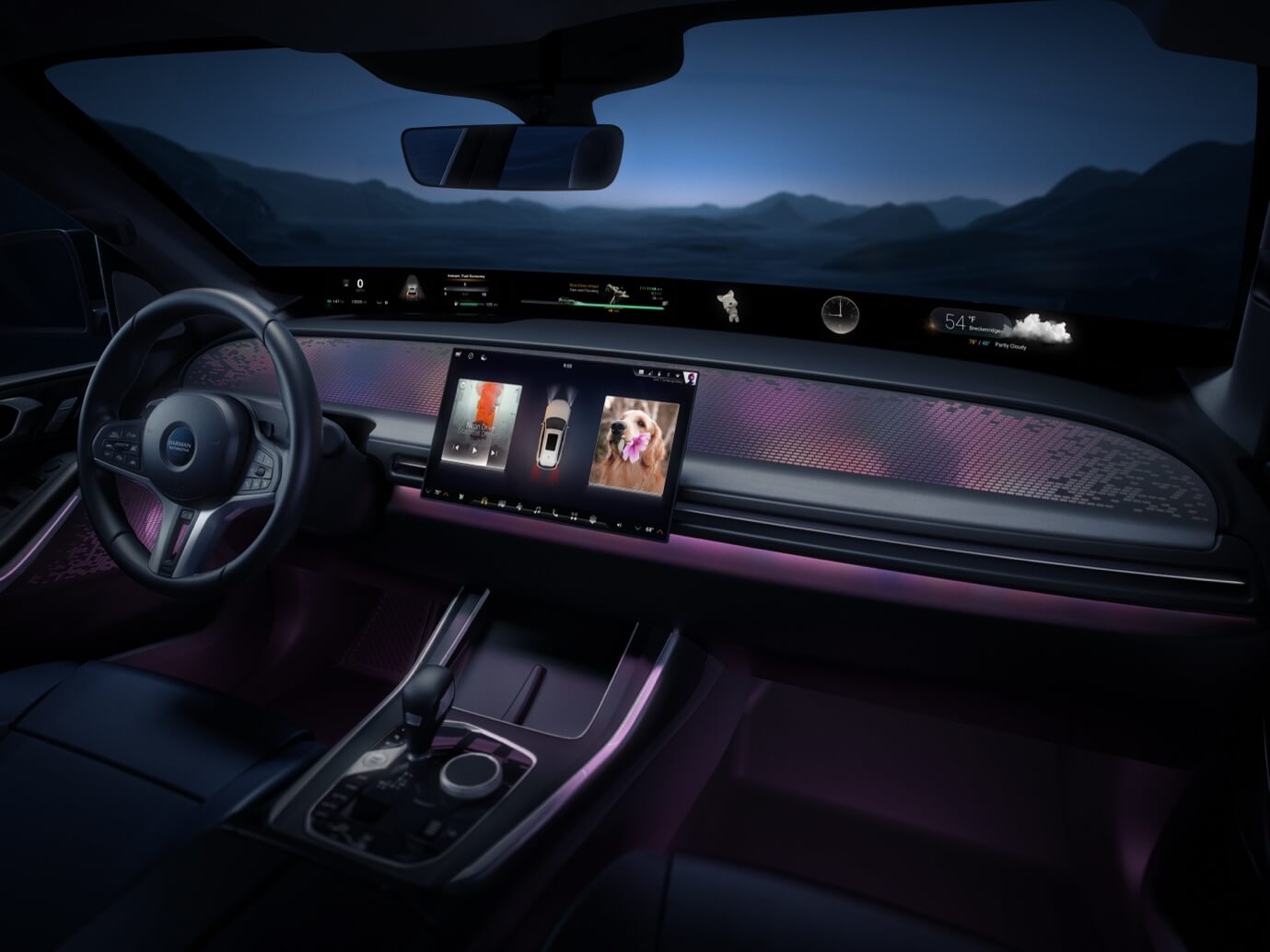
Harman is pursuing cockpits where value comes from organizing information more effectively within the driver’s visual field. Their portfolio, newly augmented with Ready Display and Ready Vision QVUE, is built around Samsung Neo QLED technology. Legibility, contrast, and driving-context adaptation are the central anchors.
Ready Display is presented as the industry’s first automotive-certified HDR10+ display. It offers display robustness under variable and difficult lighting conditions, with real-time adaptive visuals and improved energy efficiency. The new NQ1 model adds wider color gamut and easier daylight legibility than conventional LCD setups.
The Ready Vision QVUE system places information in the driver’s natural line of sight by using the lower windshield as a high-contrast reflective display surface. Harman is positioning QVUE as a “right information, right place” alternative to conventional cluster layouts. It puts key information closer to the eye-road axis instead of making the driver retrieve it from a separate cluster or secondary screen.
QVUE dynamically adjusts how much information is shown depending on the driving situation: quick-glance mode when attention must remain on the road, richer detail when conditions allow, and fuller content when requested – a remarkable shift from a cockpit that throws everything at the driver all at once to a dynamically, appropriately curated one.
Harman also adds functions to improve the UX and safety performance: gaze-aware brightness tuning, obstruction detection when an object interferes with projection, eMirror Live View to support visibility while turning, and QVUE Canvas and a UI editor to simplify configuration and accelerate OEM-side HMI development.


