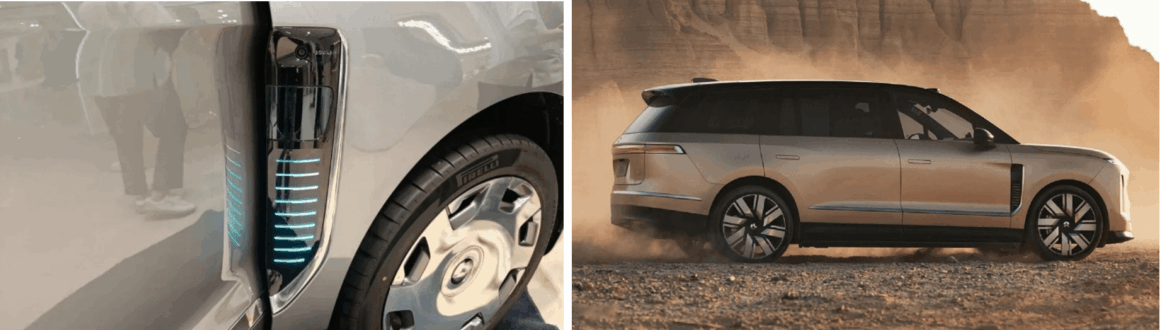
Nio just revealed their top-of-the-line ES9 SUV, building on last year’s top-of-the-line ET9 sedan with similar design.
The ES9 adopts Nio’s latest ‘Shark Nose’ design language, featuring angular split headlight assemblies – which Nio call ‘Ultra Pure Crystal Diamond’ daytime running lights. The headlight system supports three welcome light effects, three welcome projections, and two projection light shows capable of displaying 20-30 second videos (with music) on surfaces about 10 metres ahead.
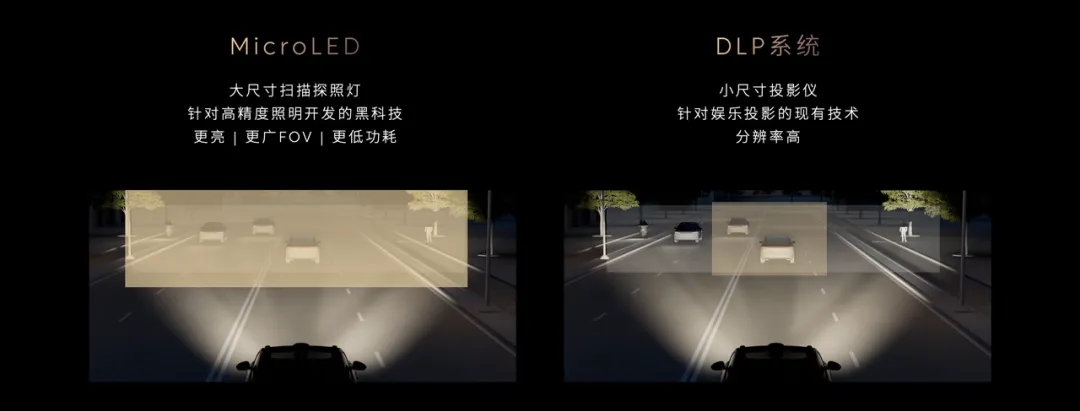
The intelligent high-definition projection headlights extend coverage to six lanes, utilising multiple sensors to detect distant vehicles, pedestrians, and obstacles for enhanced nighttime safety. Nio announced what they described as the automotive industry’s first headlight system that projects the vehicle’s planned driving path onto the road surface.
The ES9’s headlights use five high-performance independent optical modules coordinated through what Nio calls ‘Intelligent Collaborative Lighting’.
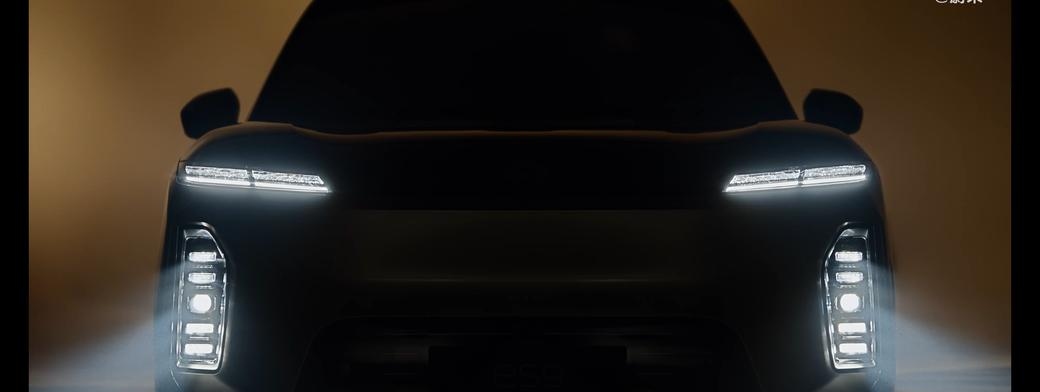
The system is powered by the image signal processor in the company’s in-house ShenJi NX9031 chip and the Aquila super-sensing suite includes roof-mounted lidar, wide-angle fender lidar sensors, 4D imaging radar, and multiple camera arrays.
The system can isolate lighting zones as small as 25 centimetres from 100 metres away – pixel-level precision that allows it to selectively illuminate specific objects, highlight lane markings, or dim around oncoming traffic and pedestrians to eliminate glare.
High beams reach up to 600 metres, up from the 500-metre range on the ET9 sedan, which uses similar technology based on ams Osram’s Eviyos HD 25-kilopixel LED modules.
The special feature is what Nio call a ‘Full-Scene Intelligent Light Carpet’, a wide-beam ground projection system the company say is an industry first in two respects. First, the light carpet covers a 30 × 6 degree spread at 90,000 cd/m2, which Nio say is the widest and brightest in the industry – the projection spans about six standard traffic lanes.
Secondly, the ‘S-shaped navigation light carpet’, which Nio say is the industry’s only headlight system to projects the vehicle’s upcoming driving path onto the road ahead, including curves.

The system integrates with the ADAS decision-making layer and uses what Nio call a ‘spatial projection-fitting algorithm’ to project lane-level navigation data as a visible light pattern on the road surface. In other words, the headlights bend their illumination pattern in advance of curves, projecting the planned trajectory rather than a static beam.
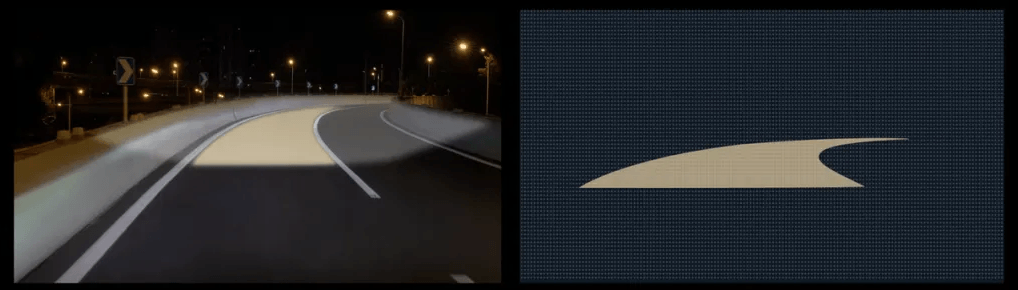
The system draws on the same sensor fusion and navigation data that powers Nio’s assisted driving functions, creating a direct link between the vehicle’s perception of the road and its illumination of it.
Rear lamp design is similar to the ES8, with a bigger size; it’s 2,365 mm wide.

The turquoise AD-S light design is quite interesting on the side area of the car, mixed with the ADAS camera and lidar.