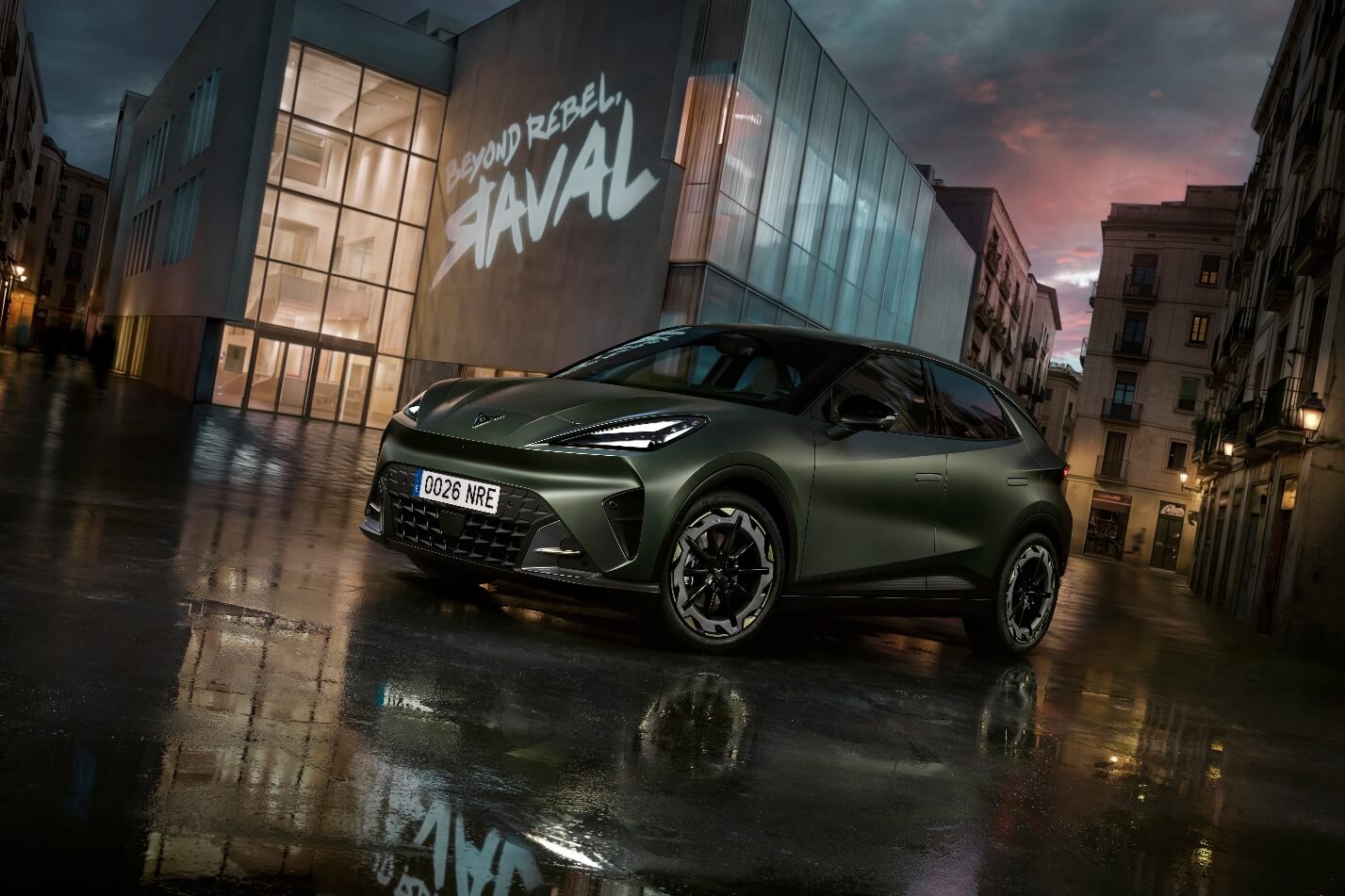
Cupra just revealed their new Raval, with heavy emphasis on lighting signature.
The brand-familial triangle signature remains, but with a new interpretation: it’s inverted on front, for starters. Major effort has been made for low and high beam and ADB to fit inside the DRL signature in a sort of tilted Y-shape, which also creates a signature in low beam. Modules are super tiny: just 10 × 10 mm, including the matrix module – surely a first for such small ADB modules.

The Cupra logo can be lit with the position lamps, with thin light connections in the bumper (as in the pic below) to fulfil the 75mm rule.

Rear lamp design is also super interesting, with Cupra’s first clear lens. The Cupra logo is lit very cleverly; Cupra designers added a microöptic texture between the main tail functions (more triangles!) and the logo.

The reversing and fog lamps are tiny modules at the outboard edges of the bumper, atop the reflex reflectors, to simplify the main lamp design. You can see the reversing lamp on the right side in the picture below.

The interior lighting setup is most impressive. Customizable ambient lighting offers seven selectable environments, with dynamic colours and animations that enrich the onboard experience and accompany digital displays. At the heart of the cockpit, Smart Light Next Generation transforms lighting into an intuitive communication interface between the car and the driver. Integrated into the dashboard, it provides clear visual feedback related to driver assistance systems, such as blind spot monitoring, while also animating in a distinctive way during key performance moments, such as when activating the e-launch function.
Lighting becomes an even more immersive signature thanks to the dynamic light projections on the doors, a unique feature in the segment. It’s done with DLP projection, already seen on BMW’s MINI with projection on the dashboard.
A projector seamlessly integrated into the dashboard delivers customizable motion graphics to the door panels, extending the lighting beyond traditional surfaces.