Outside, Sindelfingen is doing what modern auto plants do: being reconfigured at industrial scale. Straight roads, long warehouses, lots of industrial-grey punctuated by safety-yellow. Right next to Mercedes-Benz’s ultramodern Factory 56, the site is under reconstruction including the company’s next-generation paintshop project, a major investment aimed at future-proofing the plant.
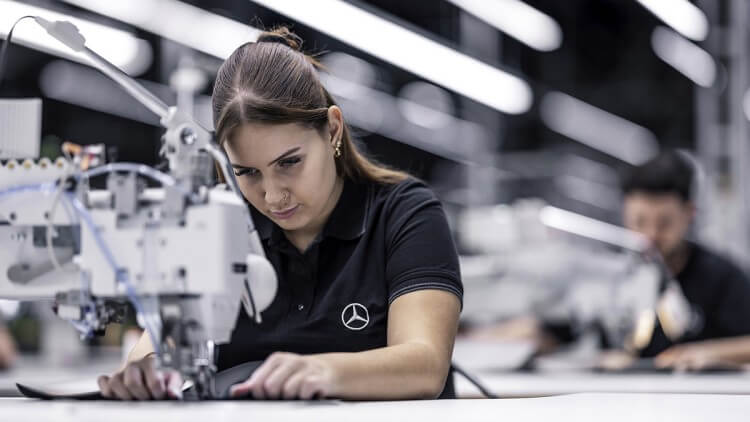
Inside, the Manufaktur area is nearly silent. There are no conveyor belts; instead, there’s leather laid out with surgical precision, textiles spread like pattern books, sewing machines humming at a respectful volume. The air feels cleaner, the space calmer. It’s a workshop within a factory complex.
That contrast is not a marketing spin – it’s all real, by design and intent. Mercedes-Benz has built a deliberately shielded quiet zone where craftsmanship can flourish without fighting the logic of mass production. And it’s not a tiny artisanal corner, either: roughly 200 specialists, working in two shifts, create bespoke interiors and special equipment for Mercedes-Benz, Mercedes-AMG, and particularly Mercedes-Maybach vehicles being built in the broader production site.
Luxury carmakers have always loved to emphasize craftsmanship, but lately it has become something even more attractive: a scalable margin engine.
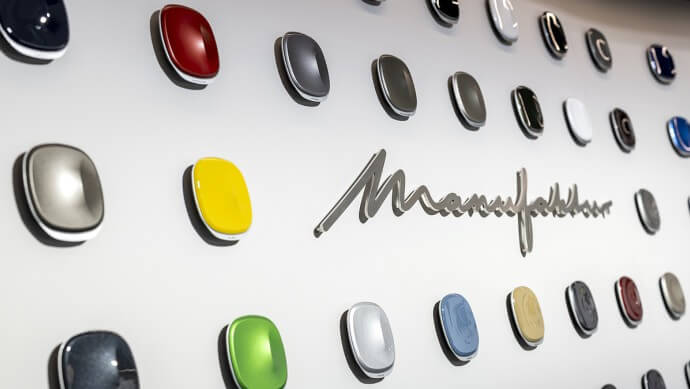
In Sindelfingen, the numbers underline the shift. Almost every second S-Class leaves the factory with at least one Manufaktur option, while for Maybach customers, individualization is close to 100 per cent of production. That kind of prevalence rate happens not because people suddenly became textile engineers, but because the luxury buyer’s definition of value has changed. It’s not only performance and tech, but personal signature. Mercedes is leaning into that demand publicly by expanding and showcasing their Manufaktur ecosystem – including a dedicated customer-facing studio concept and broader offerings across brand lines.
It’s not just Mercedes. Rolls-Royce has framed their growth strategy around bespoke demand, investing heavily to expand their Goodwood facility to support more custom work. Bentley continues to promote craft-depth embroidery, veneers, and leather as key differentiators from ‘spec-sheet premium’ cars. Porsche positions their Sonderwunsch / Exclusive Manufaktur approach as a structured route to true one-offs.
So individualisation is booming, and Manufaktur is Mercedes’ way of industrializing the bespoke dream without turning the main line into a chaos factory.
On the Manufaktur floor, it’s readily apparent that luxury is not only in the leather, but in the workforce strategy. Mercedes highlights low turnover, with many employees having decades of tenure. Some families reportedly span multiple generations working inside the same bespoke operation.
Most crafters come through training as vehicle interior specialists, rotating across several disciplines. Sewing, upholstery, cutting, of course. And digitally-controlled machinery, 3D printing, and data-driven quality assurance, because today’s luxury is less about hand-built instead of tech-built, and more about hand-built with tech quietly in the background. Both-and instead of either/or.
The philosophy is almost anti-industrial: each person follows their component from cut to final inspection, owning the full chain rather than a single repetitive micro-task.
From a production mindset, that’s radical. From a luxury mindset, it’s perfect: accountability is tangible, and quality becomes personal.
For example, look at leather, one of the oldest crafts still involved in auto manufacture. The leather warehouse is where Manufaktur’s ‘analogue + digital’ character is most obvious. Hides are stacked in shades ranging from deep black to near-white, with sourcing described as largely regional (southern Germany) and European. A Maybach interior can require four to five hides, and every hide is inspected intensely.
So far, so normal. But inspections are supported by AI-based systems that detect and mark irregularities in the material. The nuance matters. Natural characteristics – scars, insect bites – aren’t automatically rejected, but managed. The goal is to place imperfections only where they won’t be seen later, and to keep waste low without compromising the final appearance.
This approach says a lot about how luxury manufacturing is evolving. It’s no longer just the reflexive rejection of anything imperfect, but rather thoughtful curation of imperfection, because real material has a story which must appear in the right ‘chapter’ of the ‘book’ that is the cabin.

The leather puzzle involves cutting patterns arranged to minimise scrap: small parts near larger seat or headliner pieces, nesting like a methodical jigsaw. Software optimizes the layout, but the final decision is made by the crafter because experience still beats algorithms when the material is (recently) living, variable, and expensive.
Cuts happen in two stages: rough work using traditional cutting tools, and fine work via waterjet cutting reported at pressures up to 4,000 bar (58k psi). It’s a great example of how today’s ‘handcrafted’ interiors are supported by serious industrial processes, used selectively to deliver accuracy and repeatability.
A few metres away are the sewing machines. Manufaktur produces panels, seat covers, cushions, sun visors, steering wheels – elements to elevate the perceived quality of the interior. Some components are quite complex; a leather headliner may comprise over 20 separate parts, assembled into a surface that must appear uninterrupted.
The process mixes semi-automation with meticulous hand finishing. Large-area bonding and pressing can be assisted by systems that heat glue and hold geometry, but the finish work of trimming and tensioning, picayune correction of bubbles and wrinkles, is done manually, as it must be; “almost perfect” is simply not good enough.
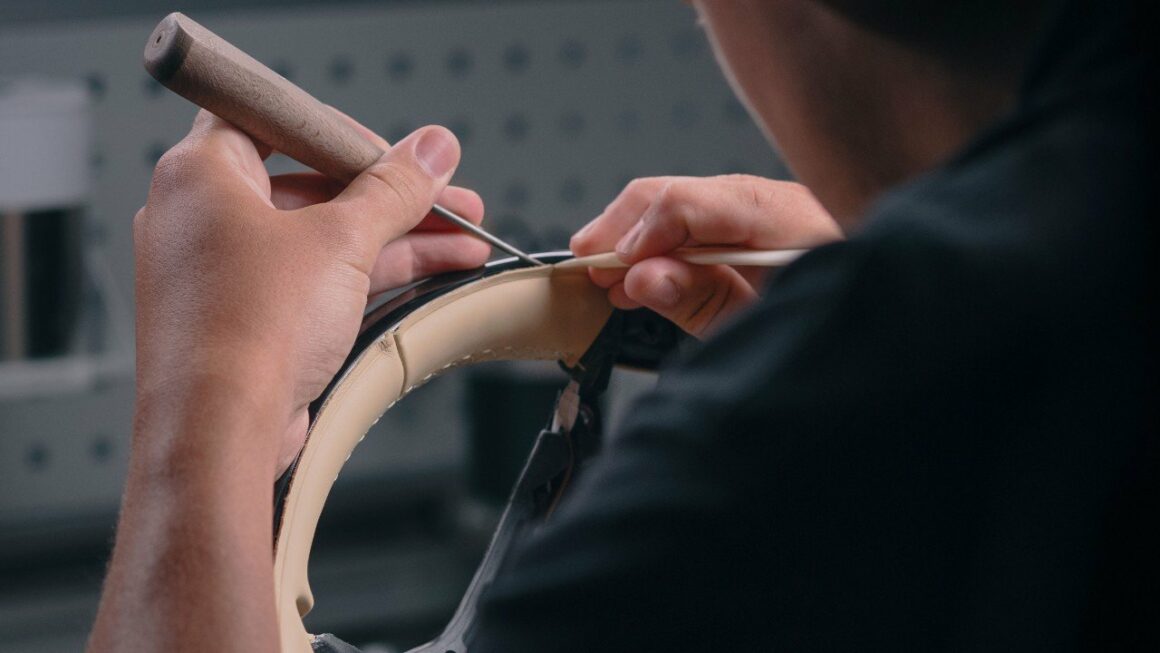
Consider the steering wheel, a focal point directly in front of the driver. Cross-stitching can take hours, and the leather must be pressed into narrow channels while integrating sensors and heating wires. Every function is tested; any mistake means starting over. In manufacturing terms, that’s a brutal rework risk. In luxury terms, it’s the price of a touchpoint the customer will interact with constantly when they’re in the car.
Or take the rear-seat cushions Mercedes offers: they close without a visible zipper, giving the impression of a single moulded piece. It’s a small detail with a big psychological payoff: fewer visual interruptions, more of a tailored appearance.
One corner of the workshop space is dedicated to embroidery: logos, patterns, and lettering stitched at high speed. Here, Manufaktur’s promise goes beyond choosing a color from a catalog. Customers can request individual motifs for seat covers or headliners — a signature, a family crest, even a custom graphic provided as an image file. The hard work isn’t the sewing, but the data processing and machine programming to translate a personal symbol into something which can be stitched cleanly, consistently, and without turning the headliner into puzzlingly abstract art.
At the end of the hall sits a separate studio space described as a think tank for future projects, prototypes, edition models, and the special requests that don’t fit normal processes. Access is limited to the most qualified employees, working alongside designers and developers.
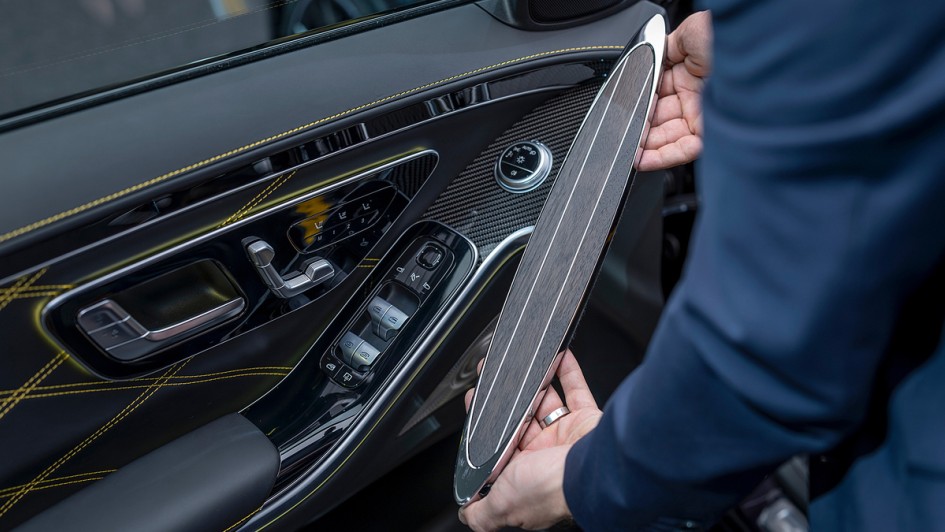
One of the most interesting themes here is materials. Beyond traditional leather excellence, Manufaktur is testing animal-free fabrics designed to feel as soft and warm as leather. They’re evaluating them for appearance, yes, and for processability, haptics, smell, and long-term durability. future luxury cabins may be defined as much by responsible material science as by stitching density.
This also connects to the broader S-Class product message Mercedes is currently pushing; they’re expanding Manufaktur offerings and positioning them as a central part of the S-Class identity, including new Manufaktur leather packages and a made-to-measure approach with very broad paint and interior color choices.
This, then, is the bespoke car build of 2026: artisanship and digital craftsmanship hand-in-hand, with software as part of the atelier. It’s quite revealing about the direction of premium manufacturing. Sindelfingen is simultaneously building for the future with megaprojects like the next-generation paintshop, while also protecting a low-noise zone where human precision can thrive. The plant is a living metaphor: the industry is racing toward digitalization and sustainability at scale, while at the top end, customers are paying for the feeling that their car didn’t come out of a template.
Manufaktur is Mercedes’ response to those customers’ desires: craftsmanship engineered to coexist with high-volume reality not by romanticizing or artificially emulating the past, but by selectively combining old-fashioned skills like cutting, sewing, and upholstery with modern tools like AI inspection, optimization software, controlled processes, and data-driven QA.
That’s why the place feels so quiet. It’s not slow, it’s controlled and intent-centered.
Not every customer will order a family crest stitched into their headliner. But more and more will want the cabin to feel like it was made for them, not just another trim level ABC with package XYZ car. That’s the luxury market today.
This has been something of a deep dive in the Mercedes end of the pool. There are others swimming vigorously in this pool, too; Rolls-Royce, for example, has seen rising demand from wealthy buyers for high-margin, personalized cars. In January 2025, Rolls-Royce invested $376m to expand their Goodwood, UK plant to focus more on bespoke cars for high-end buyers, featuring everything from gold sculptures to mother-of-pearl artwork.
In 2024 BMW opened a high-end bespoke unit offering ‘artisan-crafted exquisite details’ including solid 18-carat gold sculptures, embroideries consisting of more than 869,500 stitches, wood veneers including 500 individually-shaped pieces of wood, and holographic paint finishes.


