By Andreas Friedrich
TactoTek held their IMSE Days event at their office in Munich on 3 February – the day before the DVN Munich lighting event. It was a great opportunity to learn of their latest developments. I have been following TactoTek since 2017; I visited them in Oulu, Finland many times, and this was my third IMSE Days.
It was really impressive to see their progress and hear how they will continue the journey and what service they are going to offer those that adopt their technology. Also, I got to hear of their success with a major OEM together with Valeo, where their IMSE technology will be used for interior lighting. Read about it here.
IMSE stands for in-mould structural electronics: a foil with printed electronics and components are moulded into one solid plastic part.
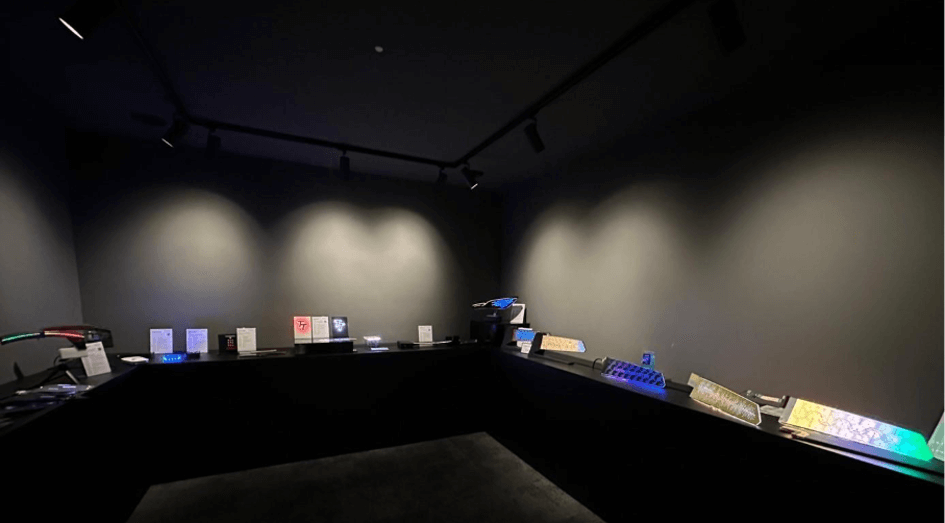
And what is printed electronics? That is when you print traces with conductive ink on a substrate that can be stiff, formable, or flexible, so the conductive inks need to be somewhat stretchable. Add to that off-the-shelf components like LEDs or other specific components developed for printed electronics and you then have a thin formable (or stiff) smart surface if you like. Read more explanations from Tactotek here, or from the Organic Electronics Association here.
From the OEA website: Printed electronics enables the production of flexible and large-area components and complements silicon electronics. Ultrathin, lightweight, robust and economical to manufacture: these key features distinguish flexible and printed electronics from traditional semiconductor technologies.
Imagine doing smart surfaces with roll-to-roll printing, just like newspapers, meters of electronics swift and cheap. That’s the vision, and it’s more or less the reality already. All kinds of sensors, touch interfaces, antennas, solar cells and suchlike can be made this way.
If I may give you one strong piece of advice: go visit LOPEC, the biggest fair for printed electronics. It’s to be held on 24to26 February (just days from now!) in Munich. You will get a glimpse of the future there, I promise. It’s an absolutely nerdy and wonderful fair to visit, and it’s not expensive.
In IMSE you use conventional and proven technology to mass manufacture the parts. Printing with conventional methods, placement of components with pick-and-place machines, forming of the foil conventionally and placing of foil as in-mould layering the conventional way. So, nothing new there, but of course a lot of expertise, IP, and testing are involved to do it right and well. Many companies are already on board in the TactoTek Ecosystem to make this reality.
And many of them, tier-1s and OEMs, were present in Munich.
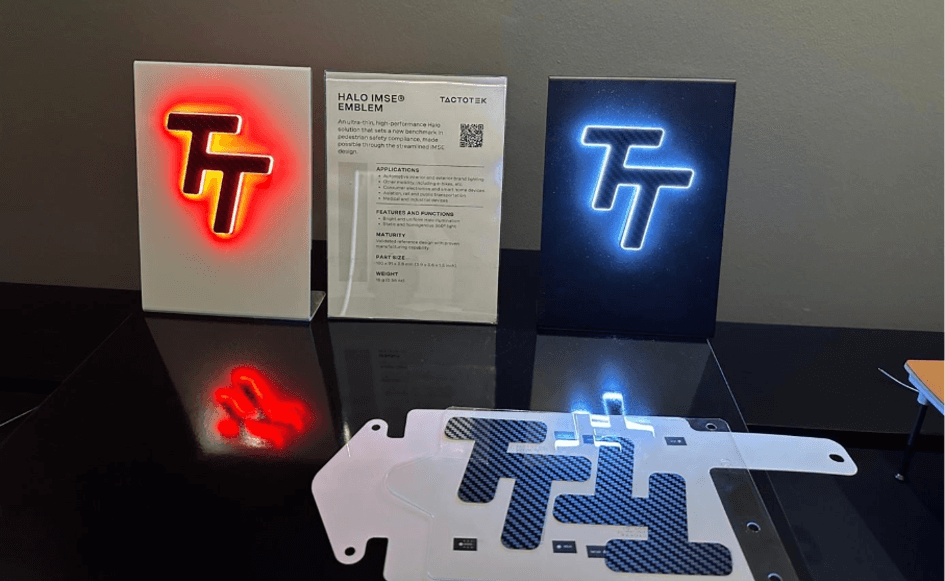
One area where IMSE is a potential gamechanger is for exterior lit emblems, as in the picture above. Imagine a super thin, 3D-shaped emblem with all LED and electronics moulded inside. You can dip it in water and it will still work.
I remember the early days of TactoTek, when they told me “Automotive testing is so boring, Andreas!” So they submerged the part in a bucket of water, put it outside for a week in freezing winter conditions, and it still worked, then took it in the sauna to thaw – and it still worked. Truly a Finnish way of testing! Of course, their technology and parts fulfill all proper automotive testing requirements.
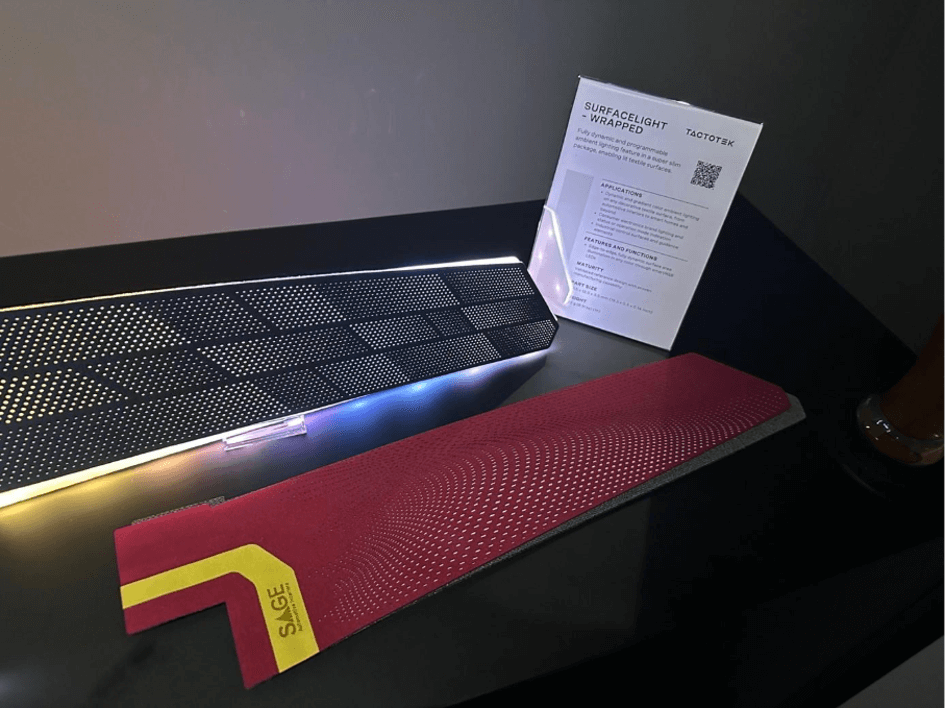
Another area where IMSE is fabulous is in ultra-thin ambient light scenarios. Like the above IMSE part which contains smart RGB LEDs and can be animated and controlled in many ways. The part can be wrapped in conventional manners with textile or perforated other materials like leather or Alcantara. Imagine that any part of a door panel can become smart and have light! Maybe with touch sensors to interact with something?
Or you can of course mould another foil on top of everything, so you have a B-surface foil containing the electronics and an A-surface foil containing the graphics, colors and aesthetics. Quick and simple to make variations by changing the A-surface foil.
By using various means for the optics, they can control the light inside the part and how it will leave the part and get experienced.
Spreading light evenly on a surface is a challenge if you want to use as few LEDs as possible to keep costs down; they have solutions for that, too.
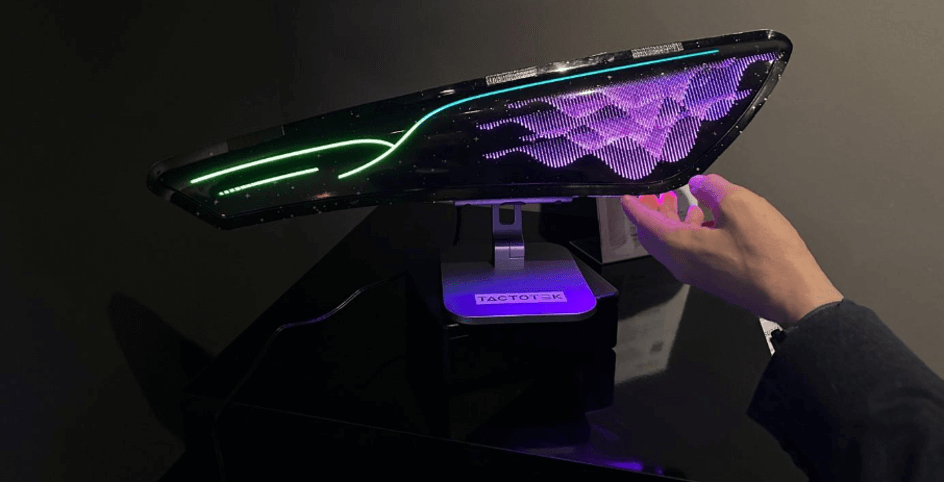
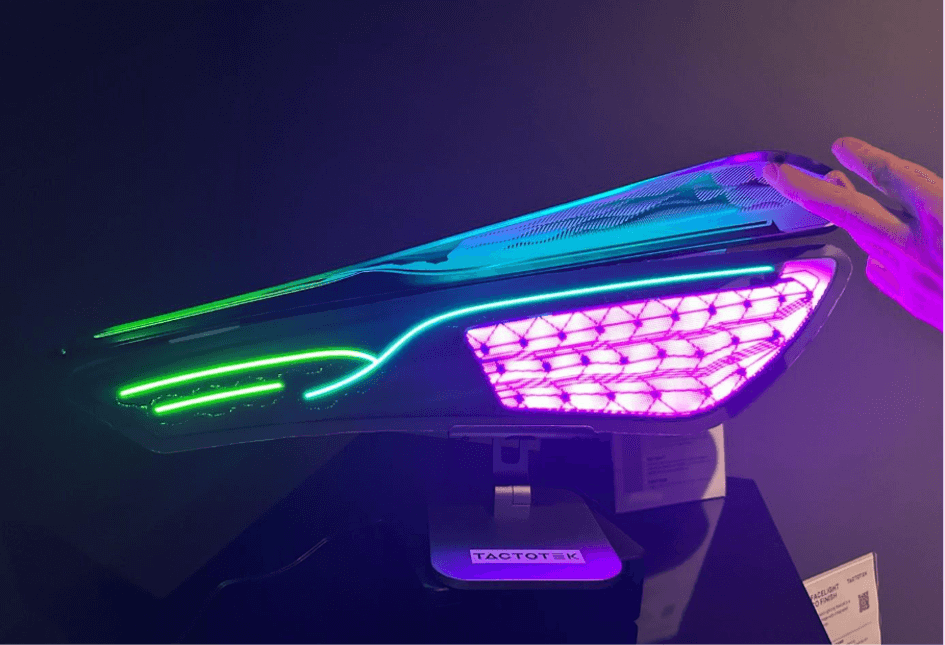
In the above example there are two different versions of light distribution, the IMSE SurfaceLight with more RGB LEDs to give an even or spread light experience, and the IMSE Lightline, which is a consistent line of light which can also be animated as a moving light.
All in all, it was a great event where I got to meet new and old friends and see TactoTek’s amazing new innovations.


