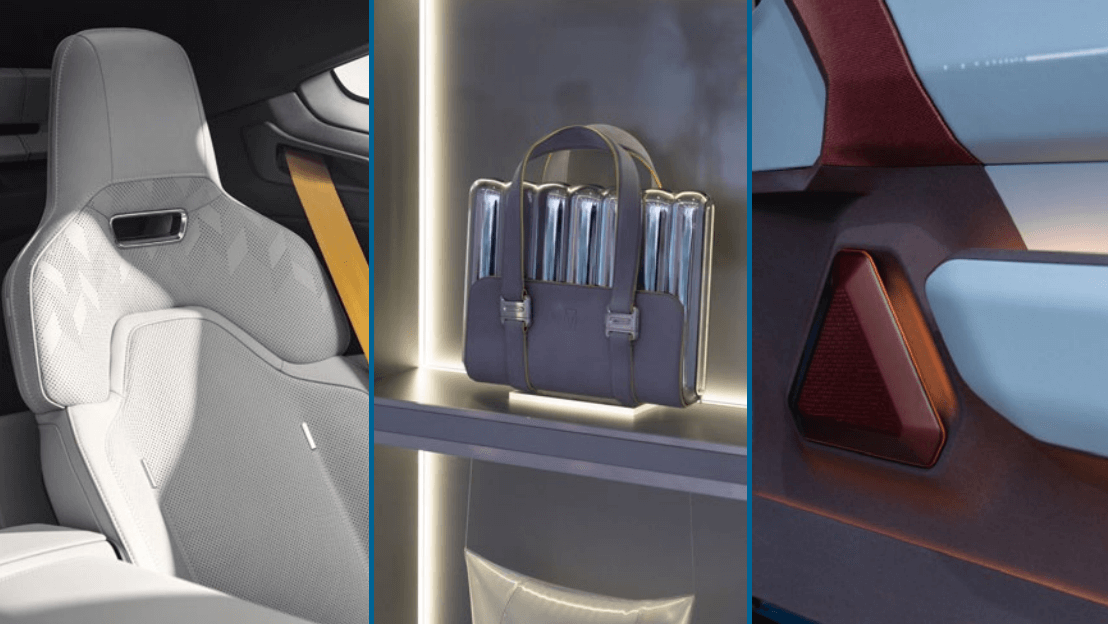
Culture Made Visible – CMF, Lighting, and UX Between China and Europe
Guang Yang • DVN Torino Interior Workshop | January 14-15, 2026

Guang Yang presented to us the OEM challenges for a common assumption in automotive interior design: is the definition and acceptance of ‘good design’ universal, or market-specific?
Through a cross-regional lens, Yang argues that what feels premium, comfortable, desirable, or intuitive is not necessarily global. Instead, it is shaped by cultural familiarity, emotional comfort, and aesthetic belonging.
A Reality Check?

Yang asked the audience whether ‘good design’ can travel seamlessly across markets, then introduced Polestar as a case study: a brand praised for its design reputation in Europe and the US, yet it has struggled hard to gain traction in China, despite strong product fundamentals.

When a Strength Becomes a Liability
How does Scandinavian minimalism, celebrated in Western markets, become a design disadvantage? In China, buyers perceived-value cues lean to richer sensory cues and more expressive experiences. The reverse challenge exists, too: as Chinese OEMs enter Europe, they face similar friction when their home-market design signals don’t match local expectations.

European vs. Chinese Consumer Differences: Visible + Invisible
Yang described consumer differences between Europe and China as going beyond visible factors like age, family status, and digital familiarity. Deeper, less obvious factors exert significant force – such as cultural upbringing, learned preferences, lifestyle context, and emotional expectations, all of which shape what users trust, enjoy, and interpret as high-quality design.

Local Optimization: How China Designs for China
Chinese domestic OEMs and suppliers intentionally craft interiors and CMF to match local tastes, from feature packaging and HMI behaviors to atmosphere, materials, lighting, and perceived luxury cues, demonstrating a highly localized approach to interior experience design.

Conclusion
Guang Yang concluded with the key message: There is no single optimal global interior. What feels premium, comfortable, or intuitive isn’t universal. Background shapes perception. Perception shapes preference. Preferences drive design.
Usage-Led Interior Roadmap: From VOC to HMI; Why ‘Too Much Screen’ is Still Bad
Read together, the S&P Global Mobility and Marelli presentations tell a very practical story: the next cockpit wave won’t be won by whoever piles the most technology into the IP, but by whoever turns megatrends into a coherent, industrializable user experience.
The interior is no longer a collection of parts, but an experience platform where perceived quality, interaction logic, lighting, materials and software lifecycle have to land on the same target. If they don’t, the cabin becomes a showroom demo that ages like a 2012 smartphone (maybe with better cupholders).
Marelli frames the matter as innovation shifting from a technology-first mindset to one that starts with real consumer needs and behaviors, backed by quantitative research (403 respondents: 200 US / 203 France) and qualitative focus groups.
S&P, in parallel, explained why certain features appear, when they diffuse, and what cost/profit dynamics do to timing. The result is a roadmap that is less of a ‘feature bingo’ and more like UX governance under real-world constraints.
Market reality first: why premiumization changes the cabin faster than we admit
S&P’s market outlook is a useful cold shower. Greater China remains the largest light-vehicle production region, Europe stays second, European production is expected to remain broadly steady, and South Asia shows increasing growth. This matters because interior innovation is not evenly distributed: it follows volume, margin, and regional competitive pressure.
S&P also highlighted a key structural shift: while the global C-segment has historically held the biggest production volume, the broader trend points toward higher sales segments, increasing vehicle value and directly influencing interior design and content. In plain terms, ‘premiumization’ is a budget enabler for bigger displays, more lighting, better trims, smarter surfaces, and more computing capacity, at least in the trims where customers pay for it. And then the diffusion mechanism kicks in: innovations debut in higher segments and reach lower segments later, largely due to cost trends and profit margin considerations. The cabin we see on a top-of-the-line model today is the cabin of tomorrow’s C-segment car, once it’s been cost-engineered, simplified, and ‘made real’.

Electrification reshapes packaging; the center console becomes a UX product
S&P noted that despite relaxed regulations in Europe and some BEV pullbacks in North America, the shift toward electrification remains steady; European makers are progressively ramping BEV production. For interior teams, the important part is what electrification does to architecture and freedom of design. When shift-by-wire became the norm and mechanical constraints fell away, the floor console was no longer just a place to mount a shifter and a couple of bins, it became prime real estate for storage, charging, interaction, and daily-life ergonomics.
S&P captured this evolution explicitly: electrification allows higher flexibility in floor console design – sliding consoles, removable ones, or even no floor console at all. Look at S&P’s Floor Console Trends comparison for Europe (2024 – 2031): wireless charging fitment in the floor console is expected to increase at a CAGR of 1.21 per cent, while gear lever fitment decreases at a CAGR of 1.31 per cent, credited to column-mounted shift-by-wire trends.
The HMI implication is larger than it looks. When the shifter retreats, what lives in the console becomes the real daily interface: phone placement, charging reliability, hand reach, storage logic, and the emotional experience of one’s stuff having a ‘home’. This is also where a lot of usability reputation is earned or lost. If the wireless charger overheats, slips, or requires a yoga pose to align the phone, an amazing pillar-to-pillar display won’t save the game.
Autonomy grows but the cabin must still be excellent for human driving
S&P’s autonomy view is deliberately sober: the trend continues to accelerate, but L4 light vehicles remain limited, reaching roughly 6 per cent market share by 2037, with China as the clear leader in L4 production. The deck even links autonomy to autonomous vehicle seating arrangements, reminding us that interiors will experiment with reconfigurable layouts but at volumes and timelines that remain selective.
This is where roadmaps often drift into fantasy. A cabin that assumes constant hands-off operation tends to overinvest in leisure UX and underinvest in everyday driving ergonomics. S&P’s L4 restraint is therefore a design brief: build interiors that are brilliant in an L2,2+ reality, and which can extend gracefully when higher automation is available. In practice, this means designing information hierarchy, glance behavior, and control placement for the human driver first, then enabling mode-based transformations only when the system truly takes responsibility. Otherwise, the cockpit behaves like a living room…during a commute.


The display paradox: modernity is attractive, but hybrid control is still the satisfaction sweet spot
S&P described the macro trend in one line: clutter-free cockpits with bigger displays and fewer buttons, though ‘not disappearing’. The deck provides concrete fitment direction: 9.x- to 12.x-inch center stack displays leading overall fitment from 2025 (rising from 47 to 53 per cent). And then the critical nuance: in S&P’s global survey, half of respondents prefer touchscreens and buttons, while 34 per cent prefer all controls in displays. This 50 vs 34 is one of the most actionable numbers in the whole package, because it legitimizes what many HMI teams observe in clinics: pure touch is visually clean but operationally unforgiving.

Marelli’s consumer work lands on the same equilibrium. When asked about preferred central information display styles, respondents don’t chase extremes; they prefer a balance between enlarged versus minimalist (a middle way rather than a single tablet or a full hyperscreen), and they lean toward touchscreen versus buttons but still value having some knobs or buttons. Even in qualitative feedback, participants explicitly prefer the shown CID over a Tesla-like minimalist tablet-only approach or a hyperscreen approach, and appreciate physical controls in the mix.
The expert takeaway is straightforward: hybrid interaction is not a compromise; it’s a product strategy. Touch is excellent for rich, spatial tasks (maps, media browsing, configuration). Physical controls remain excellent for frequent, time-critical, or eyes-off tasks. And voice is valuable only when it is predictable, fast, and integrated into the same mental model as touch/physical. The clutter-free roadmap succeeds when it reduces cognitive clutter, not when it merely removes parts from the BOM.


Horizon and pillar-to-pillar: the next battlefield is information editorialization
Marelli’s standout finding is the appeal of pillar-to-pillar / ‘HorizonView’ concepts, positioned as an evolution of HUD. Respondents like improved line of sight (50 per cent), attractive high-tech style (46 per cent), and in preference comparisons, pillar-to-pillar leads (38 per cent) followed closely by the cluster (36 per cent). Qualitatively, drivers appreciate the wide view, customizable sections, and the ability to keep eyes forward. Some participants with corrective lenses note it can feel a bit far away, and concerns appear around it being busy or too low, yet overall many still prefer it to a traditional HUD.
This is where ‘bigger display’ stops being the story. The real challenge becomes editorial: what information earns horizon placement, how density is managed, how priorities shift with context, and how to prevent the wide canvas from becoming a wide distraction. Marelli’s own qualitative summary hints at the risks: ‘too busy’ and ‘too low’ are not aesthetic critiques, they’re cognitive workload warnings.
If we connect this back to S&P’s button/touch split, we can predict the winning approach: pillar-to-pillar will thrive when it behaves like a calm, well-composed instrument, not a Netflix home screen. The cabin is becoming a media platform, yes but it must remain a driving tool. The irony is that the more screen you add, the more discipline you need in what you choose not to show.
Personalization and OTA: customers want it, but governance is the hidden cost
Marelli’s data is unambiguous: the ability to provide regular software updates to features/functions is by far the most appealing technology tested, especially in the US; France shows particular interest in comprehensive driver and occupant monitoring. This effectively turns the cockpit into a living product, evaluated like consumer electronics: it should improve, adapt, and fix itself over time.
Customization is the second pillar. Marelli finds that the central information display is the most appealing display to customize (68% total), and the desire to customize focuses on layout (80 per cent), brightness (76 per cent), and fonts/colors (70 per cent). These are not ‘fun skins’, but usability controls: readability, comfort, accessibility, and personal preference under varying light conditions. Combine this with S&P’s view that digitalization, autonomy and personalization shape the future instrument panel and with S&P’s forecast that smart surfaces on IP, floor console and door trim will grow at a CAGR of 5.58 per cent globally (2024 – 2031) and you get a cockpit that is increasingly software-defined and configurable.
The roadmap risk is also clear: personalization can explode validation scope and create UX fragmentation if left unchecked. The cabin needs a ‘doctrine’ with non-negotiable invariants: consistent critical alerts, stable interaction patterns, and guardrails around color/contrast/priority. In other words, give customers freedom where it improves comfort and identity but keep the underlying grammar stable, or the car becomes a choose-your-own-adventure novel written by your settings menu.

Materials, decors, and perceived quality: premium is increasingly engineered, not purchased
S&P’s interior content coverage goes well beyond screens, and it’s a reminder that perceived quality still starts with what people touch. For door trims, S&P expects ambient lighting fitment in Europe to grow at a CAGR of 1.53 per cent from 2024 to 2031, fitted on average in 30 per cent of front doors. Plastic remains the preferred material, followed by leather and artificial leather for comfort and soft touch. The message is pragmatic: premium feel often comes from texture strategy, touchpoints, and smart feature integration on a plastic base, rather than a wholesale shift to expensive base materials.
Decors follow the same logic. S&P notes that automakers typically use one or two tiers of decor materials unless it’s a low-cost vehicle, and they use trim strategies to deliver a perceived quality level that matches price positioning. This is quietly important for roadmaps: as displays and ambient lighting take more attention, decor becomes either a brand signature or an afterthought. The best cabins make decor work with the screen, controlling reflections, glare, and perceived continuity. The worst cabins look like someone installed a premium monitor into a budget living room.
Seat materials are another S&P theme worth fully integrating into the interior roadmap. S&P highlights a global shift toward artificial leather and other sustainable materials driven by consumer demand for eco-friendly and ethical alternatives, offering similar aesthetics and durability with lower ecological impact and better cost-efficiency. Europe remains more fabric-heavy than the global average (64 versus 43 per cent), and S&P explicitly notes that artificial leather allows higher margin than fabric. This is a strategic triangle: sustainability expectations, margin logic, and tactile perception. It also affects HMI indirectly: surface friction, thermal feel, and visual consistency influence how premium and how calm the digital cockpit reads—especially under strong daylight where cheap sheen quickly exposes itself.

Ambient lighting and smart surfaces: lighting is becoming an HMI channel, not just mood
S&P’s lighting story is ‘unbroken growth’. Global demand for ambient lighting continues to rise, and while Japanese, Korean, and North American automakers have traditionally been cautious, those markets are expected to grow faster than others in overall volume. S&P also notes that light guides remain the most sought-after solution worldwide, small lamps expand more slowly, and surface illumination is currently the fastest-growing trend; innovation is primarily driven by European and Chinese OEMs.
From an HMI perspective, this is not about turning the cabin into a lounge. It’s about creating an additional, low-cognitive-load layer of communication: welcome sequences, subtle warnings, zone differentiation, and personalization cues that don’t demand a glance. This becomes even more relevant as screens grow and attention becomes scarcer. A well-governed lighting language can reduce reliance on visual UI elements for certain cues. A poorly governed one becomes RGB panic that competes with driving. The hardware trend is certain; the UX discipline is the differentiator.
Smart surfaces sit at the intersection of materials and interaction, and S&P’s forecasted growth (CAGR 5.58 per cent globally, 2024–2031) suggests we will see more touch-sensitive, integrated-function areas across the IP, console, and doors. The roadmap question is not whether smart surfaces spread, but where they make sense. They can be brilliant for secondary controls and personalization, and painful for high-frequency tasks if feedback and discoverability are weak. The cabin that wins is the one that uses smart surfaces to reduce interaction friction, not just to reduce visible parts.


Passenger display, hidden display, privacy: the premium move is often discretion
Marelli’s research surfaces a classic tension: a majority shows interest in a front passenger display for their next purchase (60 per cent total; US 64 per cent; France 55 per cent), especially for entertainment (64 per cent) and climate control (53 per cent), but concerns about driver distraction appear repeatedly. Marelli’s answer is telling: privacy display options that restrict content from the driver’s view are appreciated, and the hidden-display concept earns praise for the clean look when off while still triggering distraction concerns if visible to drivers.
This directly complements S&P’s clutter-free narrative. The next premium signature may not be more screen area, but screens that knows when to disappear, and screens that respect the driver’s attention budget. Hidden and privacy approaches are, effectively, UX safety features wrapped in premium aesthetics. And they also support brand positioning: discretion reads as confidence. Flashiness reads as trying too hard – cars, like people, are judged accordingly.
So what does the 2026–2031 interior roadmap look like when you merge both views?
It starts with an acceptance of market diffusion: premium features will continue to debut in upper segments and then spread, shaped by cost and margin realities. Electrification will keep freeing packaging space, pushing consoles toward flexible storage and charging-first logic, with quantitative evidence already visible in Europe’s wireless charging rise versus gear lever decline. Autonomy will progress, but L4 volumes remain limited, so everyday driving UX remains the core product, not a transitional feature.
Displays will grow and widen, but hybrid control will remain the satisfaction sweet spot, as both S&P and Marelli data converge on the value of mixing touch with physical controls. Pillar-to-pillar concepts will increasingly compete as an evolution of HUD, but their success depends on information editorialization and distraction management as much as on hardware execution. Personalization and OTA upgradability emerge as major battlefields, with customers explicitly ranking software updates as the most appealing tested technology and expressing strong interest in customizing layout, brightness, and visual style.
Finally, the non-screen domains – materials, decors, seating materials, lighting and smart surfaces – will do more of the brand work than many roadmaps admit. S&P’s data on decor tiers, the shift toward artificial leather, Europe’s fabric preference, and the relentless ambient lighting growth all point to a cabin where perceived quality is engineered through smart combinations of touchpoints, texture, light, and discreet integration.
References used
S&P Global Mobility — Sascha Klapper, Interior Industry challenges. Market outlook in numbers / Material evolution and function integration in the interior, January 12, 2026.
Marelli — Salvatore Grande, Decoding the Cabin: What Today’s Consumers Expect from Tomorrow’s Cars, January 15, 2026 (Museo Nazionale dell’Automobile, Torino).


