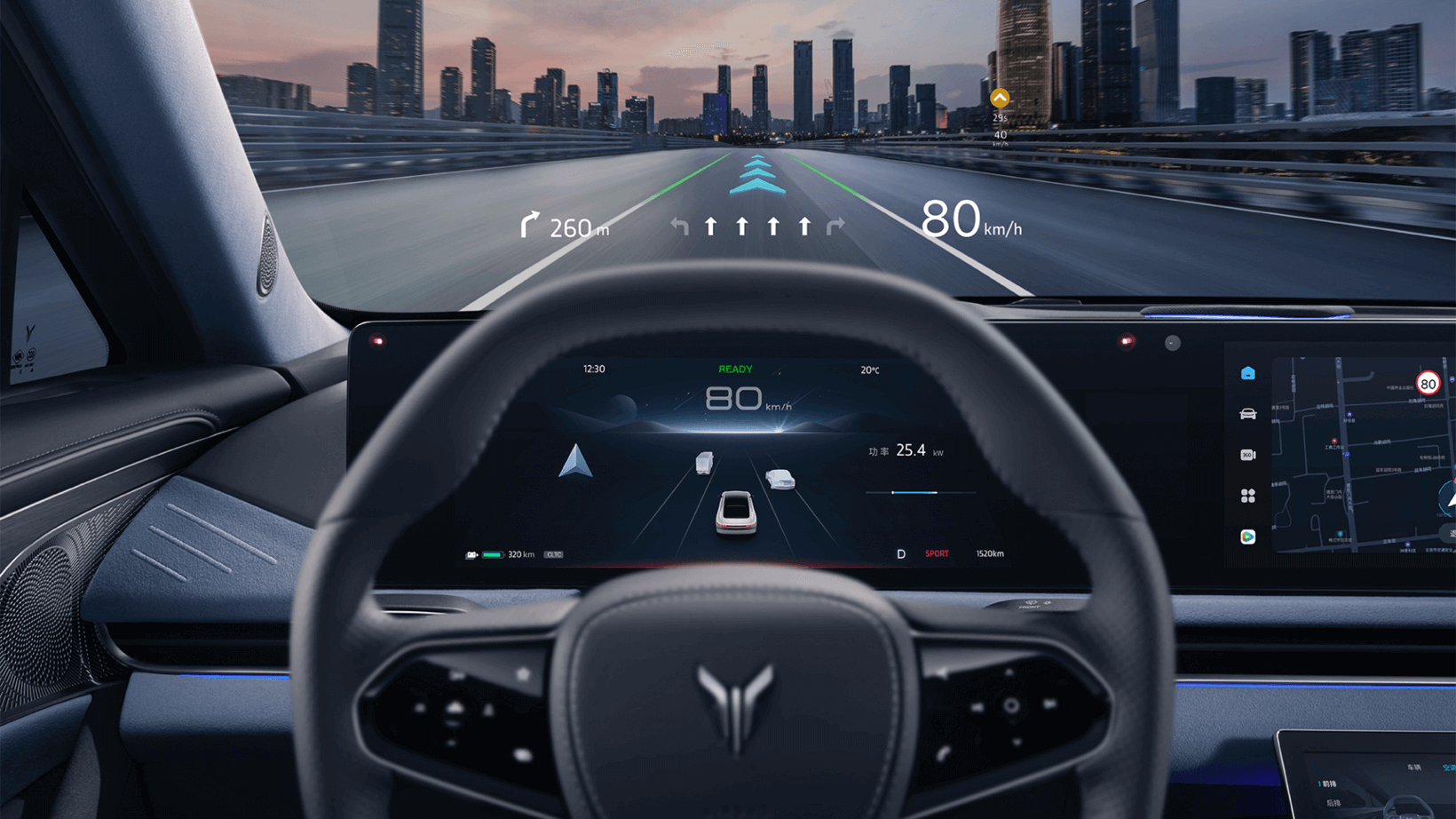
GB/T 46926-2025, Technical Requirements and Test Methods for Field of Vision Assist Systems for Light Vehicles has been formally issued. This is China’s first national standard for FVA (field of vision assistant, i.e., in-vehicle HUD), and its main provisions will be optionally implemented as a supporting standard for GB 11562-2025, Requirements and Measurement Methods for Forward Field of Vision of Drivers in Light Vehicles.
The revision of GB/T 46926-2025 drew on the main content of UN R176 FVA regulations, and introduced mandatory technical specifications for in-vehicle HUDs.
The most significant change introduced by the new regulation is the reclassification of the forward field of vision into Zone 1 and Zone 2, moving away from the previously defined S Zone based on the fixed angle of -1° as specified in GB 11562-2025 and UN R125.
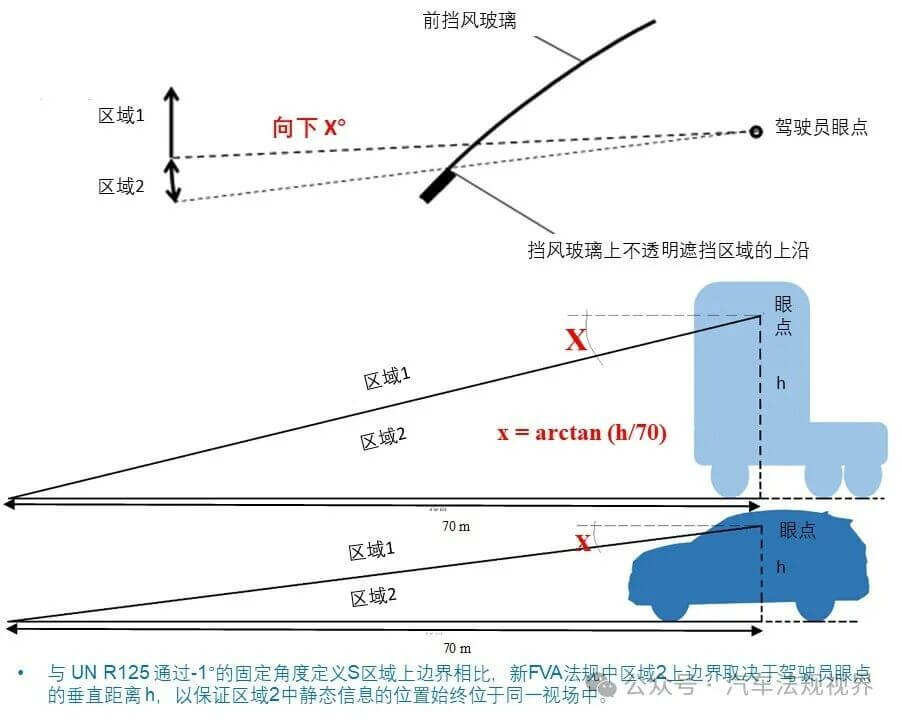

The lower boundary of Zone 2 shall be the upper limit of the opaque obscuration area of the windshield (which means any region on the glass that obstructs light transmission, including solid or dot-matrix printed areas, but does not include areas where light transmittance is merely reduced).
Zone 1 is the upper section of the forward field of vision, where only non-static information may be displayed. Zone 2 is the lower section of the forward field of vision, where both non-static and static information may be displayed.
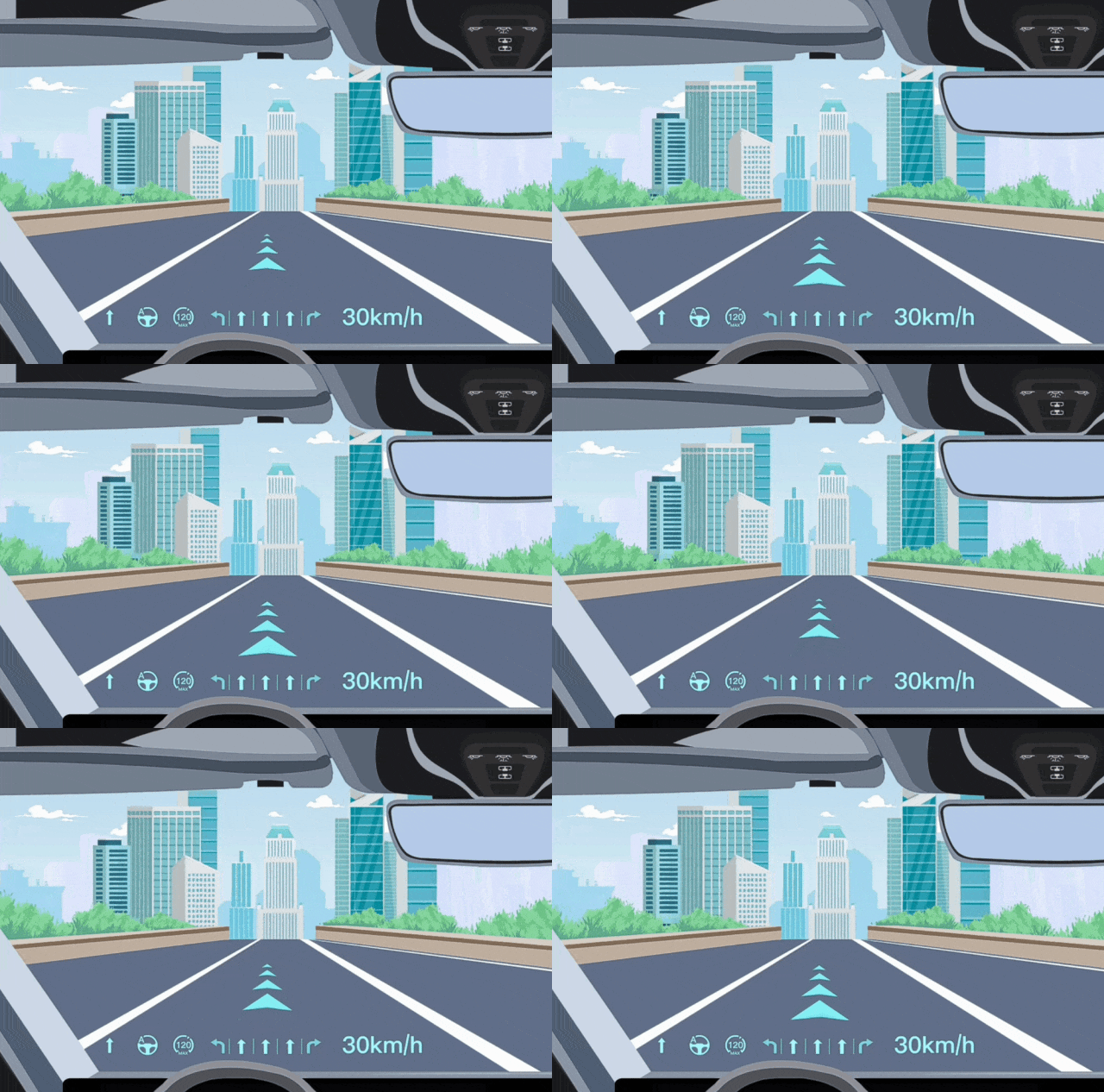
When the conditions required to maintain non-static display information no longer exist, the corresponding symbols and graphics displayed in Zone 1 shall disappear.
In Zone 1, the maximum area of opaque pixels shall not exceed 50 per cent of the FVA display area, and the coverage of opaque pixels within the basic graphics shall not exceed 50 per cent.

In Zone 2, the area covered by opaque pixels shall not exceed 66 square degrees, or it shall comply with the dual 50-per-cent restriction by referencing Zone 1, or it shall meet the requirement that obstacle projection in the “S” Zone as defined in GB 11562-2025 and UN R125 does not exceed 20 per cent; refer to the Driver’s Forward Field of Vision Verification Guidelines (GB 11562).
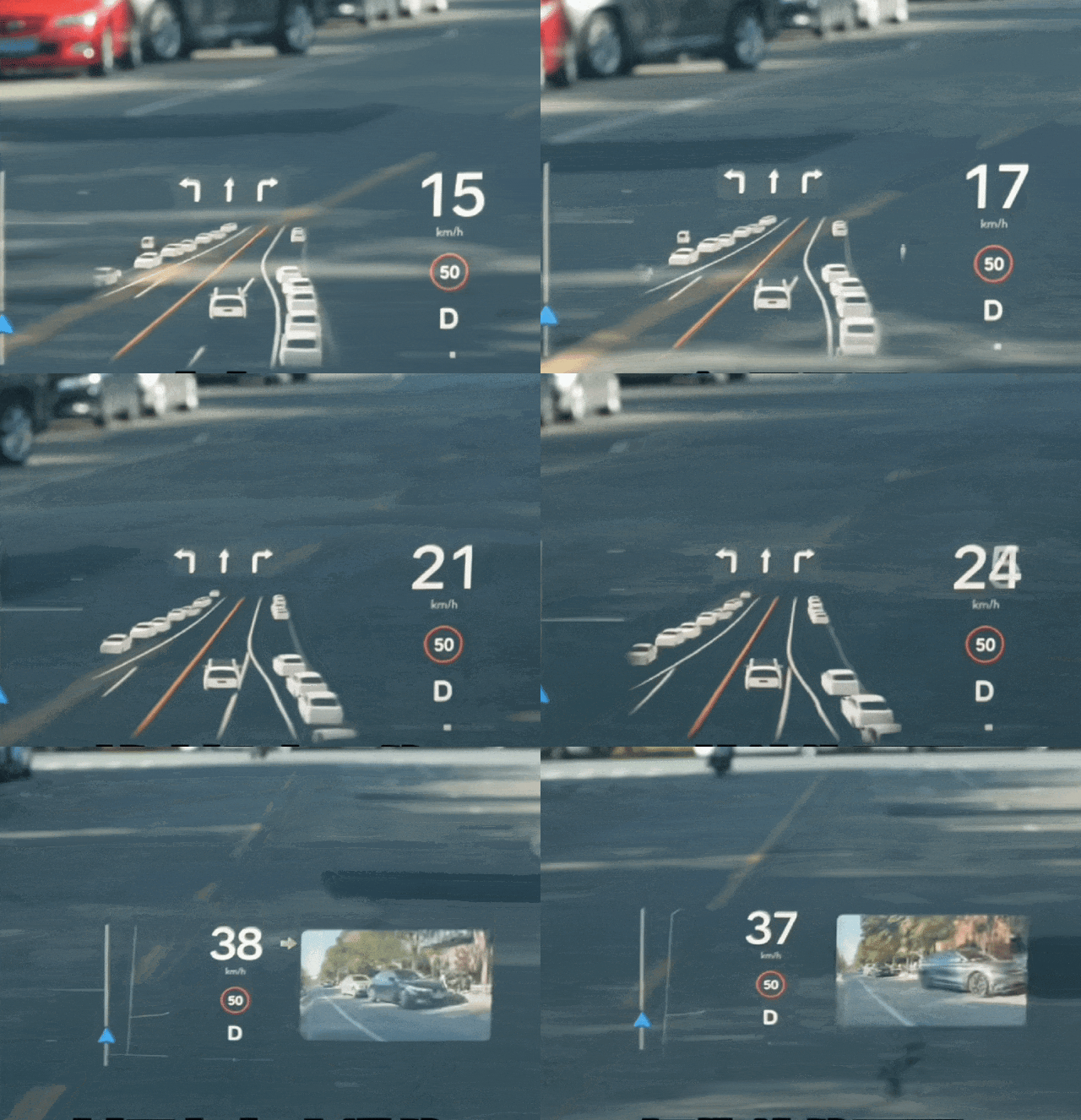
The 50-per-cent restriction is intended to prevent the accumulation of information like system errors or multiple dynamic objects displayed by the FVA (e.g., multiple pedestrians or vehicles) from each being highlighted in a manner that occupies more than half of the available FVA display area.
HUD Information Display Requirements
Information displayed on the HUD shall be relevant to driving or vehicle operation, except when the vehicle is in a parked state. Exemptions also apply when the vehicle is in automated driving mode (refer to Analysis of the Latest Technical Indicators in UN Automated Driving Regulation R157). However, information unrelated to driving or operation shall disappear within 500 ms after the automated driving system issues a takeover request.
Incoming call information may also be displayed.
The HUD system may replicate information that is required to be displayed under other GB and UN regulations, but this does not constitute a substitution. Information mandated by UN regulations must remain displayed on the instrument panel or central control screen. For details, refer to Detailed Comparison of Chinese and European Regulations on In‑Vehicle Switches and Signaling Devices.
The use and color appearance of HUD symbols may refer to UN R121 and ISO 2575 but are not mandatory.
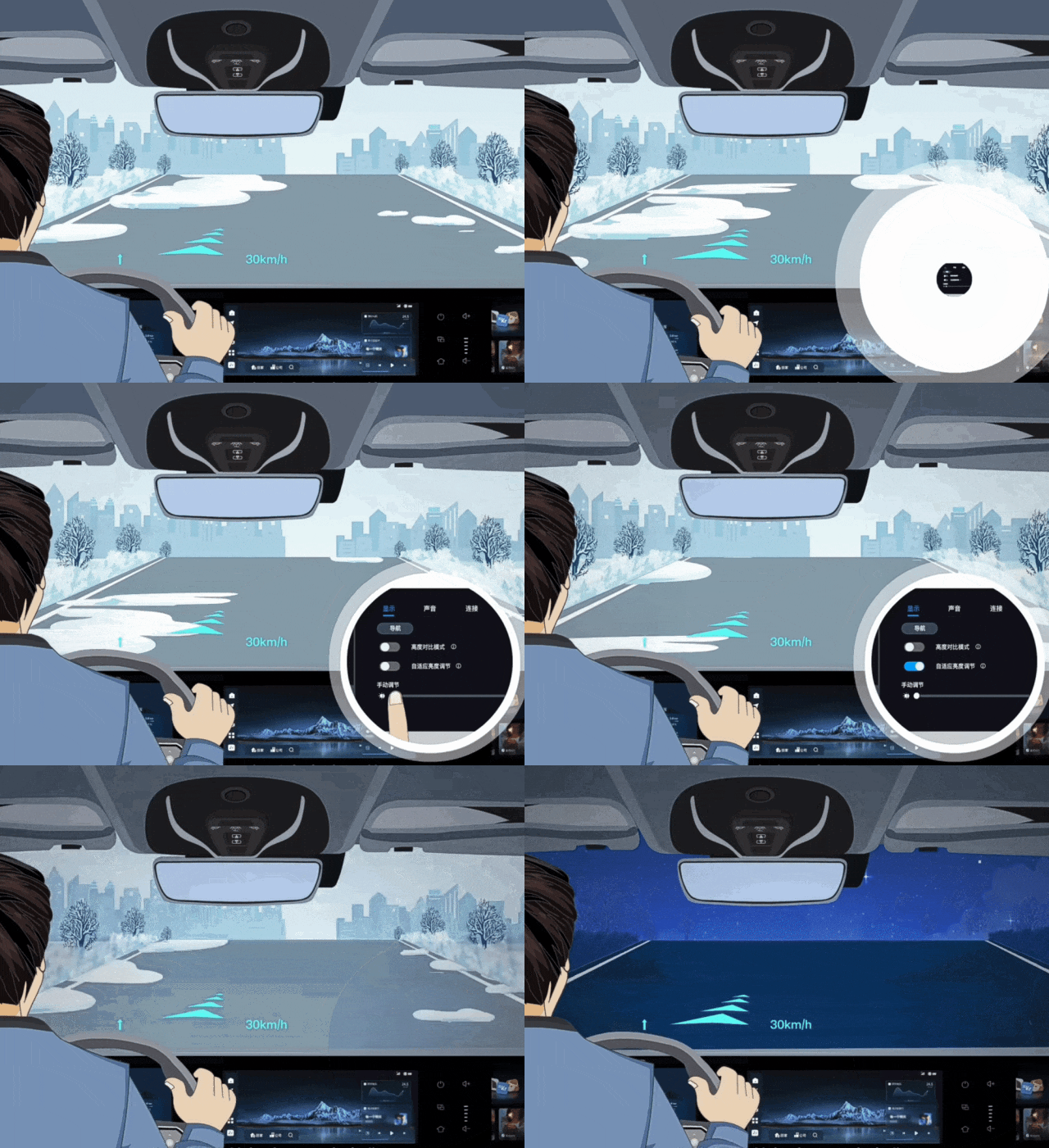
The HUD shall be equipped with both automatic and manual brightness adjustment functions. For systems with an eyebox vertical dimension smaller than 120 mm, an eyebox height adjustment function shall be provided.
Vehicle manufacturers shall demonstrate that the HUD does not cause additional distraction or unnecessary obstruction, and shall provide documentation of safety risk reduction analysis conducted using functional safety standards (e.g., GB/T 34590, ISO 26262) and safety of the intended functionality standards (e.g., ISO 21448).
After the driver independently deactivates the system display function, the time required for the system display information to turn off shall not exceed 1 second.
The driver shall be able to manually turn off the HUD through a simple operation involving no more than two consecutive steps, where actions such as double-clicking, sliding, and pressing are considered a single step.

Information Format Requirements
The size requirements for static system information are as follows:
The flicker frequency of replicated information shall be consistent with that of the source information. For non‑replicated information, the flicker frequency should preferably be within the range of 60 to 120 times per minute.
Are PHUDs Subject to the New Regulations?
Panoramic head‑up displays use a special black coating design at the lower edge of the windshield and near‑field projection technology to project driving information into the driver’s forward field of vision, achieving wide‑area, high‑definition information display.

The regulation defines “Field of Vision Assistant (FVA)” as “visual information displayed within the transparent area of the vehicle’s forward field of view, intended to assist the driver in perception and decision-making.” Its scope regulates obstacles within the transparent area of the windshield, so a PHUD is not covered under this regulatory requirement.


