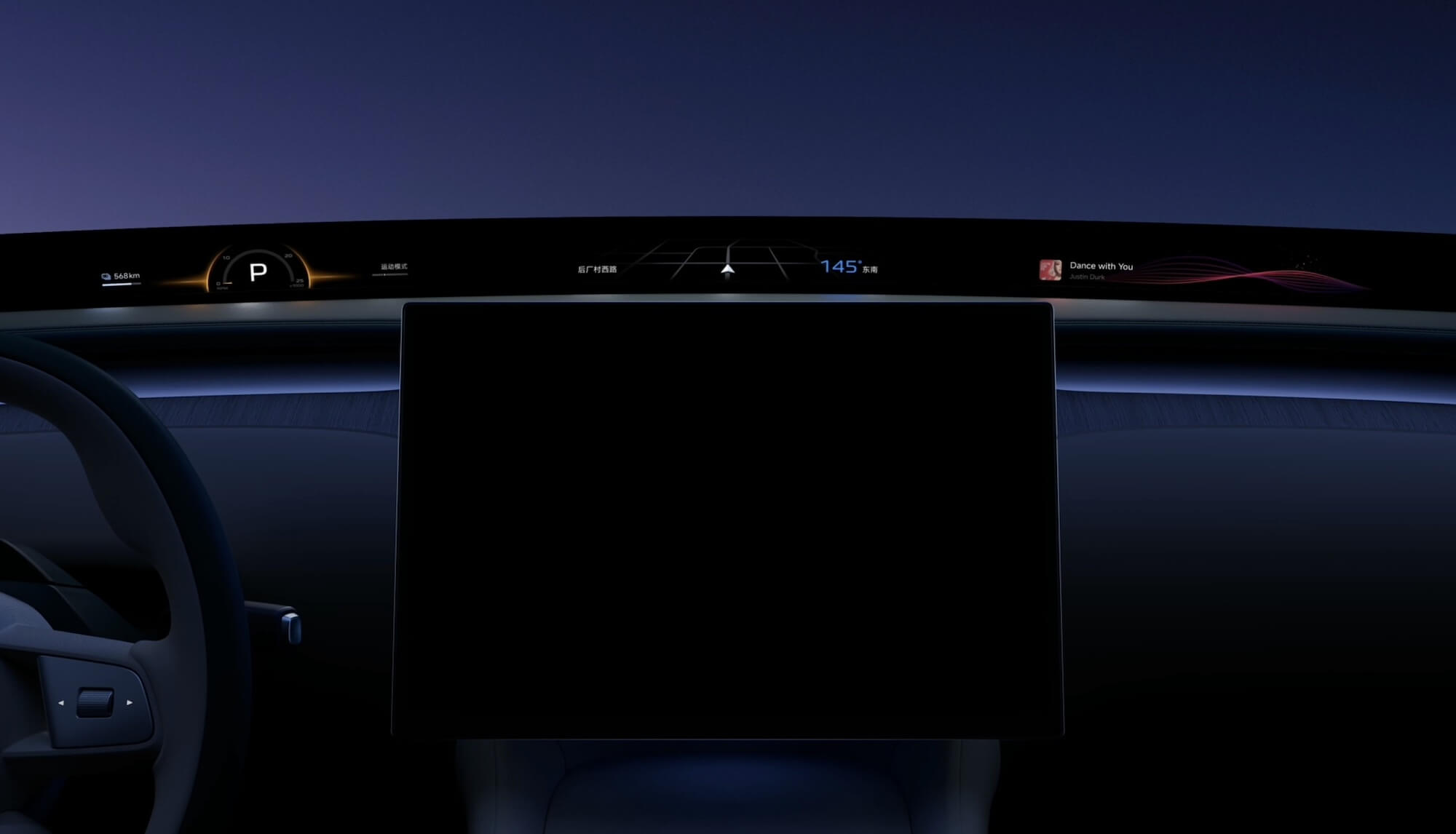
Xiaomi’s YU7 SUV ships with a full-width ‘PHUD’ (panoramic HUD) called ‘HyperVision’. Foryou Group supplies the PHUD imaging solution, while the three 11.98″ miniLED panels behind it come from TCL CSOT.
Three miniLED screens project into the black-band area below the windshield, creating a ~1m-wide PHUD. It has high pixel density (~retina level), peak brightness around 1,200 nits, and 900+ local dimming zones with nano-scale optical coatings.
It boasts extremely low reflectance & ghosting (SCE < 1%, transmittance < 0.01%), enabling the PHUD to become the primary driver information plane.
The YU7 is a mass-market EV and PHUD is standard, not a high-cost option. In terms of US, Xiaomi effectively replaces the conventional instrument cluster with a full-width HUD band, freeing physical dashboard space and pulling all critical info up into the driver’s line of sight.
For Chinese interiors, PHUDs are becoming mainstream, and that radically changes layout logic: the steering wheel zone can become cleaner and more architectural, while information design shifts from “screen surface” to “visual volume in front of the driver.”
Globally: if a Chinese volume SUV proves PHUD is robust and well-received, it will pressure other OEMs (and HUD suppliers) to move beyond small, rectangular HUD patches to wide, MiniLED-backed optical bands as a new baseline.


