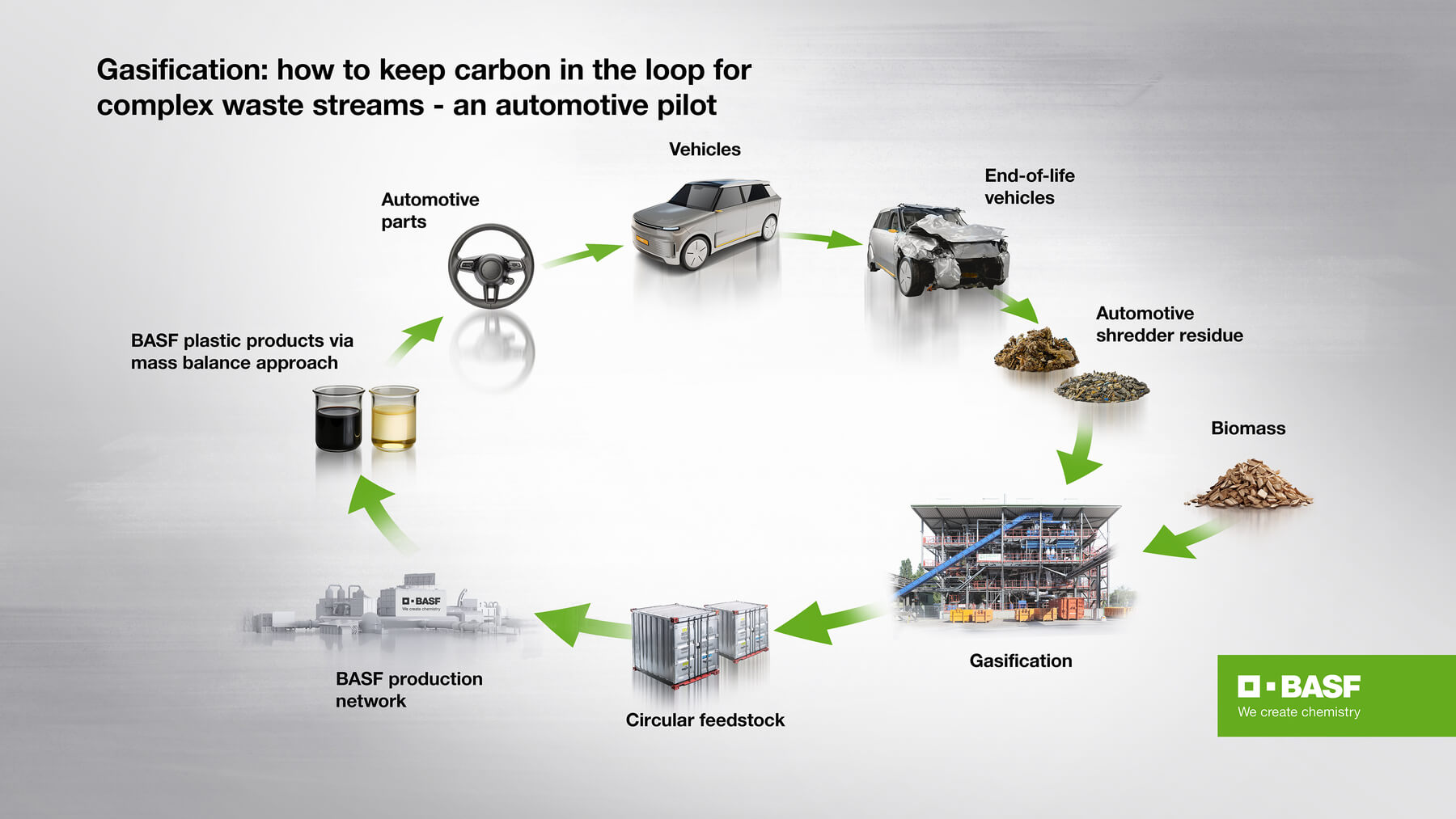
BASF, Porsche and Best are announcing the success of a pilot project involving chemical recycling of ASR (automotive shredder residue from end-of-life vehicles) co-treated with biomass through gasification, with a demonstrated application: a PU formulation for steering wheels, allocated via mass balance.
The key point is the complete substitution of fossil inputs with non-fossil flows (ASR + biomass) at the thermochemical conversion stage, followed by the insertion of this syngas/syncrude into the compound to produce plastic precursors.
On the process side, high-temperature gasification transforms complex mixtures – plastics, foams, films and paints – into high-quality chemical raw materials that are compatible with demanding parts.
‘Attributed circularity’ is based on an auditable mass balance approach, allowing the circular share to be allocated to finished products without reconfiguring downstream units.
For the automotive industry, there are two big benefits: diverting a source of waste that has historically been incinerated, and securing volumes of secondary materials that meet safety specifications (e.g., steering wheels).
The initiative illustrates a path to defossilization through complementary approaches: mechanical methods remain the priority when purity/sorting allows, with chemical methods (pyrolysis, depolymerisation, gasification) taking over for heterogeneous flows.
Several technical media outlets confirm the feasibility of ASR and the integration of mass allocation down to interior parts, highlighting a credible industrial milestone.
Beyond the pilot project, BASF documents an expansion of the ASR spectrum: extraction of polyamides through advanced sorting/processing as another means of recovery, in parallel with gasification.
The challenges of scaling up are classic: securing/logistics of ASR deposits, robustness of LCA compared to alternatives, market acceptance of mass allocations and regulatory clarity at European level.
At this stage, the chain is technically closed from the mixed deposit to the automotive part, without compromising performance, with the potential for demand-driven deployment if certification and the regulatory framework adapt to allow for it.


