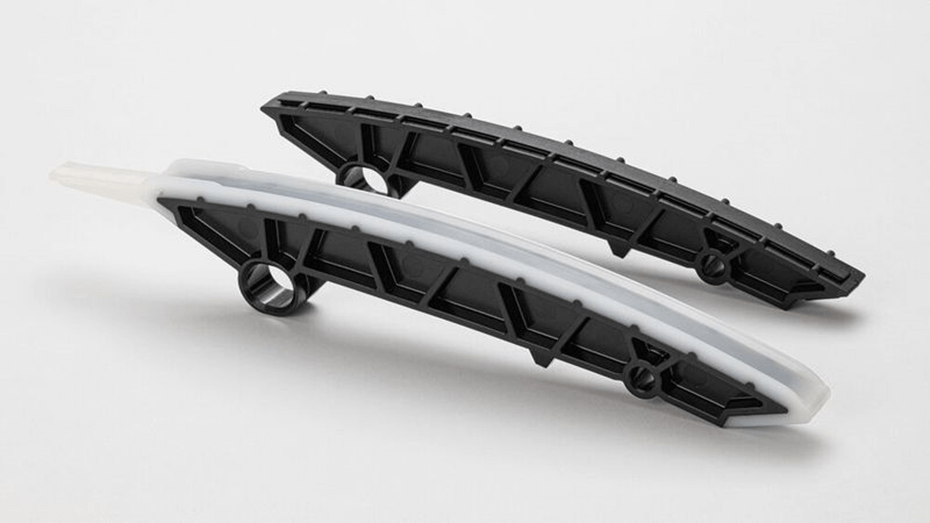
At the K plastics fair, BASF showed two new recycling methods for polyamide-6. The projects were developed together with Mercedes-Benz and suppliers Pöppelmann and ZF.
In a pilot project, a chemical process was developed with which technical plastics can be recycled via depolymerization. This involves splitting the long polyamide chains at the inherent predetermined breaking points. The resulting ‘caprolactam’ monomers are then purified and re-synthesized into polyamide-6. Further processed into a compound, the material then meets the applicable quality standards and is suitable for demanding components in the automotive industry, BASF says. Project partner ZF has used this material to produce a chassis component, a Mercedes-Benz stabilizer link.

The second process uses shredder residue from end-of-life vehicles; BASF has also succeeded in extracting polyamide (PA6) from these residues. The polyamide fraction obtained in this way was used as a starting material for a new solvent-based recycling process as part of the pilot project. In this process, the polymer chains are not split, but selectively dissolved with the aid of a suitable solvent, then purified and reprocessed into usable PA6 compounds.
The components were manufactured and successfully tested by Pöppelmann under near-series conditions as part of the pilot project. According to the group, the results showed significant savings in CO2 emissions for both new recycling processes, in comparison to both the use of fossil raw materials for the production of comparable polyamide compounds, and conventional thermal plastic recycling methods.


