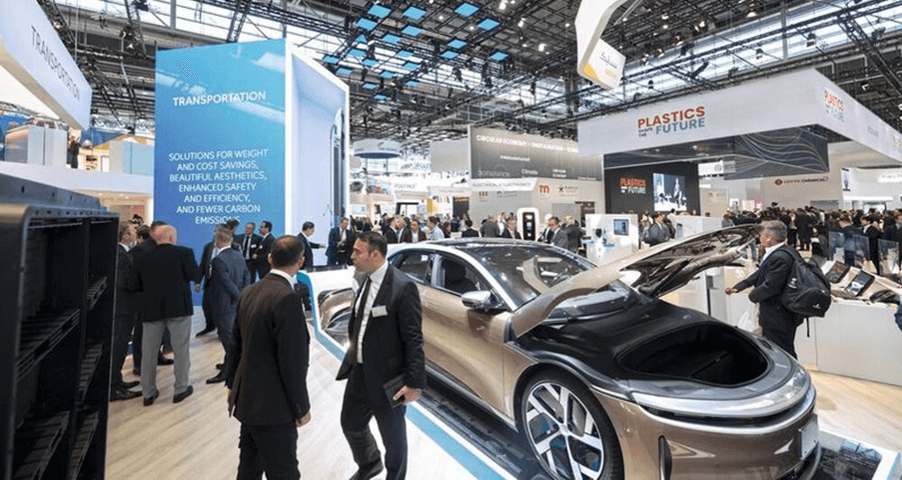
The automotive industry is one of the plastics industry’s biggest target sectors. The world’s leading plastics trade fair, K, is therefore also a meeting place for automotive developers.
Fiat is addressing two trends in the choice of materials for car interiors: the use of natural fibers, for one, such as in the Fiat Grande Panda: The dashboard trim in the La Prima trim level features a textile material containing one third bamboo fibers. And for two, the use of recycled material – in the form of a slight glittering of visible parts in the color blue. The glitter comes from the aluminum parts of the recycled beverage cartons, from which the Italian compound manufacturer Lapolen produces a composite material. In addition to bamboo, each Grande Panda also contains recyclable materials from around 140 drink cartons.
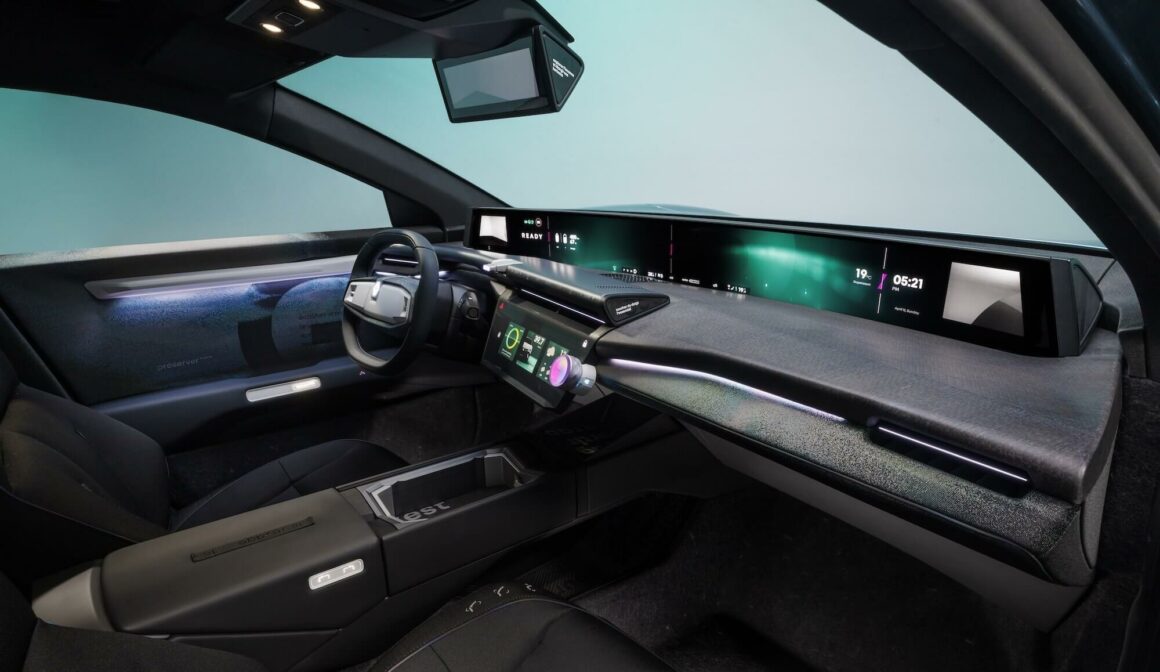
Renault’s Emblème concept car uses decorative materials and upholstery made from recycled or natural materials developed by Forvia. The contact surfaces on the door panels and the center console are upholstered with pineapple fiber, an alternative to leather that is more sustainable and also lighter. The dashboard is covered with linen from Normandy. This sustainable material, which is renewable and stores CO2, also lends the interior an aesthetic quality thanks to its structure. In the Emblème, Renault is also testing an innovative process for coloring the plastic fibers in the interior. All the colors of the fully recycled and recyclable woven polyester were created by weaving threads in just four different colors: cyan, magenta, yellow, and black. This process, known as additive synthesis, eliminates the need for dyes, reduces CO2 emissions and can produce up to 62 shades.
Materiact, a Forvia company, has a composite material called NafiLean-R made from recycled plastic and 20 per cent hemp fibers. It’s meant for use in injection-molded visible parts in car interiors. The biomass content remains visible for a natural look. Around ten million vehicles are already equipped with it. And NafiLean Vison is a further development in which other natural materials such as wood, reeds, vine cuttings. and oyster shells are used instead of hemp, in proportion of up to 25 per cent. The biomass is combined with low-carbon, mechanically recycled plastics from consumer waste.
According to Materiact, the new class of materials maximizes the decarbonization of plastics and makes them usable for visible vehicle parts. It also enables a wide variety of designs with natural colors and grains, and with visible and tangible surface structures. Nafilean Vision can be processed using a simple injection molding process, without decorative painting or film coating. This cuts CO2 emissions, reduces production costs, and simplifies production. In combination with newly developed coloring technologies, the material meets major automakers’ highest color, material and surface (CMF) requirements. CO2 emissions are down to 75 per cent lower than with conventional materials.
The Mercedes CLA bristles with innovations including a trim element made of paper, which is manufactured from cellulose and hemp fibers and is very robust. The high-quality decorative surface offers a new look that is designed to inspire ‘wow’ reactions. In the case of the seats, Mercedes shows that recycled materials can be processed into very-high-quality interior trim parts, like black leather-look seat covers. Here, the carrier textile consists of recycled PET bottles, which are regranulated, turned into yarn, and woven into textiles. As an alternative, the Microcut microfiber nonwoven, which is made from 100-per-cent PET bottles, is offered for the AMG upholstery. A high-quality and robust fleece is created from regranulated yarns in an elaborate microfiber process, which resembles suede in its look and feel and is also used in the door armrests. The floor covering is made of Econyl yarn, which compises 100-per-cent recycled material.
On show at K ’25 was the processing of natural fibers into an interior trim component. The basis is a natural fiber mat covered with a decorative film made from the long-fiber-reinforced composite material NFPP developed by Polyvlies, a combination of natural fibers and polypropylene. It is inserted into a vertical injection molding machine in a fully automated process, overmolded with precise contours, and provided with a QR code. An integrated camera checks the dimensional accuracy. This ‘NFPP’ one-shot technology was demonstrated live at the Wittmann stand. It was developed jointly by Frimo, Leonhard Kurz, Polyvlies, and Wittmann, and demonstrates a production-ready solution for the manufacture of lightweight visible components in vehicle interiors.


