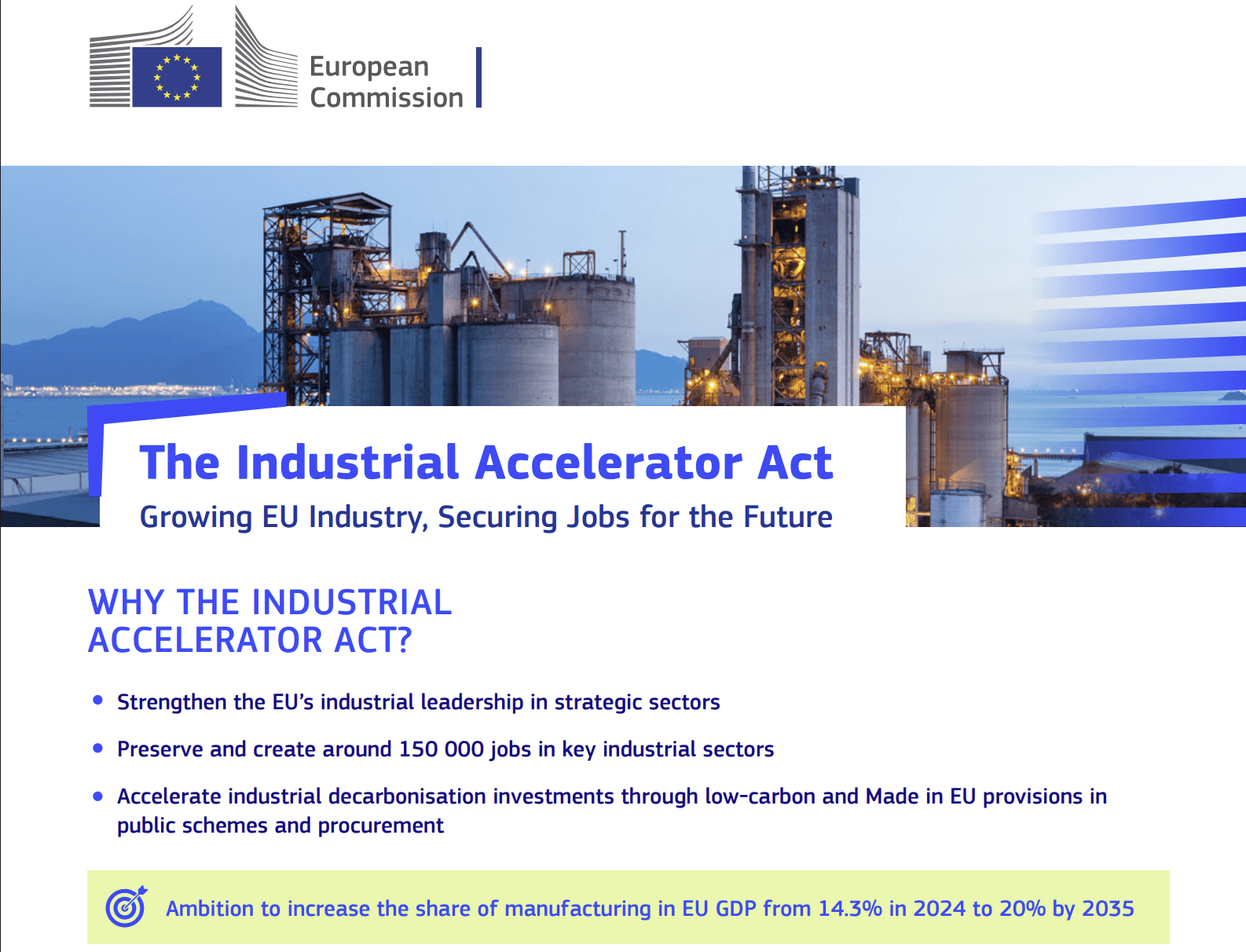
On 4 March 2026, the European Commission presented their Industrial Accelerator Act (IAA), a legislative proposal aimed at strengthening Europe’s industrial base and speeding up the transition to low-carbon manufacturing.
According to the document:
“The EU manufacturing sector is the largest employer (18.7%) and value-added provider (24.1%). However, the EU industry is losing ground. Manufacturing as a share of EU GDP declined from 17% in 2000 to 14% in 2024. Low investment levels, along with challenges such as slow economic growth, unfair international trade and competition, the need for decarbonisation and technological competition, affect the competitiveness of EU industry and impact the business case for investing in European low-carbon technologies. The global market for net-zero technologies is projected to nearly triple by 2035. While their deployment in the EU is progressing, the EU’s global market share is declining, and domestic manufacturing capacity remains limited. Furthermore, economic security is a central pillar of EU industrial policy, with key technologies underpinning the green and digital transition, which are currently exposed to strategic dependencies and supply chain risks. Without a competitive and decarbonised industrial base, the EU will not achieve the objectives of the Clean Industrial Deal and the Economic Security strategy”
With the IAA, the aim is to ensure that by 2035, this trend is reversed and that manufacturing represents 20 per cent of the EU GDP. A focus is clearly mentioned on our automotive industry:
“Downstream industries are also under pressure. The competitiveness of the European automotive industry – a symbol of Union industrial leadership – has significantly decreased, with the average profitability of European automotive suppliers dropping from 7.4 % in 2017 to 5 % in 2023 and more than 100,000 job cuts announced in 2024/2515 . Recent surveys show that half of the European automotive component suppliers plan to reduce production capacity in the EU in the next years. This decline threatens hundreds of thousands of jobs and the integrity of Europe’s industrial future”
The proposal introduces a three-level definition for European vehicles, which mandates vehicle assembly in the EU, an immediate 70-per-cent local content (excluding the battery) threshold for automotive production in the region, and a 50-per-cent threshold for critical components to be implemented three years after publication.


