By Hans Joachim Schwabe
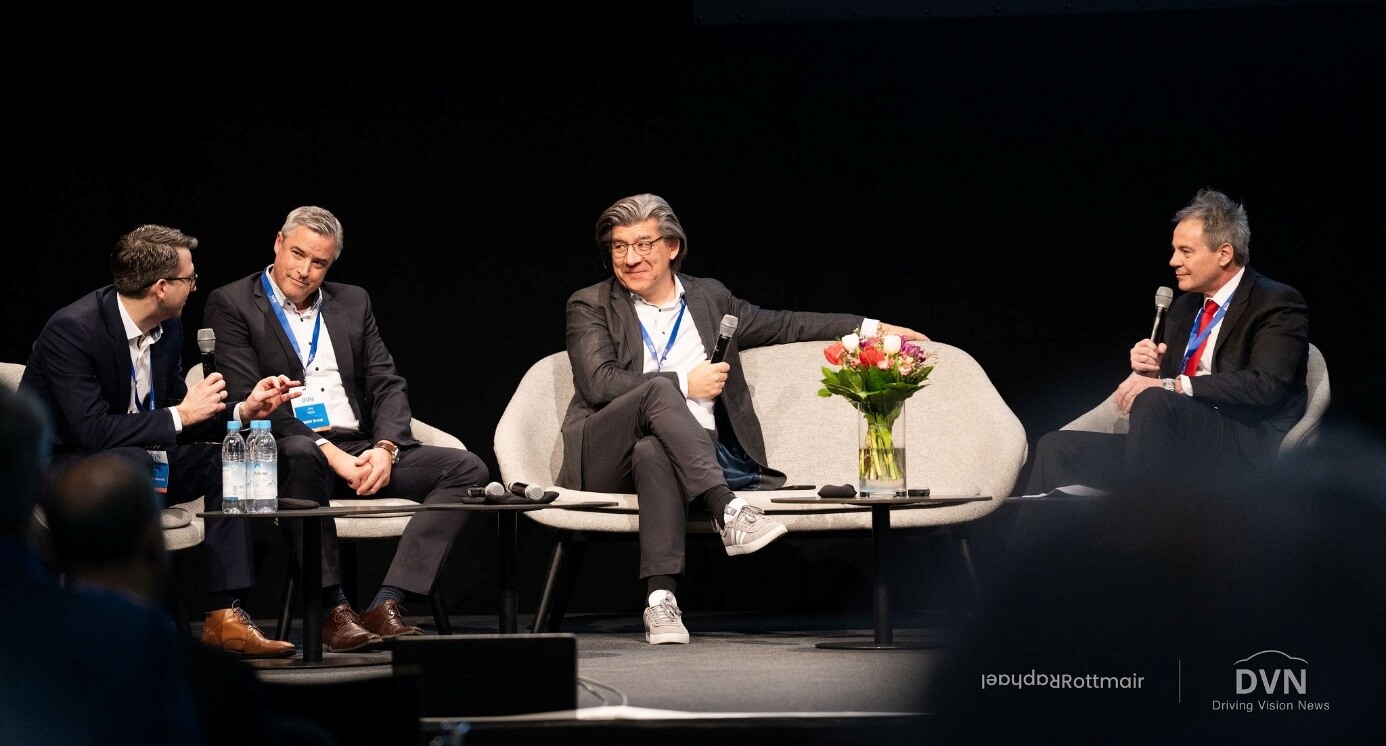
We gathered on stage lighting leaders from Mercedes, Audi and BMW to exchange with the automotive lighting community about the challenge our industry is currently facing. The discussion started with OEM highlights BMW mainly focused with ‘Neue Klasse’ (last year’s DVN award winner for best concept car lighting) by integrating smart sensing and lighting and realizing classical BMW design (e.g kidney style).

Mercedes Benz marked their highlight with a lit grille concept, demonstrated during exhibition, which won the award for best new technology, and also introduced to the market their next-generation Digital Light with microLED technology.

Audi mentioned the new Q3 with microLED plus OLED available now for all vehicles at least as an option, and presented all functional topics developed over the last years in reality now.

First question was focused on lamp size and performance, a usual discussion between R&D and design teams, never easy to arbitrate.
Audi are handling it with early involvement of design options by specifying module sizes (e.g., beam angle defined beforehand). No compromise on performance. Targets are well defined and agreed. BMW is quite similar: early agreement with design on target values including size. Mercedes define lens area (size). If necessary, compensation via aperture (light cone) may be realized to find the best compromise. Also, Mercedes mentioned that signal lighting of the GLC and S-Class were a challenge for design and functionality (3D Star).
The second question focused on ADB, and especially ADB US – why not first?
Mercedes clearly stated that added value as function is main reference. Functions are also dependant on platforms, and which architecture is under consideration. Audi reminded that initially SAE and NHTSA had a specification [readily compatible with UNECE], but then NHTSA instead enacted their own specifications. So, adaptations were necessary regarding oncoming traffic (glare values low/high beam), including camera software modification (detection). That took time.
What about SDV (software defined vehicles)? Is SDV generating changes to process and organization?
Audi mentioned their JV with Rivian (VW – RVT). New generation hardware and software are under development, and also Audi will be incorporated with next vehicle. Audi is preparing R&D capacities, with already more than half their workforce in function development (including software).
Mercedes are focusing on their own operating system (OS). Then software can be realized in-house or outsourced. Certification still a bit more hardware and software identification under work (unclear still).
What about China (Speed and Platforms): how to answer?
BMW identify change management being necessary but also mentioned this is time consuming. China is more stringent in staying with fixed design until SOP. BMW still manage design iterations if necessary. Audi have been first by trying a unique Chinese platform with safety, chassis, and design initialized in China (with target price half that of normal price). Speed is possible, but acceptance of China standards and R&D to be proven. (Audi E5 Sportback with SAIC).
Mercedes talked about short life cycles with partially low sustainability. Mercedes still focus on reliable safety concepts, and they don’t develop only entertainment lighting features like a fixed DLP module.
What do they think about exterior displays – progress and regulation?
Mercedes have already worked on specification for components in an advanced mode. Potential use cases are still under discussion (probably conflicts with design). Audi pretty much agreed with discussion during a deep-dive session the day before the DVN Munich event. We need a set of standardized symbols to be learned and widely accepted. This should be realized before autonomous driving becomes reality. In 2027 Audi will demonstrate more options either mandatory or optional, but correlation with autonomous driving is obvious. BMW are still under discussion which direction to focus.
What about sustainability?
BMW did a deep headlight research study with Hella (> 70 per cent of components able to be recycled). Nevertheless, design compromise is necessary, and lighting is only 1 per cent of the total vehicle (so what?). More focus is needed on energy efficiency.
Mercedes have lighting activities bundled with program “Tomorrow XX” (possibility to exchange components for aftermarket or lamp reuse). Audi are also a bit sceptical on lighting design requirement (e.g., homogenous light) that are destroying energy efficiency (low optical efficiency). Activities derived on 48V architecture that may be more efficient for lamps (no need to have voltage buck/boost that may be replaced by only a buck that is more efficient and cheaper).
How to improve ADB performance – closed loop ADB?
Audi focused on simplification of production, but future direction is clearly on autonomous headlamps (e.g., including sensors that assure the correct aim). Predevelopment is ongoing; software is still the bottleneck. Mercedes have very high interest in software and system development. Predevelopment is also ongoing, not yet fully ready but with a strong focus.
What would be the three key messages for suppliers?
BMW focused on trust, reliability, and expertise – the quality of work. Stronger home base of suppliers in Germany is desirable. Mercedes emphatically confirmed that pressure is getting stronger, complex change management is sometimes absorbing and purchasing decision are not getting easier.
Audi summarized with fair partnership integrating competence, quality, and willingness to co-develop.


