By Wolfgang Huhn
Before the official opening of the DVN Munich Workshop, a pre-event was held in Motorworld with two parallel sessions. One session was an expert discussion about automotive lighting sustainability, and the other was a “deep dive” into external displays and a status update on research from institutes and industry.
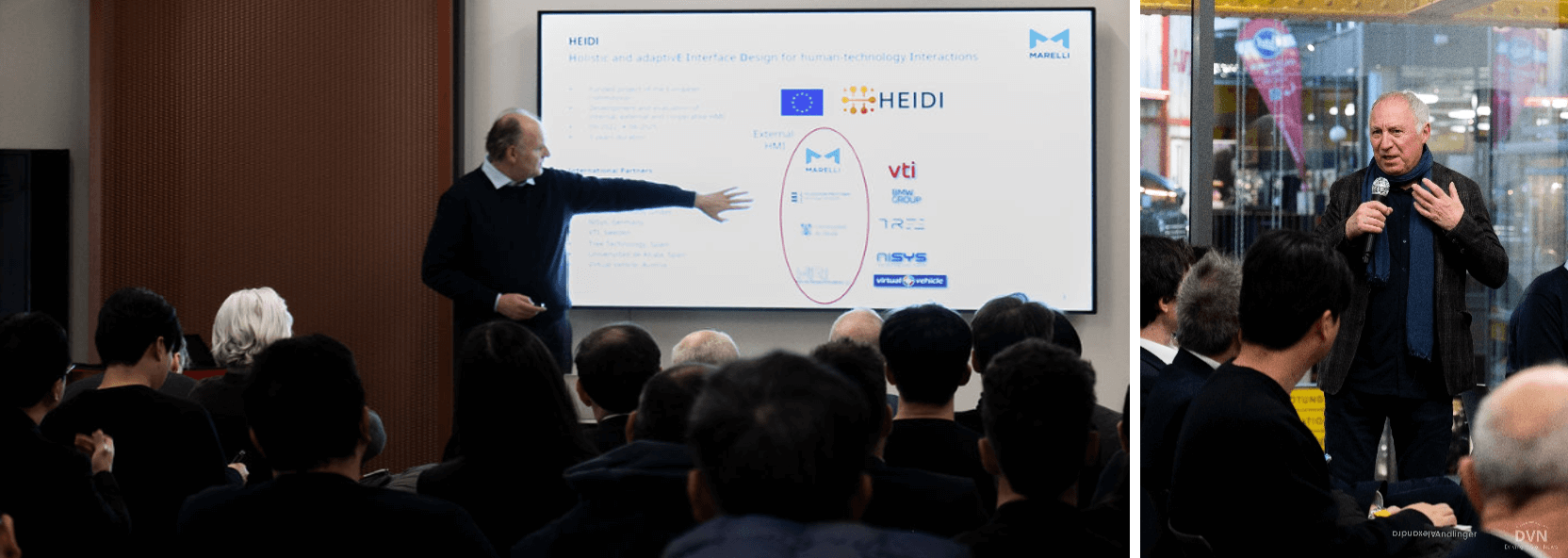
I choose the external display meeting which was opened by Elo Rosenhahn’s presentations on the “HEIDI” research results. The HEIDI project was a research project involving European research institutes and industry partners that ran last year. The project focused on communication with external displays in traffic. Simulation tools and experiments with real cars were carried out. After the presentation, the test car prepared by Marelli was shown and explained. The most notable outcome was that pedestrians’ decision time was significantly reduced when they had information about the driver’s intentions communicated via the front display. This would make traffic safer and more efficient.
Christian Schmidt from Forvia Hella presented their research car, which has a front display that includes several turquoise AV signal lamp solutions.
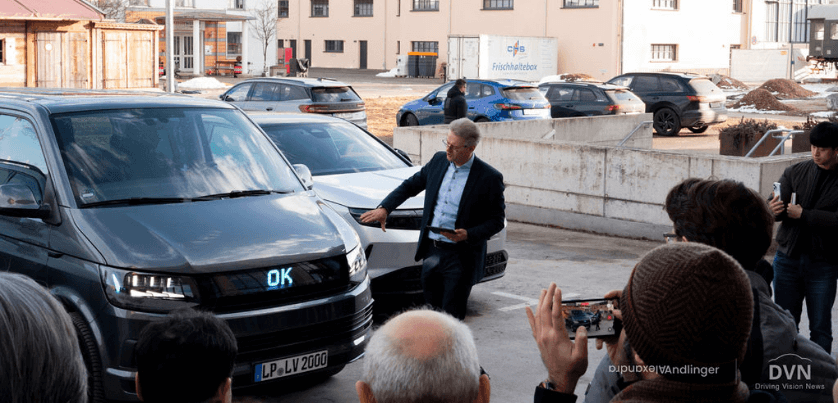
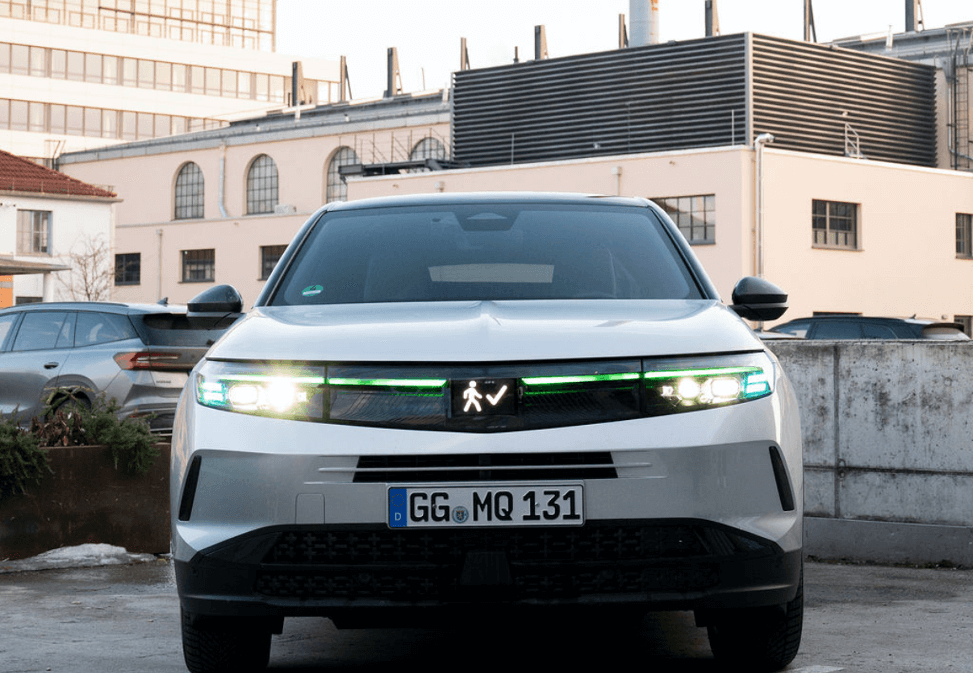
Julisa Le from Stellantis was talking about their investigations with the test car with an HD display and full RGB abilities.
Wilfried van Laarhoven gave a great and lively presentation about the usually dry topic of GTB’s regulatory development. Well done, Wilfried!
Jonas Bix, a Ph.D. student at Darmstadt University, spoke about the principles of symbol design, which are important for clear communication and avoiding misunderstandings.
All these investigations and studies will help the GTB develop a regulation draft for the decision-makers of the contracting parties in the GRE in Geneva.
The official opening of the event took place the following day in Munich’s Olympia Park, featuring keynote speeches and presentations by car manufacturers and Tier 1 and 2 suppliers on technical innovations and design. Design was clearly the main topic of the DVN workshop, followed by technical improvements. One of the technically interesting examples was the integration of radar sensors into the headlamp of the BMW iX3 using a special radar-transparent film. Mercedes said that they are the first European OEM to offer adaptive driving beams (ADB) in the USA, following Rivian, which introduced them two years ago. Despite having no advantage over the ECE regulation, the US ADB regulation is more difficult to meet.

A day full of high-level presentations will culminate in the award ceremony for the final design contest. Seven international design schools were invited to present their ideas for the future of automotive lighting. The students and their teachers presented wonderful ideas that were far from any regulations or feasibility. They offered a glimpse into the future of science fiction, showcasing a remarkable creative prowess. In any case, it was an interesting and entertaining part of the conference.
The very last part was another awards ceremony for the best headlamp and rear lamp designs, as well as others, chosen by the DVN community. Once again, design trumped technical content or the potential for safety improvements in new products.
The last day began with a pre-event: a session about optical design for optical specialists. Some improvements in cost, performance, and scalability were presented.
Later in the day, Renault’s François Bedu gave an interesting presentation on the future fusion of lighting and ADAS. He demonstrated the advantages of merging lighting and ADAS into one architecture. In most electronic architectures today, lighting is part of body electronics, despite the fact that video processing for driver assistance projections and image processing for adaptive driving beam (ADB) would offer significant advantages and enable new, improved lighting functions. Are the OEMs flexible enough with software solutions?
Another notable session was the Electronics session, chaired by Alfred Vollmer, a renowned technical journalist from Germany. The clear message of this session was that the large number of bus systems used to communicate with lighting elements, especially for interior control of color shift and LED luminance, creates many disadvantages in terms of cost and development capacity for the entire industry. Several proprietary, more or less private bus systems (Iseled from Inova, others from e.g. Osram or Elmos) compete with each other, because no open standard is available. From the GTB standpoint, it can be said that this is an example of how standardization can be beneficial if implemented correctly.
In summary of the total event, one could say that design (styling) is still king in automotive lighting due to its significant impact on a car’s signature and brand image. Regulations should support individual car styles if safety is given the highest priority and energy consumption isn’t completely overlooked.


