
By Aniella Marie Johannsen, L-LAB
In recent decades, the design and functions of automotive headlamps have changed considerably. The integration of LEDs and innovative optical concepts enables the design of small light-emitting surfaces and precise contours, opening up new possibilities for modern designs. To fulfil legal requirements (ECE) minimum or maximum light intensities at certain points within the lighting distribution need to be realized. This results in defined illuminances at given distances, e.g. at point B50L1, which corresponds to the driver’s eyes of oncoming traffic at 50 m. The same luminous intensity and thus the same illuminance at a defined distance can be generated from headlamps with different sizes of the light emitting area. However, the average luminance of the light emitting area will change with the area size.
In the context of glare during night-time drives, the question arises whether headlamps with very small light-emitting areas cause more glare for oncoming traffic than those with larger surfaces. There have been several empirical studies which could not find any2,3 or only a minor effect4,5 of luminance on discomfort glare if the legal requirements are fulfilled. If the ECE maximum values of luminous intensities are exceeded, discomfort glare as well as disability glare increased significantly. All these studies were conducted as static experiments in the laboratory or in a light tunnel. This raises the question of whether the results can be transferred to dynamic situations.
To validate the results obtained under static conditions for real road traffic, a study was designed to investigate discomfort glare in a dynamic setting using headlamps with varying light-emitting areas. The following hypotheses were formulated accordingly:
1: Misaligned headlamps produce significantly more discomfort glare than correctly-adjusted ones.
2: Headlamps that meet the legal requirements differ only slightly in terms of discomfort glare regardless of the luminance and size of the light-emitting area.
In a first vehicle, a test subject drove back and forth on a straight, dry country road between two roundabouts. On this section, one of the test vehicles with one of the headlamps activated was oncoming, and the two vehicles drove past each other. After the pass, discomfort glare was rated on the De Boer scale. The order of the headlamps systems was randomised. To increase reliability, each pair of headlamps was presented twice, and the ratings were averaged.
First, two practice runs were carried out to allow the test subject to become familiar with the procedure. Following this, ten encounter runs were conducted, with the test subject rating the perceived glare after each one. To avoid order effects the presentation was pseudo-randomized using two different orders. Two test vehicles were equipped with headlamp racks (Figure 1). Five pairs of headlamps were mounted. The headlamps of the test vehicles varied in the size of light-emitting areas and thus in luminance.

Four pairs of headlamps were adjusted to produce 0.4 lx ±10% at B50L. The properties of the headlamps are listed in Table 1. The halogen projection headlamps were misaligned, so the legal maximum value was exceeded. The size of the light-emitting area corresponded to the external dimensions of the surfaces. Not only the average luminance but also the extent of luminance inhomogeneities and peak luminances varied between the systems. As it has not yet been clarified which luminance differences the human visual system can resolve and thus perceive, the average luminance was used in this work.
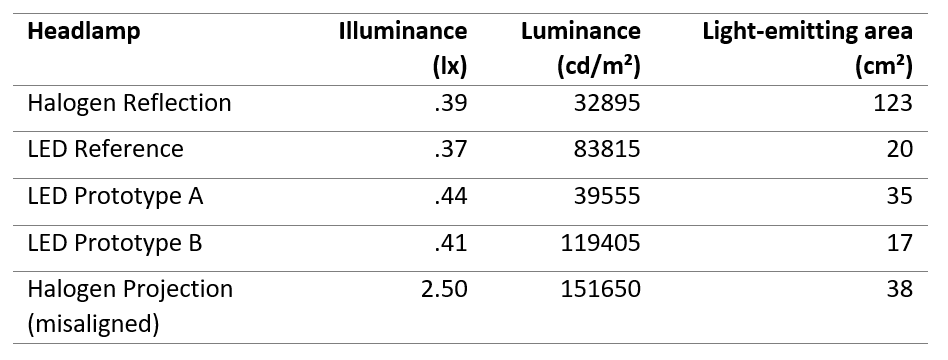
17 participants took part in the study (Mean age 30.9; 12 men, 5 women). The results are shown in Figure 2.
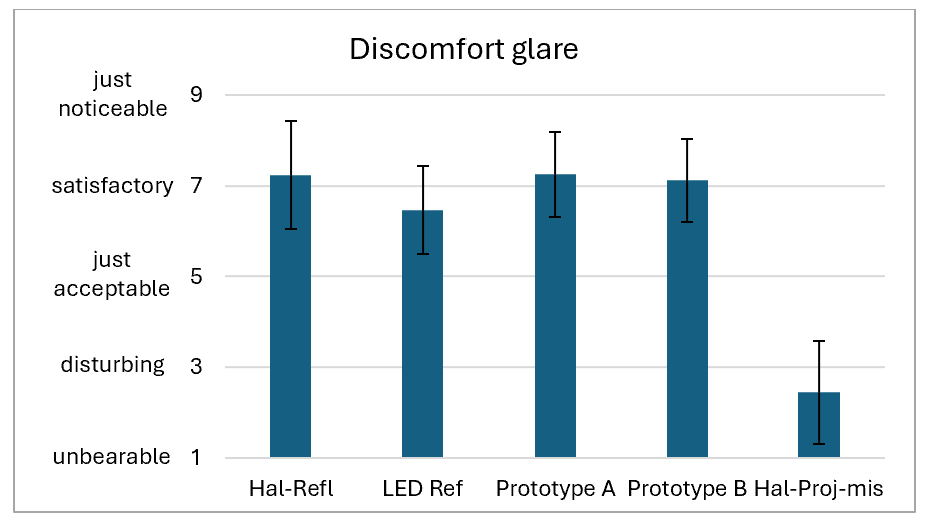
(Hal-Refl = Halogen Reflection; LED Ref = LED Reference; Hal-Proj-mis = Halogen Projection misaligned)
All correctly-adjusted pairs of headlamps were rated as satisfactory (Range: 6.5 – 7.3) on the DeBoer scale. In contrast, the misaligned headlamp was rated as disturbing (2.4).
For the comparison of correctly adjusted and misaligned headlamps (Hypothesis 1) the ratings for all five headlamp systems were analysed. The Friedman test showed a statistically significant result (p < .01, χ2(4) = 41.90). The results of earlier studies are fully confirmed. High illuminance at the eye leads to a strong perception of discomfort glare.
To investigate the effect of luminance and the size of the light-emitting surface (Hypothesis 2), the four correctly-adjusted systems were compared with each other. Despite substantial differences in luminance and the size of the light-emitting area, no significant differences in discomfort glare ratings were observed between Prototype Headlamps A and B, nor between the prototype systems and the halogen reflection system. Statistical analysis confirms that neither luminance (Kendalls’s rank correlation τ = -.67; p = .18) nor light-emitting area size (Kendalls’s rank correlation τ = .33; p = .49) significantly correlates with discomfort glare.
Interestingly, the LED reference Headlamp was rated as slightly more glaring. This deviation was statistically significant according to the Friedman test (χ²(3) = 8.90, p = .03), yet it cannot be explained by luminance or size of the light-emitting area. This finding suggests that other factors influence discomfort glare, possibly related to spectral composition.
Regarding the validation of the static studies’ findings, the results show a high congruence between static and dynamic settings, including the slightly worse discomfort rating for the LED reference system.
Previous studies on the influence of luminance and illuminance on discomfort glare were performed under static conditions in the laboratory or in the light tunnel2,3. In the study presented here, discomfort glare was assessed under dynamic conditions in real driving situations. The results of the earlier studies were essentially confirmed. Variations in discomfort glare ratings cannot be explained by the luminance of the headlamps’ light emitting area. However, high illuminance levels at the eye of the oncoming driver cause very strong glare. This effect is considerably greater than the effect of higher luminance values of correctly-adjusted headlamp systems. Therefore, to minimize glare in road traffic at night it is important to ensure that the legal requirements are permanently complied with.
The authors acknowledge the support of the International Automotive Lighting and Light Signalling Expert Group (GTB) for sponsoring this project. The financial and organizational assistance provided by GTB was essential to the successful completion of this work.
References
1 · United Nations Economic Commission for Europe, Regulation № 112 – Uniform provisions concerning the approval of motor vehicle headlamps emitting an asymmetrical passing beam or a driving beam or both and equipped with filament lamps and/or LED modules, E/ECE/324/Rev.2/Add.112/Rev.5, Jan. 2023.
2 · J. Locher and F. Kley, “Disability and discomfort glare of headlamps,” in Proc. 8th Int. Symp. Automotive Lighting (ISAL), Darmstadt, Germany, 2009.
3 · T. Sapovalov, Blendung durch KFZ-Scheinwerfer, Master thesis, Hamburg, Germany, 2019.
4 · J. W. A. M. Alferdinck and Varkevisser, “Discomfort glare from D1 headlamps of different size,” in VEDELIS, TNO Institute for Perception, IZF C-21, 1991.
5 · S. Völker, Blendung durch Kfz-Scheinwerfer im nächtlichen Straßenverkehr: ein Review bis 2006 – Beschreibung, Maßzahlen, Bewertungsmethoden, vol. 10. Universitätsverlag der TU Berlin, 2017.


