By Wolfgang Huhn, GTB President and DVN senior advisor
During the 92nd GRE session in Geneva this past April, signal road projections (SRP) were discussed. While the SRP for the reverse light function was accepted, two delegates from contracting parties (that is, countries which have signed the 1958 Agreement, which is the framework for the UNECE Regulations and their system of reciprocally-recognized approvals) had concerns about the direction indicator SRP. The concerns were mainly about the potential for distraction of road users, as well as doubts about the function’s usefulness. The GTB suggested organizing a live demonstration in real traffic before the next GRE meeting, which will take place at the end of October in Geneva, to clearly demonstrate the real-world characteristics of road-projected turn signals.
The GTB contacted Prof. Khanh from TU Darmstadt, the chairman of the ISAL conference, and requested his support for a demo at the conference. He immediately agreed. Thank you!
The objective was to offer the opportunity for GRE delegates to get a dynamic live demonstration in urban areas to see how direction indicator projections as defined in the latest GTB proposal work in practice, and with the aim of facilitating the discussion at GRE-93 in October 2025.
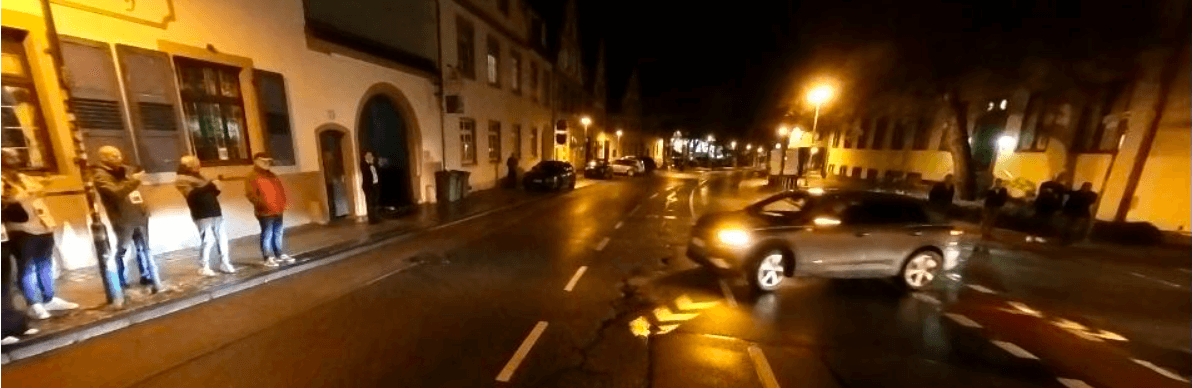
The demonstrator cars included an Audi Q4 e-tron with front and rear SRP, a Cupra Leon with front and rear SRP, a Mercedes S-Class (only static demo), and Marelli’s Mercedes S-Class with front SRP.
The direction indicator projections shown during this demonstration fulfil the current regulatory amendment proposal regarding intensity, projection location, and projection angle. Regarding projection shape, three vehicles displayed chevrons in a line, per the proposal. One of the vehicles was able to deactivate the projection above 15 km/h, in accord with the latest changes introduced in the proposal.
After the GTB president, GTB WG-FL secretary Ana I. Muñoz and Nikolai Kreß from the TU Darmstadt team gave a brief introduction, the team led all the participants to the underground parking lot of the Darmstadtium. There, they saw a static demonstration of DI projections provided by Mercedes, Audi, Cupra, and Marelli. GRE delegates had the opportunity to see different kinds of front and rear direction indicator projections, take photos and videos, and ask questions.

After the static demonstration in the parking lot, the GRE representatives had the opportunity to test-drive the cars from the co-driver’s perspective in various traffic situations, such as turning left and right, passing a moving bicycle, and encountering another car with DI SRP, among others.

Then, all participants observed the projecting vehicles turning in a T-junction on a public road, from different points of view. All participants could see vehicles parked on the side of the road simultaneously projecting DI to simulate a parking intention. The delegates also had the chance to ride a bicycle next to the projecting vehicles to evaluate the visibility and distraction of the DI projection from a cyclist’s viewpoint. Several times, participants reproduced and evaluated the situation of the main direction indicator being visible or not visible in combination with the projection by the cyclist.
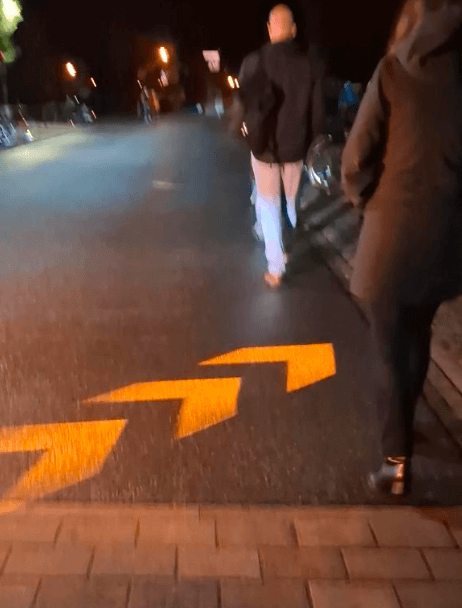
Finally, all participants moved to a less trafficked road to simulate a projecting car’s approach to a pedestrian or bicyclist from behind, about to turn. For the last test, all participants walked slowly on the sidewalk, staring at their smartphones (smartphone zombie behaviour), while cars slowly passed by, displaying direction indicator SRP.
Outcome and Main Takeaways:
• All participants reported a generally positive reaction. There were no reports of distractions or glare, even on wet roads.
• When the regular turn signal is covered, the projection becomes the only visible signal.
• The rear DI projection was also useful while moving forward, especially for cyclists, whose focus is farther ahead than that of pedestrians.
• In the case of an approaching vehicle intending to turn, the DI projection allowed pedestrians to anticipate the vehicle’s approach before the foremost DI became visible.
• For pedestrians walking while staring at their smartphones, the DI SRP was extremely helpful. It draws attention to a potentially dangerous situation involving a turning car, and it was the only visible signal in that moment.
• The 15 km/h limit seems too low.
The GTB would like to thank the GRE representatives, the TU Darmstadt team, and the companies—Audi with Stephan Berlitz, Cupra with Carlos Elvira, Mercedes-Benz with Daniel Betz, and Marelli with Elo Rosenhahn—who sponsored a vehicle to support the UNECE regulatory process.
This testing and demonstration were a significant moment for the lighting community, including regulators, scientists, testing laboratories, consumer protection organizations, and industry representatives. It provided the GRE representatives with valuable information to inform their decision-making.


