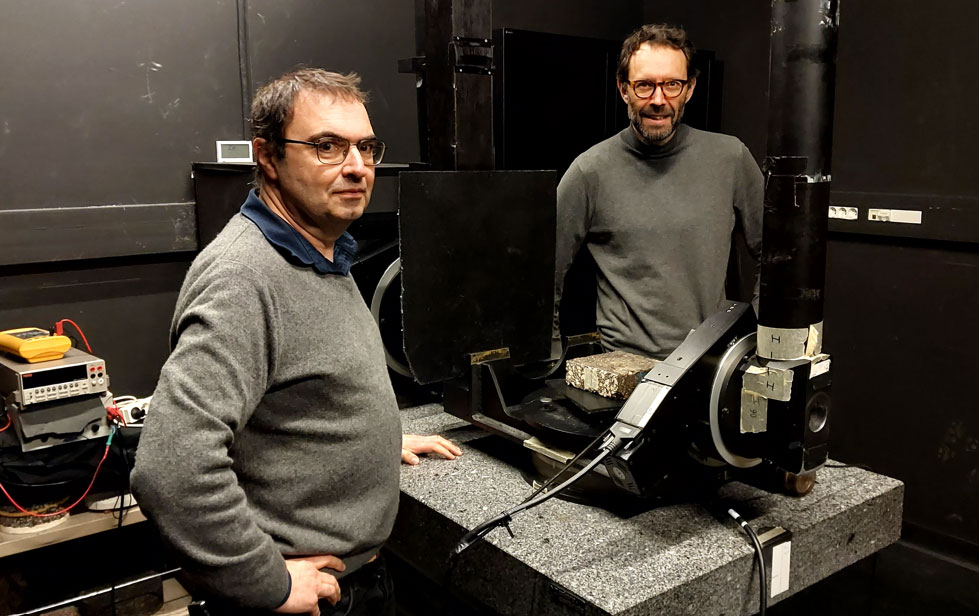
P.H. Matha and J.P. Ravier from DVN visited the PICS-L laboratory in Marne la Vallée near Paris. Located in the Université Gustave Eiffel, a university with 17,000 students and 3,000 people supervising teaching and research. The PICS-L lab is one of the nine laboratories of the CoSys department (Components and Systems). This department was previously part of the former French science and technology institute for transport, planning and networks, under the authority of the French Ministry of Ecological Transition.
The PICS-L laboratory is involved in cognitive psychology (psychophysics, human factors), human vision (visibility, glare, visual attention), photometry (BRDF, lighting), computer vision (simulation of human vision), and computer graphics (image rendering), applied to road safety and urban mobility, with a focus on adverse visibility conditions. Among the research scientists of PICS-L, Roland Brémond and Céline Villa are particularly interested in the performance of fixed road lighting, but they also address vehicle-based lighting.
Bremond is the French representative at C.I.E. Division 4 on Transportation and Exterior Applications of lighting and signalling.
The PICS-L lab welcomes master’s and PhD students and works in cooperation with foreign universities including the University of Bologna in Italy and the University of Queensland in Australia. They are involved in various National and European projects.
In our field of vehicle lighting, they have particularly worked on the subject of glare, among other things with a PhD work completed in 2019, and published ten papers between 2015 and 2023. On the three aspects of glare—disability, discomfort, and eye damage—they have particularly focused their research on discomfort and disability.
They are continuing their research, in particular on the effects of moving light sources, effect of glare for people affected by cataracts, analysis of glare for multisource front lighting and in relation with their size, etc.
For the future, they are interested to work more closely with the vehicle lighting industry in this domain of the effects of glare.
DVN visited their laboratory full of equipment including a driving simulator.

Selected papers on glare from the PICS-L laboratory:
- Brémond et al. (2018). Driving at Night With a Cataract: Risk Homeostasis? Transportation Research Part F 53(2):61-73
- Brémond (2022). Stimulus Range Effect in Discomfort Glare Studies. Light & Engineering 30(5):40-46.
- Girard et al. (2017). Discomfort Glare Caused by Several LED Sources. In Proc. Lux Europa, pp. 212-216, Ljubljana, Slovenia
- Girard & al. (2021). Discomfort Glare from Several Sources: A Formula for Outdoor Lighting. LEUKOS 17(2):108-124
- Girard & al. (2022). Discomfort Glare from a Cyclic Source in Outdoor Lighting Conditions. LEUKOS 18(4):459-474
- Girard & al. (2023). Modelling the Probability of Discomfort Due to Glare at All Levels: The Case of Outdoor Lighting. LEUKOS 18(4):459-474
- Villa et al. (2015). Visibility and Discomfort Glare of LED Road Studs. Lighting Research and Technology 47(8):945-963
- Villa et al. (2017). Assessment of Pedestrian Discomfort Glare from Urban LED Lighting. Lighting Research and Technology 49(2):147-172
- Villa et al. (2017). Predicting the Discomfort Glare Experienced by Pedestrians: UGR and CBE. In Proc. CIE Midterm, pp. 1088-1097, Jeju, South Korea
- Villa et al. (2022). Discomfort Glare in Motion. In Proc. 17th International Symposium on Science & Technology of Lighting, Toulouse, France


