By Hans Joachim Schwabe
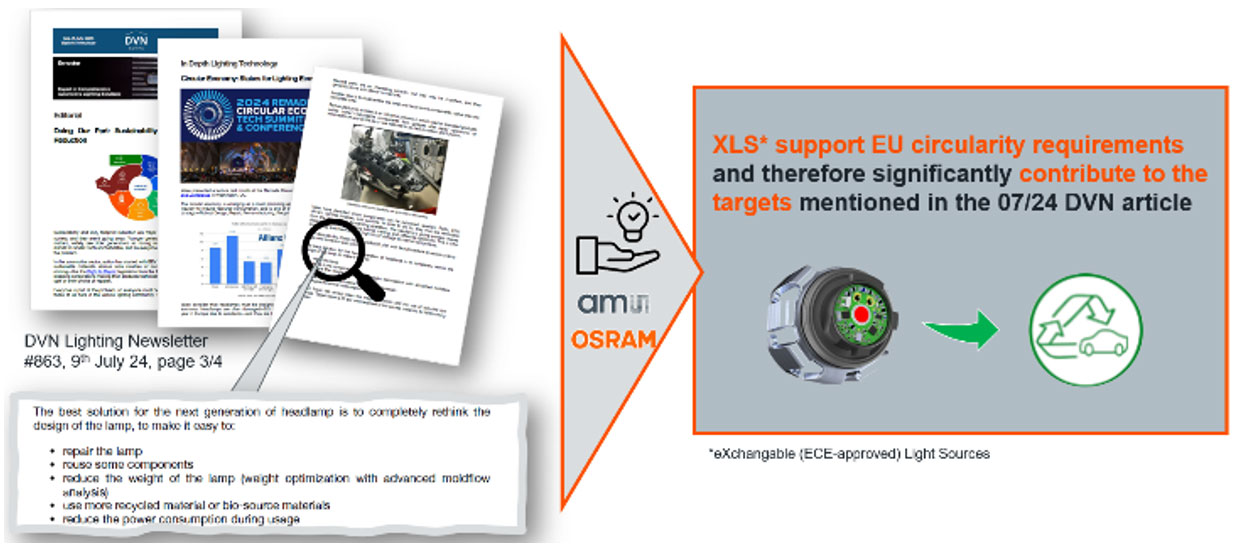
Sustainability and CO2 footprint are major topics for carmakers and the automotive industry as a whole to realize progress for all humanity with regard to climate change. ams Osram have been at the forefront of these discussions, since over a decade ago one element for potential reuse in a circular economy was addressed by their development and introduction of a global LED exchangeable light source (XLS). Replaceable light sources facilitate dismantling of vehicles at the end of their service life, and enable the refurbishing of vehicle lamps, so they can be used as spare parts, thus providing an option to solve the challenges described in the DVN newsletter of 9 July 2024 (Valeo and GM).
Toyota was the first automaker to shape and direct that development by aligning several tier-1 and -2 suppliers to realize this future target. One of the ideas behind this approach was the significant cost of repairing a lamp assembly rather than having to replace the complete lamp. This quickly became obvious after first LED units penetrated the market some years ago, with the emitters being unstandardized components from a point in the fast-moving performance curve according to Moore’s Law. Major drivers of this replaceable-LED technology have been its ability to reduce warranty costs and to offer safe and reliable standard components, thereby avoiding cheap and nasty aftermarket ‘solutions’. From the onset it was clear that this program would only be successful as a globally regulated solution, realizing economies of scale through cost-efficient development and production across global car platforms and car models, with stable, reliable and competitive supply chain across the whole industry, along the lines of the globally regulated filament light sources in good old UN Regulation № 37.

For LED-based replaceable car light sources, UN Regulation № 128 defines mechanical, electrical, and optical interfaces to ensure safe interchangeability. The XLS light sources can reasonably be described as ‘LED bulbs’, but they are a different approach to the LEDification of the vehicle parc than the likes of LED retrofit light sources designed for aftermarket use in lamps designed to take filament bulbs. The XLS family are intended as original-equipment light sources, designed into the lamp from the start, so their application needs to be considered upfront in the (circular) vehicle design phase.
History and product range:
Toyota initiated the global program in 2015 inviting several tier-1 and -2 suppliers to contribute for a global introduction in 2018. Osram were drawn in as an industrial partner by Koito to ensure a global rollout through UN standardization and mass production in one of their industrial plants. The Osram manufacturing site in Herbrechtingen, Germany was chosen, enabling automated production in close alignment with a strong in-house R&D team. So far, the production lines in Herbrechtingen have produced over 60 billion standardized light sources, including incandescent, halogen, and LED ones. The XLS family includes light sources for use in DRLs, front and rear fog lamps and turn signals, tail and stop lights, and reversing lights; CHMSLs, and signature lights.

New ideas include using XLS as light engine for signal projection and 24V applications.
All efforts have been successful to realize a powerful and reliable product generation with consistently excellent freedom from faulty units—significantly below one per million. Following the idea of a circular economy, multiple automakers have decided to integrate XLS as standard light sources in their lamps—unstandardized design elements by necessity. This way, automakers and suppliers have full flexibility in how they design their lamps, but the light sources themselves are removable, replaceable, and standardized.

Osram were awarded a Koito Tech Award in 2019. Business development is ongoing, building out the application base in the U.S. and Europe.
Technical features
The use of a linear driver and a bypass design ensures stable light output even at low and high voltages (6 to 16 V). The design includes temperature derating, making these ‘LED bulbs’ robust across a wide range of temperatures.

The Osram XLS ensures robust EMC design according to relevant automotive standards as well as automaker-specific requirements for radiated and conducted immunity (e.g., ISO 11452), transient immunity (ISO 7637), electrostatic discharge (ISO 10605), voltage variations and overvoltage (ISO 16750) and radiated and conducted emissions (CISPR 25 class 5). Due to the linear driver, the XLS light sources produce zero electromagnetic emissions.

They meet advanced automotive requirements such as 6V stop/start functionality over a wide temperature range, and enable outage detection via open-circuit behaviour < 20mA in failure mode. They avoid false failure detection by ensuring currents > 100mA in operation from 9 to 16 V.

XLS can be used to power both simple and complex vehicle lighting designs as showcased at DVN events like Detroit in June 2024. This includes intricate lightguides with lengths exceeding 1 metre for tail lamps, demonstrating the flexibility and capability of the XLS in meeting diverse automotive lighting needs with the latest high-lumen categories, like LR6 and LW7. The latest LW7 / LWYx front lighting demonstrator will be exhibited at the next DVN workshop in Munich. Of course, XLS lamps can also be mixed with PCBA solutions (mix and match).

The effort to develop a dedicated COB architecture paid off. This technology enables superb thermal behaviour at reasonable product cost, leaving room for further high-lumen packages. It also allows flexible use of LED chips with different colour bins.

Production

It starts with an advanced COB, where single LED chips are bonded onto the PCB with linear driver electronics. The core element here is precise adjustment of colour steering and luminous flux.

The integrated production even contains the phosphor conversion material, allowing customized colour adaptions on request. 100-per-cent inline inspections supported by AI-based tools ensure zero defect at maximum yield with full traceability over the value chain.
Automated inline moulding machinery can realize all types of the XLS family with different connectors.
Outlook and Conclusion
With the growing trend towards circular design, we expect a wider distribution of Osram XLS. All seven points of the EU circular economy graph are addressed.

The existing trend towards further cost reduction without decrease in performance requirements like start/stop capability, top level EMC and reliability will remain. To cover the latest styling requests, LR6 and LW7 will provide increased luminous flux, LWYx enables combination of white DRL and amber turn signal with one light source, while an LR5 variant with deep red colour can address premium design demands.
To enable future plug-and-chug standardized light sources for software-defined vehicles, Osram propose to streamline communication protocols for exterior lighting. Such a standardized protocol could perfectly be implemented into future XLS generations with a dedicated ASIC solution.
Furthermore, Osram see the possibility to install re-tested or fresh XLS light sources into exterior lamps as a perfect lever to give a warranty to spare parts dismantled from ELVs.


