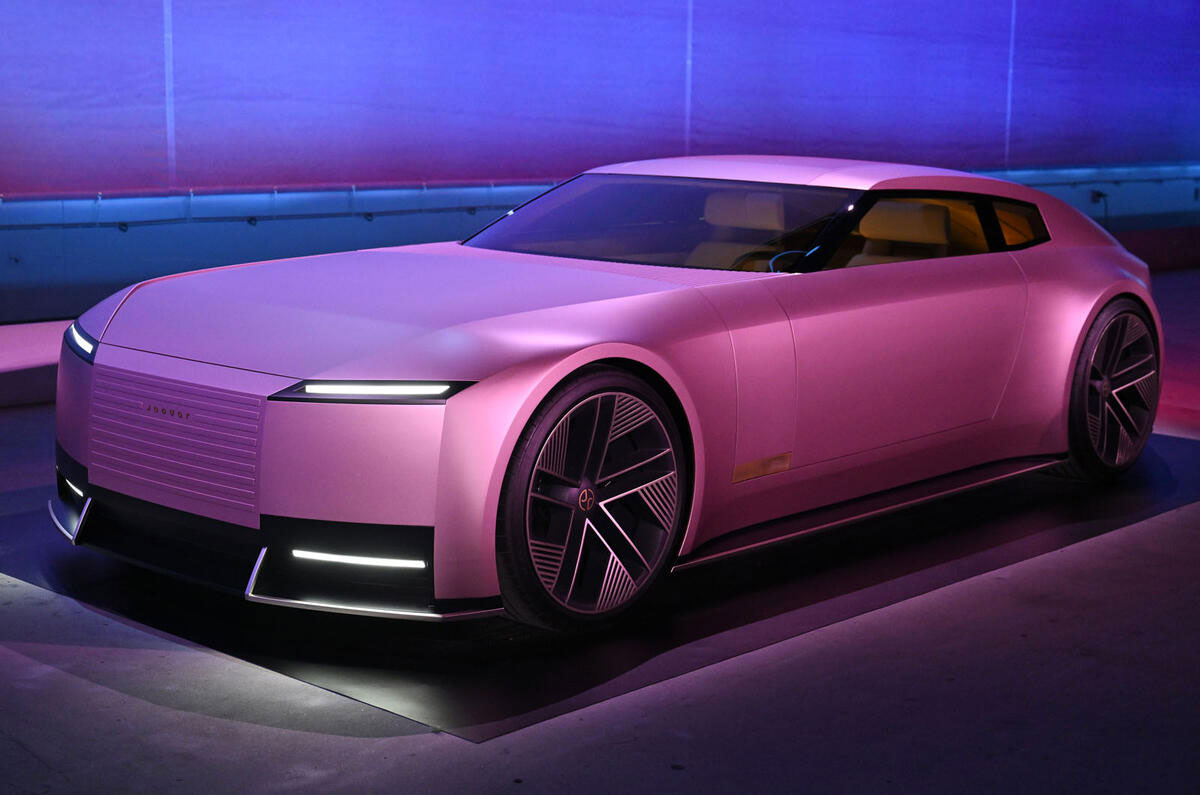
By Paul-Henri Matha
I have read so many articles about Jaguar’s new brand strategy since November! Me, I really like it: a simple design; less is more.
When I was working at automakers, it was part of my job to analyse concept cars for commercialization potential. Which technology should we develop? is this design legal or not? So, I tried to think about this Jaguar concept in those terms.


I think the front is feasible. The upper lamp between hood and bumper seems to be the area for low beam, high beam, and ADB. Really thin modules, super slim design. Can we fit here an HD module with minimum height 35mm? I do not think so, and I do not really see any other places for such hardware.
MLA technology, including ADB, would fit perfectly—and low beam homogeneity from a pedestrian next to the car would be perfect.
Pedestrian head impact seems to be ok (head will hit the hood), overhang seems to be ok (the back of the lamp is not in the wheel).
The DRL, turn indicator, and position lamp seems to be very low. will they meet the 350-mm minimum height for position and turn signal lights in UN Regulation 48, or the 381 mm minimum height in MVSS 108? Speaking of which, front side marker lamps and reflectors are missing.

About the rear, I really like this design with two slim lines. But is it possible to do such a design? In UN Regs, it cannot be the position lamp (only one line can be, due to the 75mm rule and the 60% rule). But in USA it may be ok (needs 41 or 56 cm between the two lit areas, depending on whether this is a 2- or 3-lighted-section design). It may be also an auxiliary lamp
If these lamps are on a movable component like a trunk lid, it is not possible. You’d need another lamp in the bumper, or behind the lid (visible when the trunk is open).
Now, do these meet the width requirements for lamps? UN Regulation 48 requires that the outermost extent of the lit area be no more than 40 cm inboard of the extreme outer edge of the vehicle. The North American regulations require that the lamps be “as far apart as practicable” (where “practicability” is determined by the automaker, not by any criterion in the regulations). And in North America, stop and rear turn signal lights must have at least 50 cm2 lit area—maybe not so easy with this design.
So, will this design remain the same in mass production? Can it? We will see soon, I hope!


