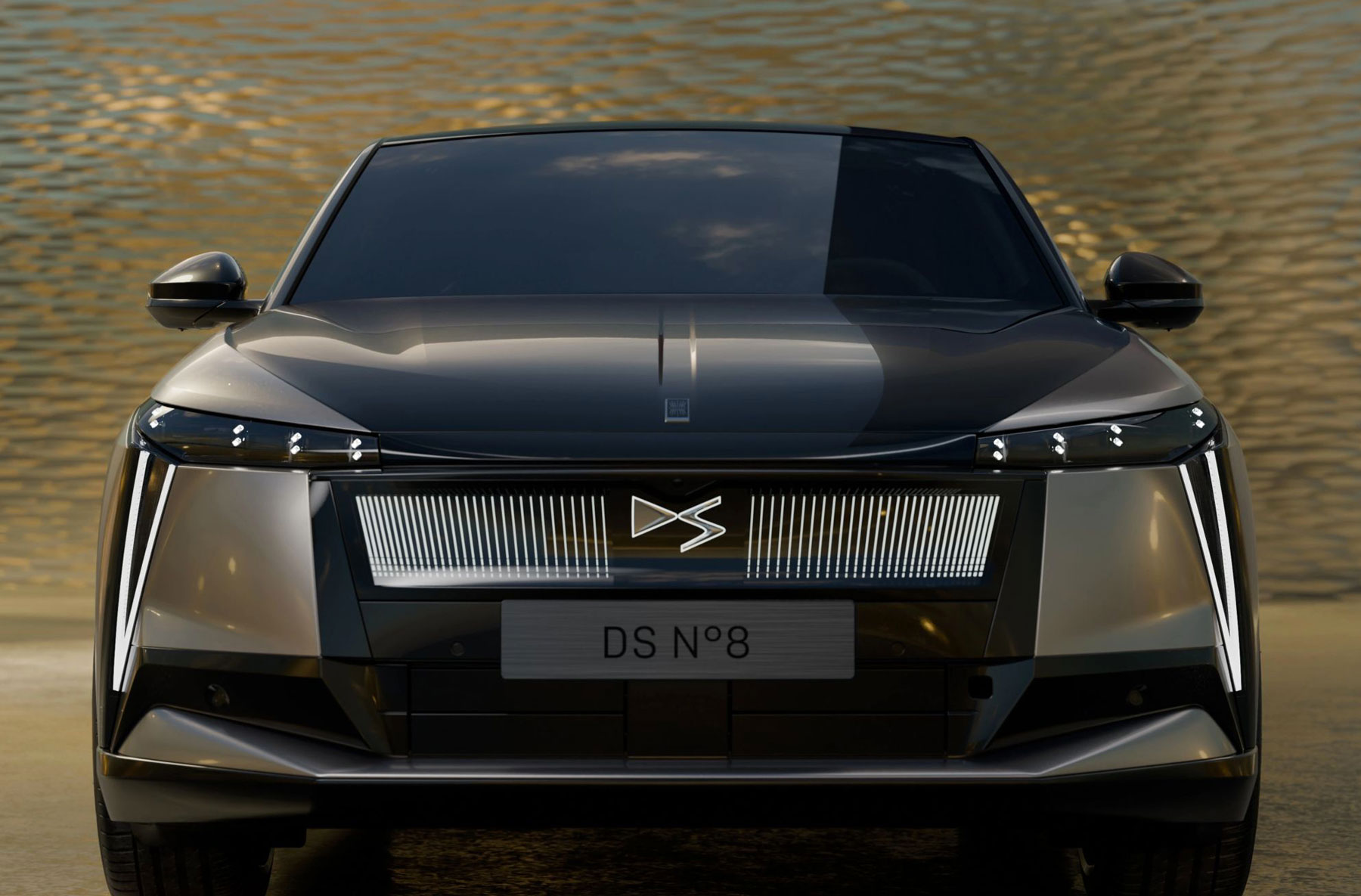
DS has just revealed the № 8, the brand’s new top model (replacing the DS 9). The new car presents a spectacular light signature. At the front, there’s a ‘Luminascreen’ illuminated grilleboard, lit up with vertical lines and DS’ first illuminated logo. Flex-N-Gate are producing the grilleboard, as well as the car’s tailgate. This luminous signature was made possible by technology developed for FnG’s Flex Vision concept.
The headlamps, comprising three modules, are outlined by eight LEDs in a Clous-de-Paris pattern, echoing the interior trim’s embossed finish.


The DS Lightblade completes this signature. This layout, which first appeared on the DS E-Tense Performance technology study, visually emphasizes the car’s width. The lightblade is vertical, in line with all DS models. Integrated into the side curves of the bumper, it contributes to the car’s aerodynamic performance by minimizing airflow disruption up to the front wheels.
The № 8 is the first DS model to present a vertical light signature at the rear. Directly inspired by the DS Aero Sport Lounge, it echoes the vertical signature at the front to make this car instantly recognisable at night, at any sight distance. 3D scale patterns fill the interior of the tapered horizontal rear lights.
DS Automobiles Design Director Thierry Metroz says the car “combines the best of both worlds: charisma with a strong front and rear identity, and elegance visible in the purity of its fastback profile, emphasized by a flowing and continuous roofline to the tailgate. The designers envisaged the evolution of SUV coupés, illustrated by an efficient, elegant shape with a spectacular and high-tech light signature”.

Aerodynamic performance is optimized by the front DS Lightblade, which slices through the air like a boat’s prow for a 2 dm2 savings (+ 8 km WLTP and +10 km on the motorway). The rear DS Lightblade optimized airflow detachment like an airplane wing for a 1 dm2 savings (+ 4 km WLTP and +5 km on the motorway).

As for lighting performance, the № 8 has DS Pixelvision, which incorporates adaptive lights, swivelling main beam, cornering lights, and ADB to provide the best driver vision.

The carhas a high beam booster, which provides more intense illumination in the centre of the high beam. This mode is automatically activated when speed on a straight road reaches 80 km/h. In these conditions, lighting range is extended to 520 m. Between 40 and 70 km/h, depending on steering wheel angle, an additional light beam illuminates the side of the road.
The low and high beams adapt to illuminate the inside of a road bend by following the car’s trajectory regardless of its speed. DS Pixelvision operates in several modes, triggered automatically, to adjust the light beam depending on driving conditions: city mode, country mode, motorway mode, rain and fog mode.
DVN comment : We can also notice how lighting regulation interferes with exterior designer. DS № 8 fully respects UNECE R48 rules for front position lamps (maximum 3 lamp units per side and 75mm between each lit area).
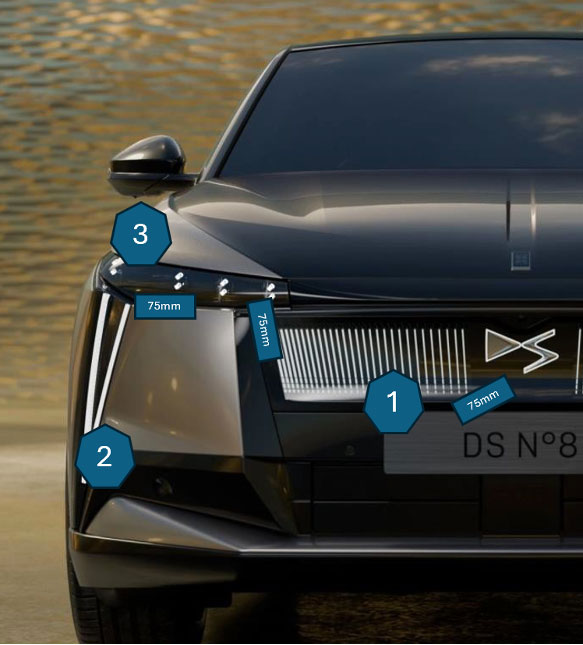
Extract of UNECE R48 for this sort of design including “interdependent lamps” :
2.4.12. “Interdependent lamp system” means an assembly of two or three interdependent lamps providing the same function.
5.7.2.1.(b) The minimum distance between the facing edges of two adjacent/tangential distinct parts of the apparent surface in the direction of the reference axis shall not exceed 75 mm when measured perpendicularly to the reference axis.


