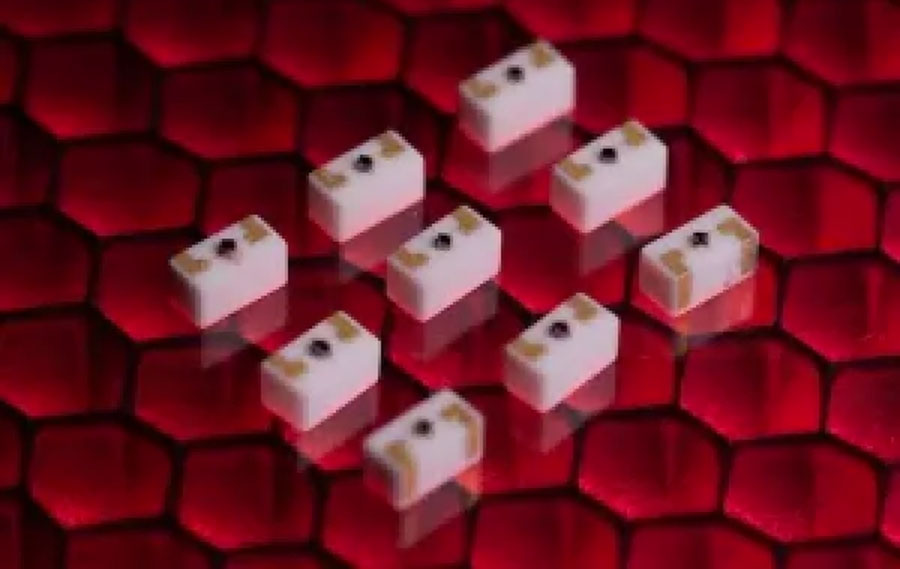
UK startup Phlux Technology has launched their first family of avalanche photodiode (APD) infrared sensors using a high sensitivity technology.
The Aura family of 1,550-nm devices use the noiseless InGaAs APD technology developed by Phlux, with 12 times the sensitivity of other sensors, while being a drop-in replacement. The increased sensitivity of the drop-in sensors improves the operating range of lidar, laser rangefinders, and optical-fiber test equipment up to 50 per cent with existing surface mount or TO-packaged footprints.
Phlux created their noiseless InGaAs APD technology by adding an antimony alloy to the compound semiconductor manufacturing process. The resulting sensors can be operated with APD gains up to 120, enabling even the smallest signals above the noise floor of a connected trans-impedance amplifier (TIA) to be amplified. A further benefit of Aura APDs is their rapid overload recovery, which means that weaker secondary pulses that closely follow a large pulse can be detected.
The Aura sensors enable 12× greater lidar image resolution for a given laser power, up to 30 per cent reduction in system size and weight, and up to 40 per cent lower system costs. The size and cost reductions come from using lower-power lasers and smaller optical apertures without degrading system performance. Thermal management is simplified because Aura APDs operate at up to +85 °C without performance degradation, which is a significantly higher temperature than traditional parts.
Phlux CEO Ben White says, “Our Noiseless APD technology is a step-function leap in performance and provides tangible benefits for any company involved with 1,550-nm lasers. Automotive lidar is an exciting application where the move from 905-nm to 1,550-nm lasers is accelerating, not least because the latter is ‘eye-safe’. But there are also huge opportunities for our products in telecommunications, laser rangefinders, imaging, spectroscopy, gas sensing and optical fiber test equipment, particularly optical time domain reflectometers”.
The Aura APD 200 (200-µm optical aperture) and Aura APD 80 (80-µm optical aperture) sensors are available as bare die or in industry-standard SMD, chip on sub-mount, and TO-46 packages designed to meet MIL-STD 883.
Typical parameters for both devices are responsivity of 0.98 A/W at 1550 nm, spectral range of 950 to 1,700 nm, and excess noise factor of 1.86 at an avalanche gain of 40, or 1.08 at an avalanche gain of 10. At a gain of 10, the noise equivalent power for the Aura APD 200 diode is 17 fW/Hz0.5, its capacitance 2.4 pF, and its cutoff frequency 0.7 GHz. The equivalent figures for the Aura APD 80 are 11.1 fW/Hz0.5, 0.6 pF, and 1.8 GHz. Both devices have an operating temperature range of -40 to +85 °C.
DVN comment
This company is developing new infrared sensor technology that could transform the performance of laser range finders, lidar systems, and fiberoptic telecommunications test equipment. They’re based in Sheffield, England, and they have large experience in InGaAs photodetectors. Their adaptation of APD sensors to a large light spectrum (950 to 1,700nm) with high sensitivity suggest that they can apply their technology to a wide range of lidars.


