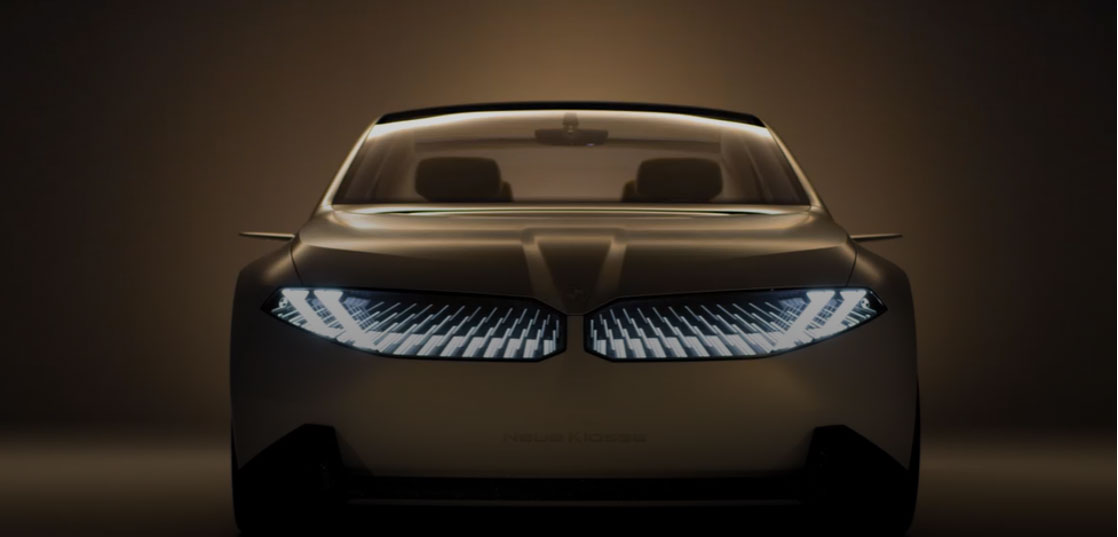
In an online article, BMW explain the lighting concept of their Vision Neue Klasse concept. Light is considered as a central element, day and night, and brings the vision vehicle to life.
Light Design Project Lead Tom Binder talks about the car’s groundbreaking lighting design and its basics principles: clarity and expressiveness. He explains BMW lighting design evolution over the decades, for example from the round pairs of headlamps to the iconic “Angel Eye” parking light rings, always striving to intensify the closeness between vehicle and driver. Modernised, reduced and yet highly emotional, the characteristic four-eyed face remains present in the concept car’s front and rear lights.
Depending on the time of day or season, the location or the journeys already made during the day, the car will use artificial intelligence and an understanding of user behaviour to recognize which scenario is appropriate at any given time. The spectrum ranges from eye-catching light animation with matching sound effects to gentle and unobtrusive understatement. The designers’ art lies in offering the greatest possible customisation options while at the same time preserving the elements typical of a BMW brand, such as the kidney shapes and the four-eyed face.
The different lighting scenarios are able not only to greet different drivers individually and thus show that they’ve been recognised (and signal that the car is adopting that user’s preferred settings and configurations), but also to display a variety of information. For example, a glance at the vehicle makes it immediately clear whether it is charging. In addition to the normal functionality that a headlamp must fulfil, this type of communication between people and the vehicle, the fusion of the physical with the digital, is a completely new function of lighting. The car has the opportunity to signal that it perceives and understands people and their needs.
A reminiscence of the slats of a radiator grille is formed by individually controllable lighting elements that enable an impressive three-dimensional depth.
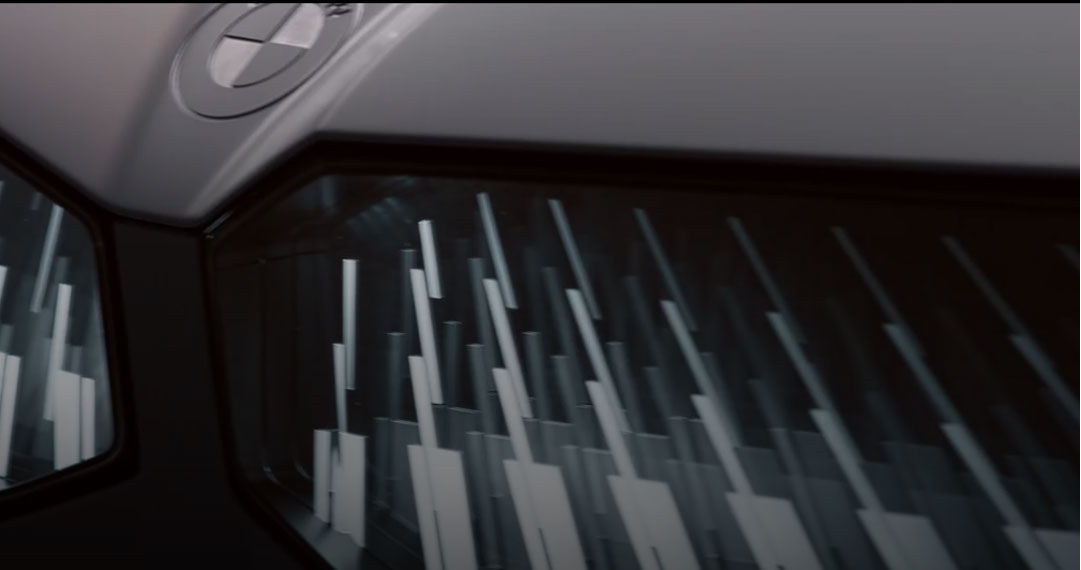
The technology behind the laser light, in which semiconductor laser diodes meet a yellow phosphor reflector in the blue area to create a point of light as bright as the sun itself, has been adapted in the BMW Vision New Class to activate new flat elements with light using laser wire and phosphor technology. Supposedly floating design elements suddenly turn into light sources.

A patented approach makes it possible to distribute 3D-printed lighting elements on different levels and control them in a targeted manner.
The integration of artificial intelligence and smart technologies is essential in the world of tomorrow. It is also the demand for durability, repairability and ultimately recyclability. LED and laser technology are designed to last the life of the vehicle, and thanks to digital technology, new lighting functions can also be added after the vehicle is sold and on the road, so users can stay for the long term in the race to keep ahead of their neighbours.
Today, the collaboration between the various areas of vehicle development at BMW has reached a new level of integration. Vehicle design, lighting design, sound design– all of this happens hand in hand. Designers and engineers work together to bring each other’s ideas to life.


