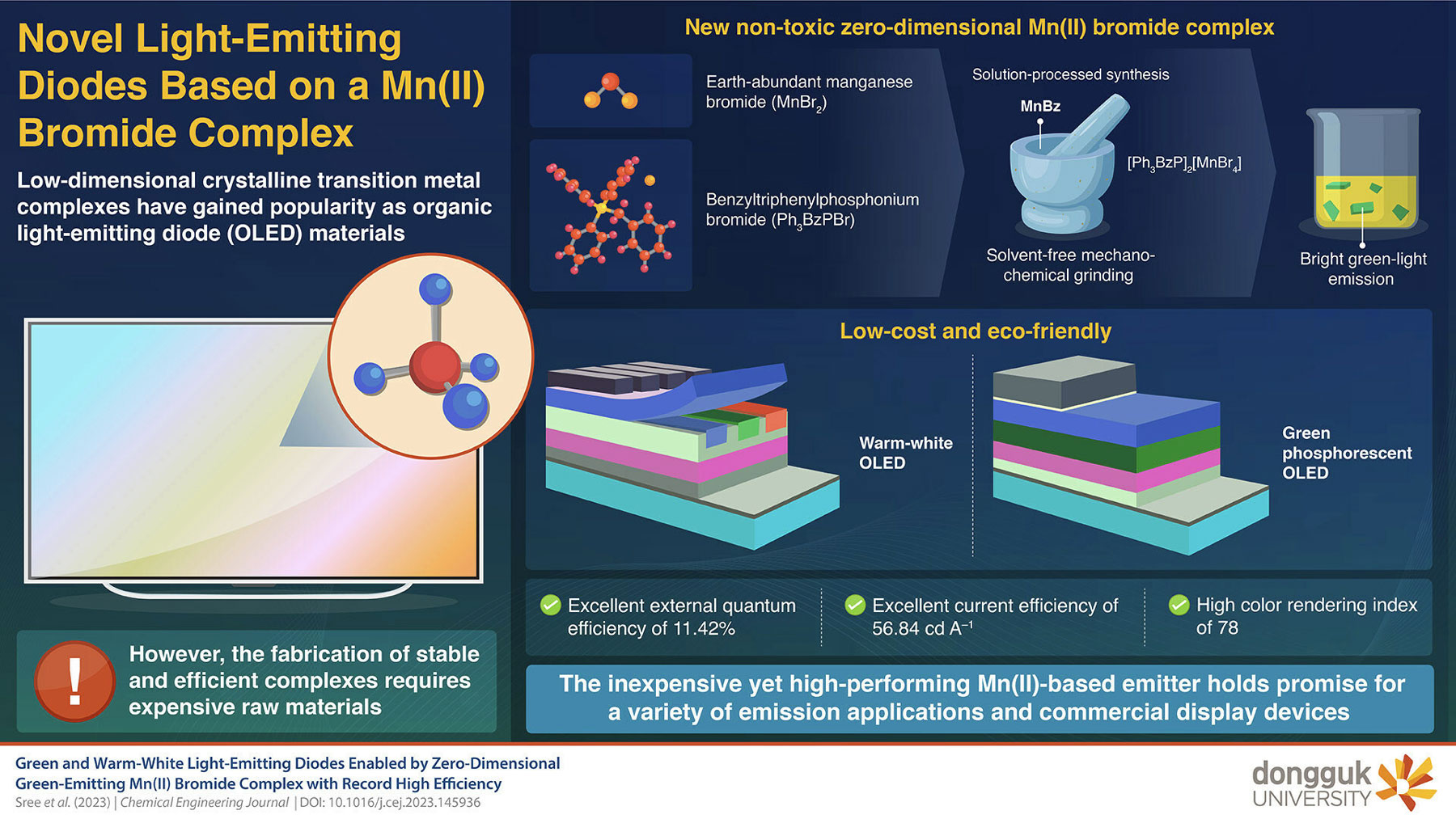
Scientists at Dongguk University, Seoul, Korea, have developed a new environmentally friendly and cost-effective bright green light-emitting manganese complex called MnBz for OLEDs. The material was used to fabricate a first-of-its-kind Mn-based white OLED device and a green OLED device with record high efficiency.
However, while the fabrication process of such LEDs itself is low-cost and simple, the raw materials used during solution process often include precious and expensive metals such as rare earth metals, driving up the fabrication costs.
Studies have shown that low-dimensional complexes of earth-abundant transition metals could be the key to solving this problem. To develop a promising solution using this approach, a team of researchers led by Assistant Professor Vijaya Gopalan Sree from Dongguk University recently attempted to synthesize zero-dimensional manganese (Mn)-based complexes for OLEDs via solution processing. In their recent breakthrough published in Volume 474 of the Chemical Engineering Journal, the team has laid out the strategy for fabricating a bright green-light-emitting Mn (II) complex MnBz, which was further utilized to design a first-of-its-kind warm-white OLED device.
“Replacing expensive rare earth metals like gold and platinum with crystalline earth-abundant transition metal complexes can help achieve lightning solutions or displays that are cheaper yet bright and vibrant,” says Dr. Sree, talking about their motivation to explore new materials for OLEDs.


