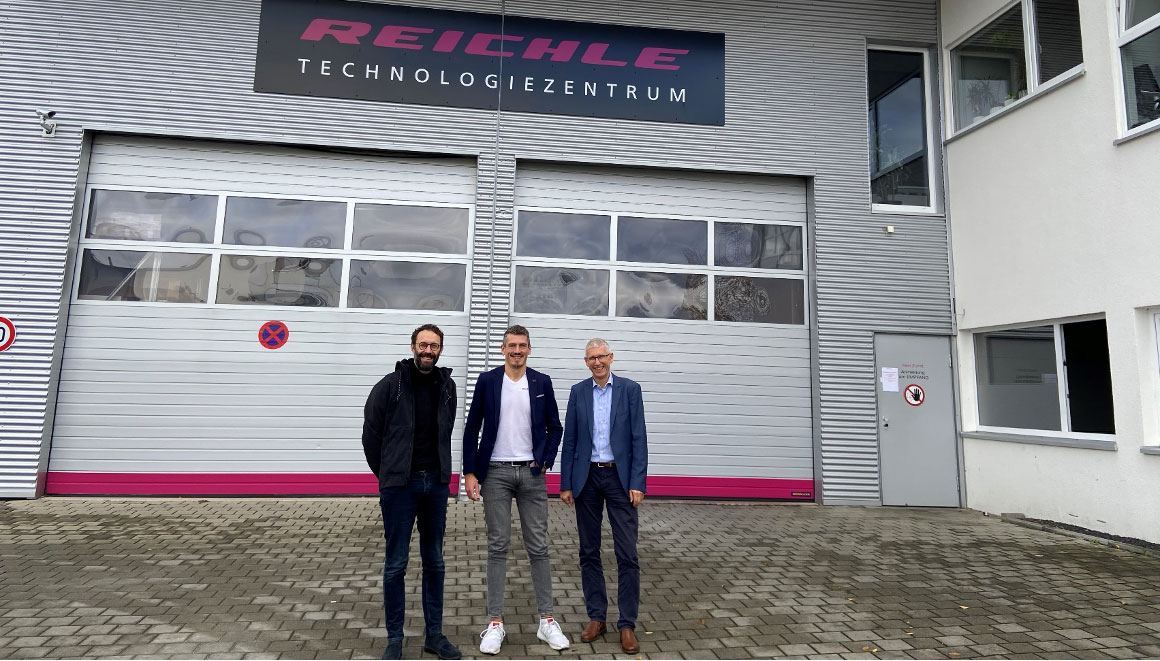
At the end of November, Paul-Henri Matha and Gerd Bahnmüller were invited to Reichle Technologiezentrum in Bissingen an der Teck in the southwest of Germany. They’re Europe’s leading service provider for laser texturing. Marco Reichle, who is the second generation to run the company together with his sister Marina, gave us a very interesting insight into the history of the company, and an in-depth look at their state-of-the-art laser technology.
The company was founded by Volker Reichle, Marco and Marina’s father, in 1981. It started out as a small engraving studio with a focus on manual engraving and milling, but soon expanded into a company with a broad range of services in mechanical processing. Today, Reichle offer expertise and innovative solutions in repair of cast parts; laser- and CNC-engraving and milling, laser- and TIG-welding, high-gloss polishing and contour restoration, grain repair and gloss level adjustment, laser texturing, lighting development, and they have an in-house design and R&D centre.
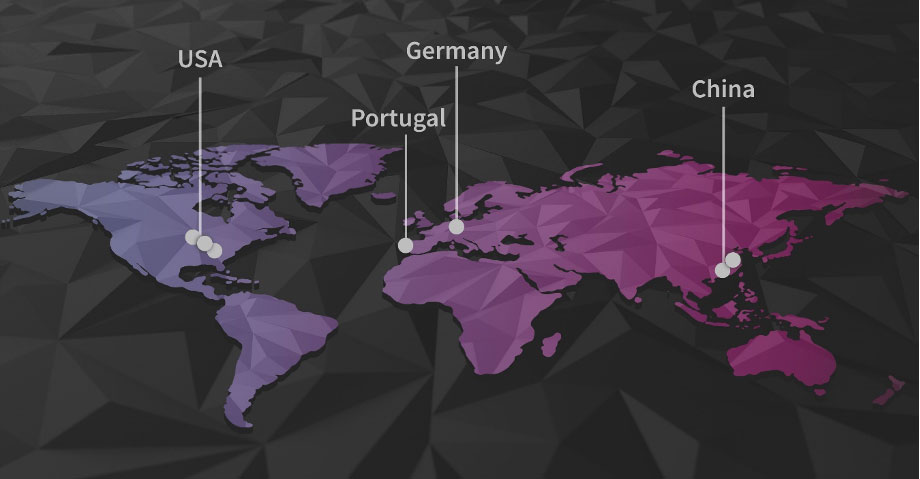
The company’s speciality of laser texturing as one of their main services deserves special attention. In 2012, they invested in their first laser texturing system, and decided to completely discontinue traditional chemical etching only one year later—a bold move, considering that etching was common industrial practice at the time. As a pioneer in laser texturing, the first few years were challenging and required a lot of perseverance. Their continued confidence in the technology paid off, and Reichle now are the largest service provider for laser texturing in Europe, with more than 20 laser machines in Germany alone. Even beyond Germany, the company have built up a global network with cooperation partners in Portugal, North America, and China, bringing the total number of laser processing machines to more than 45. Project management, R&D, design, consulting, mapping, and programming are done in Germany, ensuring the highest quality even far away from headquarters.
State-of-the-art laser technology allows the realisation of conventional blasting, etching, and eroding structures as well as modern 3D design structures, and the Reichle team strive for innovation and progress. From geometric textures, functional structures, fade-outs and morphings to textile and leather grains in complex geometries, the development of fascinating surfaces is always a welcome challenge for their Advanced Design and R&D Centre.
In comparison to other technologies like etching, blasting or EDM, laser texturing offers advantages including very short lead times; highest precision; sharp edges between high-gloss and grained areas with no blasting needed; 100-per-cent digital process for reproducible results with no manual work; matte gloss levels in all plastics; no differences between moulds and different plastics, and the list goes on. It is a sustainable process, too, with no harmful acids.
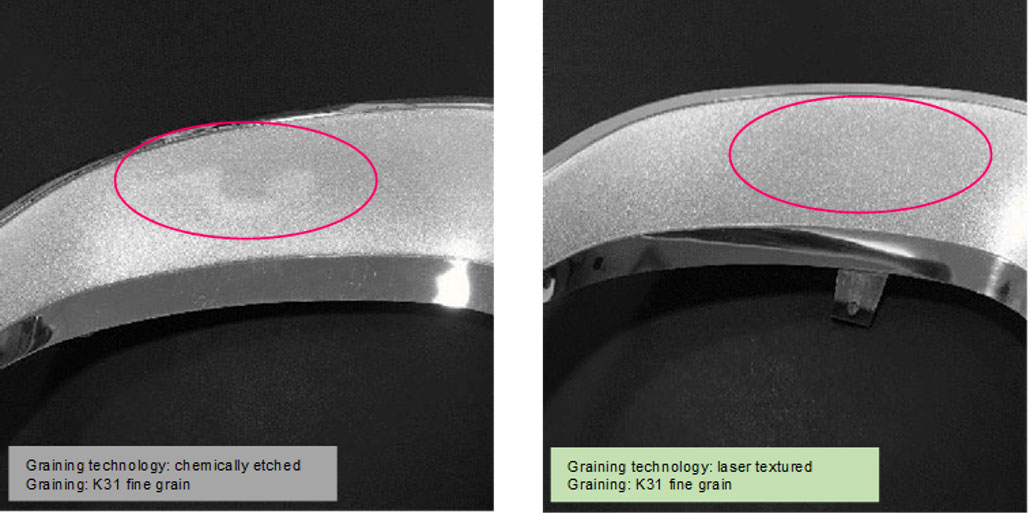
Existing etched graining was polished out by Reichle and re-textured by modern laser technology. Surface defects, shrink marks, and shiny areas are no longer visible


Different tools on the world’s largest laser texturing machine (axis movement 4 × 3 × 1.5 m)


In 2021, the company entered the field of lighting development and femto laser technology, the most precise laser technology in the world. Such a laser emits pulses on the order of one femtosecond (10−15 second, that is one quadrillionth of a second, or 0.000,000,000,000,001 second). The main advantage compared to conventional laser texturing is cold ablation. This prevents burr throw-up and thus allows the introduction of fine and detailed geometries, holograms, colour effects in metals and plastics, engravings without depth, high surface finishes and much more. See the difference between conventional laser texturing (upper row) and femto (lower row):


Due to the special features of femto-laser technology, materials such as ceramics, plastics or even challenging materials such as sapphire, nickel, titanium and many more can be processed in addition to metals. Depending on the application and customer requirements, this opens up possibilities for prototyping or working directly in plastic, in addition to the sharp-edged and vertical geometries.
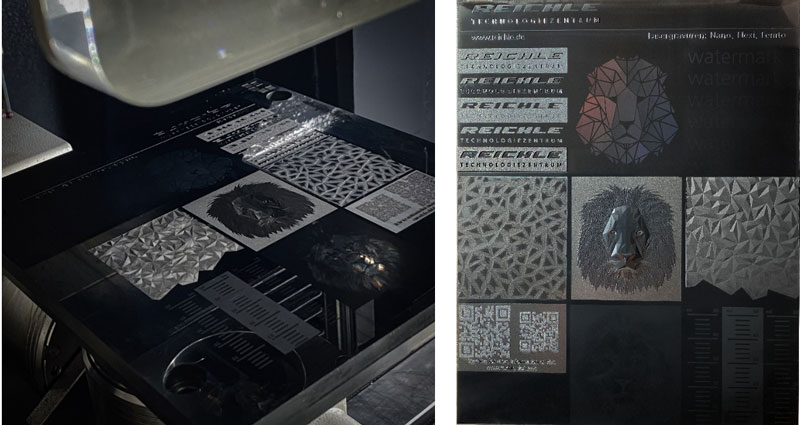
This technology is a groundbreaking innovation in devising microöptics for the likes of daytime running lights, diffusers, light incoupling and outcoupling structures, light guide structures and more, which the femto laser can realise with unprecedented precision and homogeneity. In addition to the manufacturing advantages such as maximum precision and process reliability, it can also reduce deviations between a light simulation, prototype light guides, and series components to a minimum. That significantly shortens a customer’s development time, and also improves efficiency.
With their lighting partner network, Reichle are also continuously working on innovative technologies to elevate the combination of laser texture and lighting systems. Two of their most recent projects in this area include partial transillumination of surfaces and a one-of-a-kind transparent lighting technology.
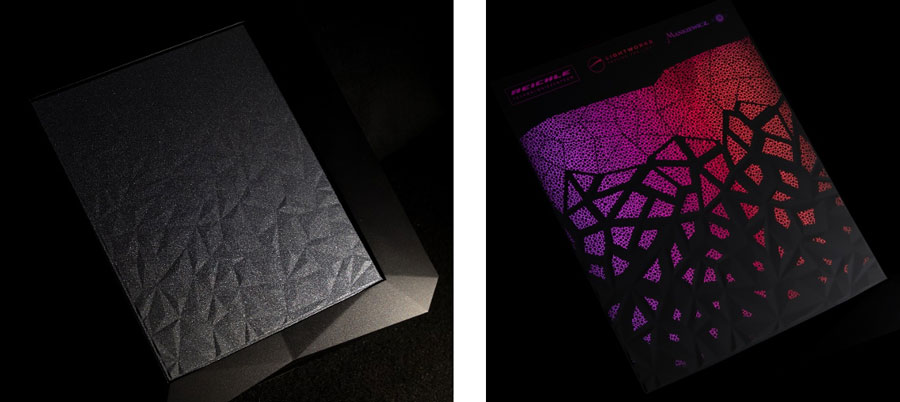
Partial transillumination of 3D-textured surfaces is the focus of the Day-Night Design 2.0. It can completely conceal structures when the lighting is switched off, and emphasise them when the lighting is on:
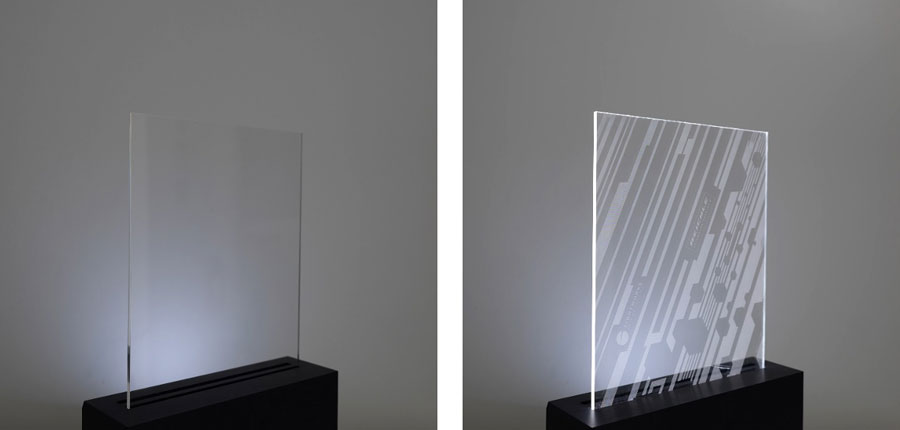
Their Hyperion transparent lighting technology is based on light outcoupling optics so precise that they are almost invisible on transparent plastic when the light is switched off, but form a homogenous surface light guide when illuminated.
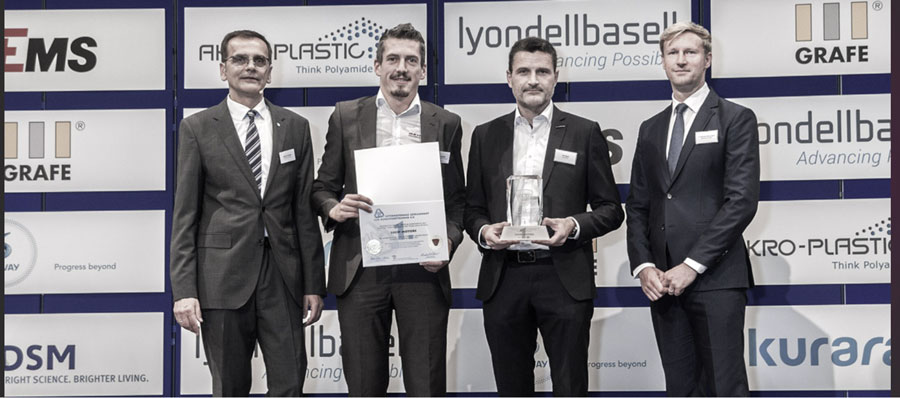
Reichle Technologiezentrum have accumulated an extensive client base with well-known automakers and tier-1 suppliers—over 1,000 companies worldwide. The company history of Reichle shows that Marco Reichle’s team is full of ideas and innovative drive to attract attention and custom in the automotive industry. As an example, Reichle got in 2021 the SPE Central Europe Automotive Award for innovative plastic parts and components.
Extract from news piece about the award:
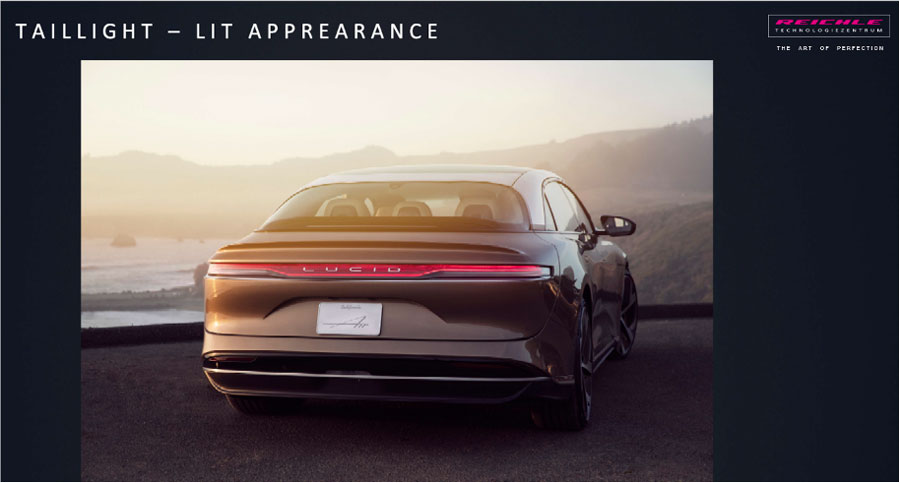
Together with the US automotive company Lucid Motors, which specializes in electric vehicles, the Reichle Technology Centre and lighting technology specialist Hella have developed this award-winning rearlight for the Lucid Air.
With its dimensions of approx. 1.80 × 0.5 m and a two-metre-long cover lens, the vehicle’s pioneering one-piece rearlight is characterized by its enormously narrow and efficient design. Due to its unusual shape and thus highly sophisticated design, the Reichle Technology Centre developed special light outcoupling optics together with Hella, which could be lasertextured into the injection moulds of the lights thanks to the latest laser technology. A special micro-optics system ensures light outcoupling, while the light guide optics enable extremely slim light surfaces and a 3D depth effect. The high level of homogeneity created in the light imaging not only ensures a very aesthetic experience, but is also extremely efficient in terms of energy consumption.
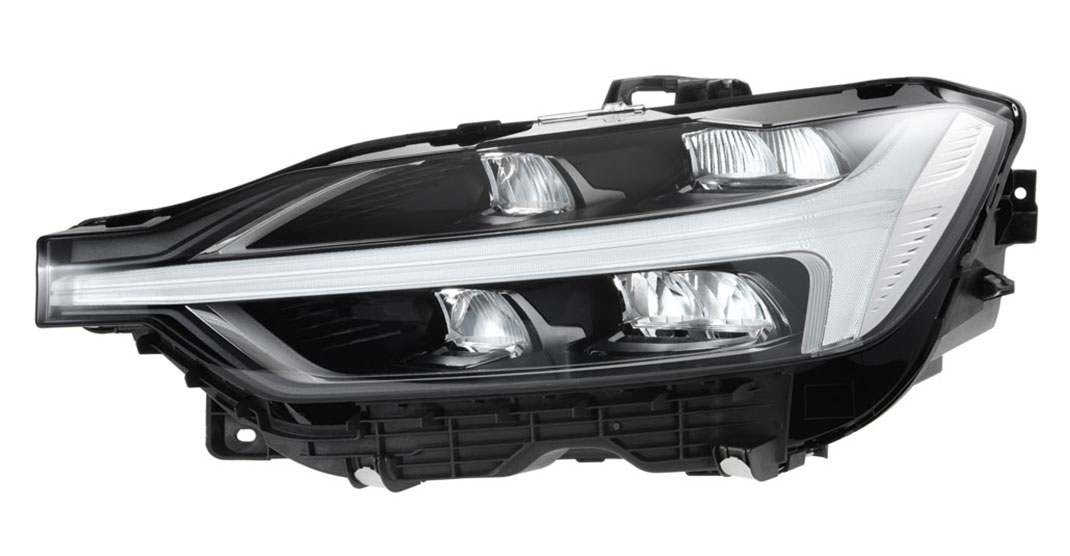
ZKW is also working with Reichle to develop the laser graining structure for optical elements on Volvo Thor’s Hammer xc40 and xc60 headlamp


