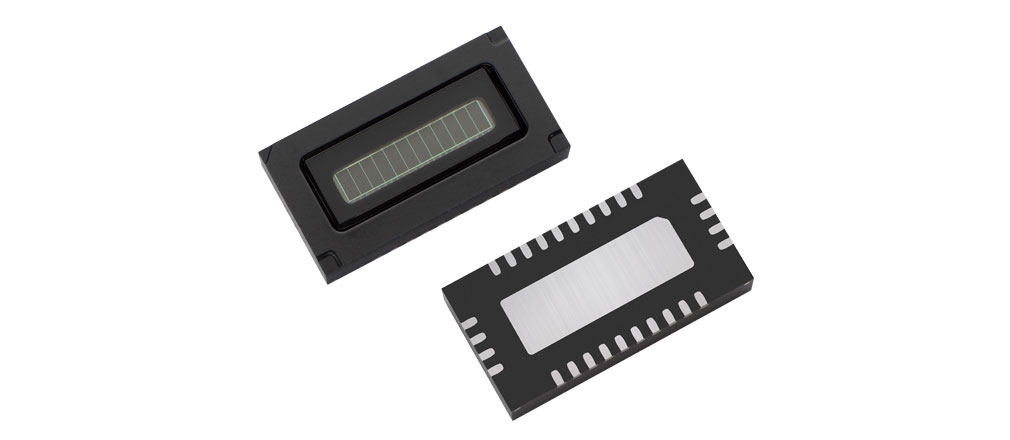
Silicon photomultipliers (SiPM) are highly efficient light sensors that confer single photon detection capability on the receiver. SiPM-based lidar offers a remarkable signal-to-noise ratio (SNR) advantage over other kinds of sensors, such as avalanche photodiodes (APD). A SiPM’s high internal gain and fast response time allow higher detection probability of low-reflectivity targets at long distances. This significant improvement is achieved without the need to increase the outgoing laser power requirement, thereby reducing system power requirement and thermal management burdens.
Furthermore, this better SNR is achieved using a smaller aperture—a smaller optical lens—to maximize light collection, compared to the wider aperture required by APD. This means the physical system size can be reduced, which is helpful where constraints apply to the physical design and dimensions of the lidar system, a perpetual condition in vehicle applications.
Other SiPM benefits include low operating voltage and low sensitivity to temperature. These are especially important in automotive applications where the lidar environment can be >85°C. SiPMs are based on standard silicon processes that enable low-cost device production with excellent device uniformity. These benefits can help simplify the lidar design complexity while maximizing performance and reducing cost.
Comparing the relative performance of APD- and SiPM-based lidar systems, with a common set of system-level requirements, shows the operating voltage of SiPM is significantly less than that of APD; device-to-device performance is uniform, and bias voltage variation with temperature is typically 25 mV/°C. Due to its high internal gain, the performance of the SiPM-based lidar system is much less dependent on readout electronics performance. The SiPM readout can accommodate two orders of magnitude more electronic noise compared to the APD readout. And with four orders of magnitude higher gain, SiPM system can work at a much higher bandwidth; this allows more precise depth calculation and increased scanning speed. Thanks to single photon sensitivity, a SiPM-based system requires—on average—one order of magnitude less return laser power to reach the same detection probability as an APD-based system. This improved detection capability can lead to increased ranging capability or decreased laser power requirement, or a mix of both.

Detection probability as a function of background light and laser return power calculated for Si APD (left) and onsemi next generation SiPM device (right) lidar systems. The red threshold shows the detection probability of 90 per cent with false positive probability of 0.1 per cent for SiPM and APD based lidar systems.
A typical requirement is for the lidar to operate under 100k lux, corresponding to the ambient light level on a bright sunny day. Due to its high sensitivity, the SiPM sensor may be saturated if exposed to very high light levels. This would be a problem if saturation due to ambient light prevented detection of an object. The SiPM-based system can be designed to operate under 100k lux ambient conditions by employing a narrow bandpass filter combined with a small aperture lens and a narrow angular field of view. These design solutions align well with existing trends in lidar system requirements i.e., miniaturization (small lens diameter) and high angular resolution (small angular FoV per SiPM).

DVN comments
SiPMs are capable of detecting low intensity signals of individual photons so they offer high sensitivity, making them suitable for applications requiring accurate detection of low light levels. Other advantages are high temporal resolution, wide dynamic range, low operating voltage, compactness and robustness, and relatively low cost. These advantages make it an attractive technology for a lidar’s receiver stages.


