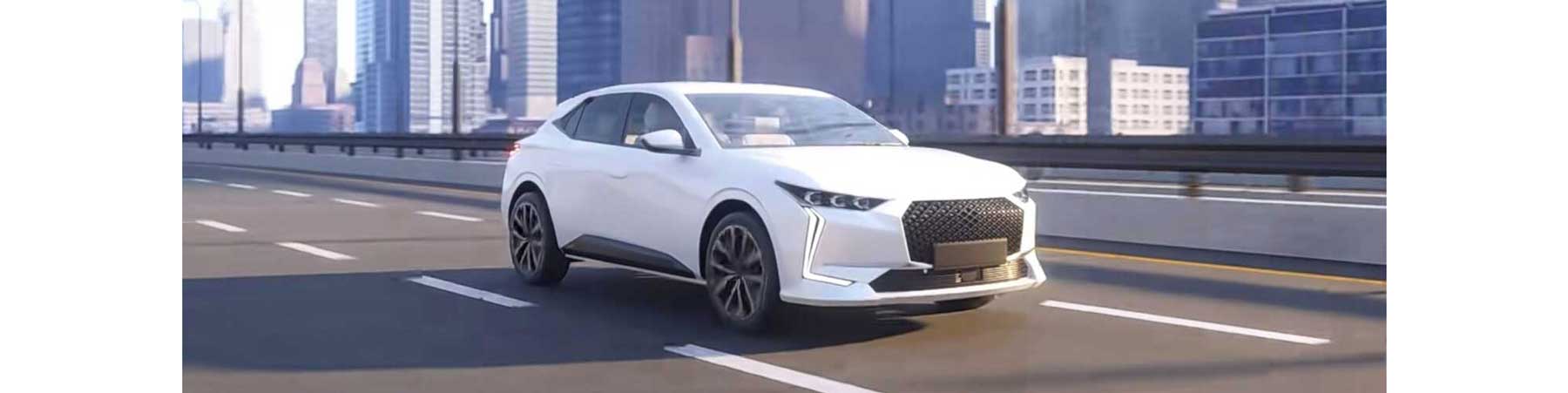
Hesai’s new ET25 lidar is placed behind the windshield, enabling a sleek vehicle design that covers practical functionality without affecting aerodynamics. However, it is inevitable for lidar to produce noise during operations. This effect is particularly noticeable in electric vehicles, where even a slight squeaking sound can become very noticeable. Therefore, the NVH requirements for in-cabin lidar solution are also tighter. The ET25 has a noise level of less than 25 dB(A) during operation; the driver can hardly perceive it.
To minimize the vibration of moving parts during operation, the ET25 was designed to achieve extreme balance with its internal components, distributing its mass evenly. By adjusting the internal architecture, dimensions, shapes, and other design elements, the scanner’s centre of gravity is positioned as close to the axis of rotation as possible. This helps minimize deviation errors, effectively suppressing imbalanced vibration and resonance. As a result, both noise and vibration levels are significantly reduced.
In addition, the interactions between internal lidar components, and the interactions between the lidar casing and the vehicle body, can contribute to the formation of resonance, resulting in an adverse NVH experience. Hesai used modal analysis and simulation tests, taking various elements into account, including the connection conditions with the vehicle body, and the effects of internal non-mechanical components. This comprehensive approach ensures the ET25 lidar casing is seamlessly integrated with the vehicle, cleverly suppressing the path of vibration and noise.
However, evaluation of NVH is highly subjective. The passengers’ experience can be affected by their seating location, and even by noise in a certain frequency range. Different automakers establish different standards based on their specific circumstances. Hesai has adopted a dual approach that includes a 1/3-octave band and overall sound pressure level evaluations to ensure low noise in each frequency range.
DVN comment
The ET25 uses a mechanical scanning principle that can be too noisy, especially if the sensor is integrated behind the windshield in the cockpit. Working on reduction of noise which has originally a level of less than 25 dB(A) induces the optimization of all moving parts in the lidar box. This optimisation can offer, in parallel an increase of sensor’s life duration.


