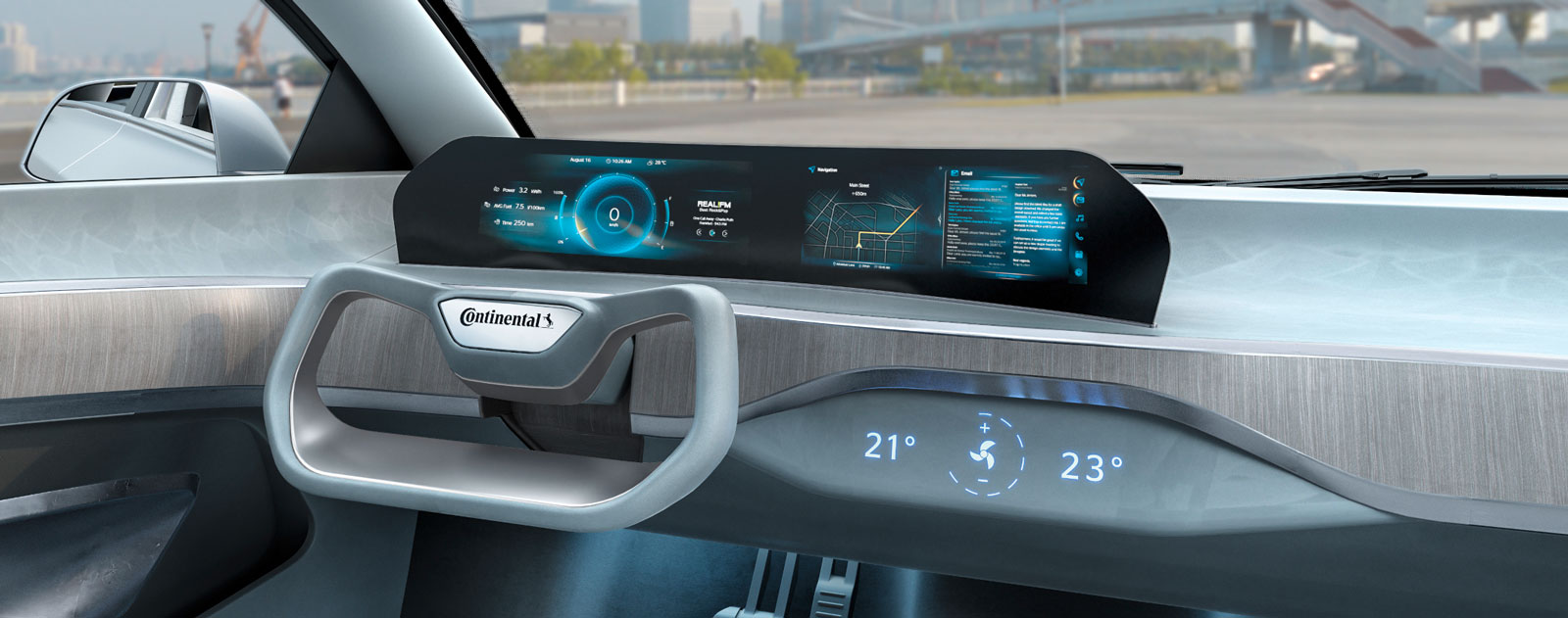
Continental have received their first major order—worth about €1bn—for OLED displays in a production vehicle. The order includes a multi-display that extends from the driver’s area to the centre console, and integrates two screens optically bonded behind a curved glass surface. Series production is scheduled to start in 2023.
One of the ways OLED technology achieves an aesthetically pleasing user experience is through its ability to light itself up; no backlighting is required, so these displays can be particularly thin and lightweight, with much greater design freedom. The technology also allows for more complex shapes as well as curved installation of the display. Furthermore, the OLED display provides brilliant colours and a deep black background, which increases contrast and improves readability for high-quality, user-friendly content. Contrast and colour diversity are maintained by OLEDs over a very wide viewing angle of almost 180° without loss, which makes the display in the centre console in particular interesting also for front-seat passengers.
The self-luminous property also makes OLED displays use relatively little energy. Instead of the entire backlighting of conventional screens, OLED technology only lights up those pixels needed for the momentarily relevant information of the human-machine interaction. As a result, the OLED solution consumes significantly less energy than a comparable LC screen for typical automotive content.


