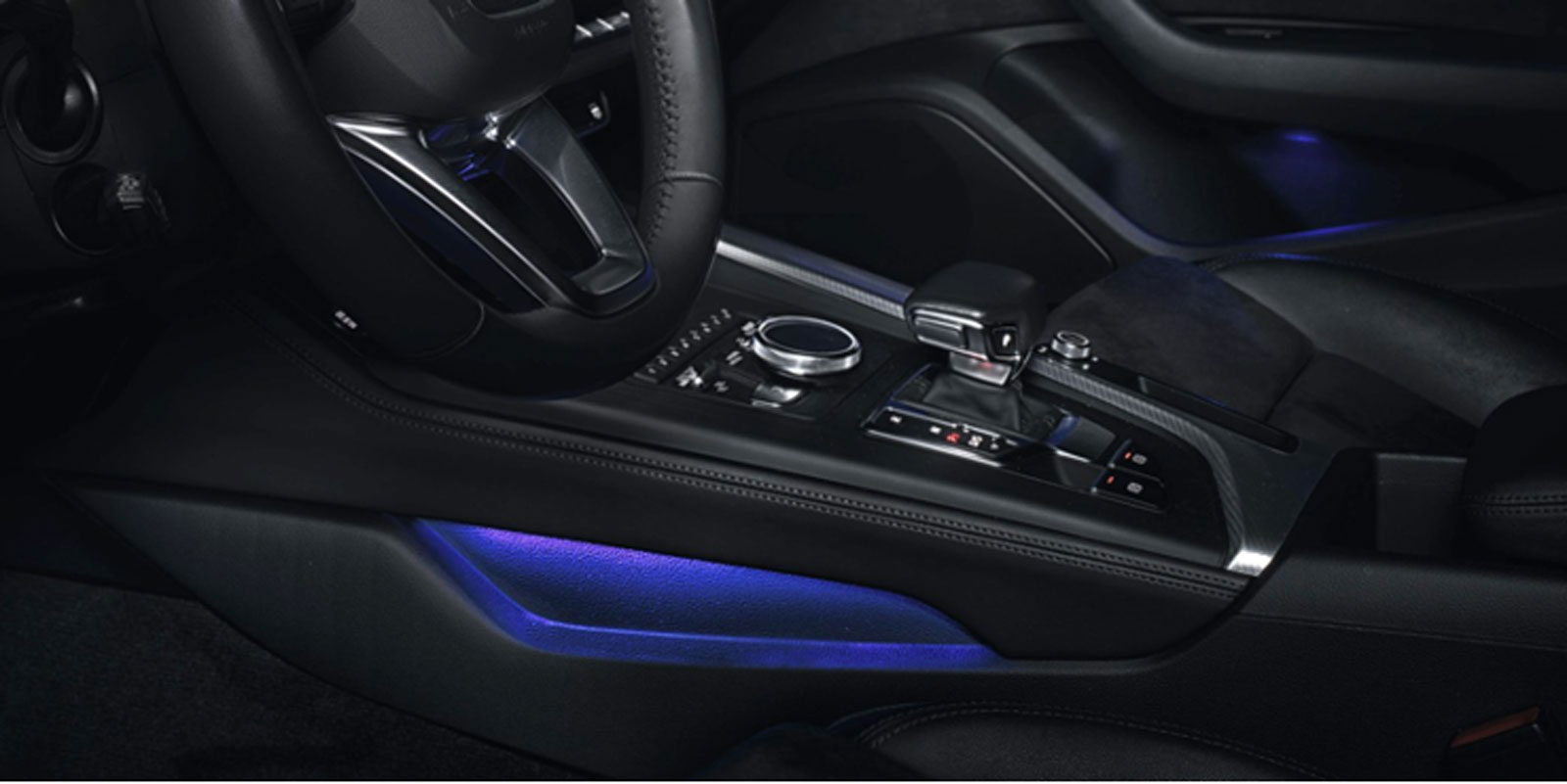
An Apple Car patent granted last month describes smart in-car lighting, able to intelligently determine what the occupants are likely to want or need at any given moment.
Conventional vehicle interior lights are static and typically vehicle occupants have to control the lights using a switch or a physical button. A conventional vehicle interior light may only illuminate a limited area while failing to illuminate large swaths of the interior of the vehicle. As an example, the vehicle occupant may be attempting to find an object dropped onto the floor of the vehicle at night. When the occupant turns on a light mounted on the roof of the vehicle, the light may not be helpful because the occupant’s body may create a shadow or the light may not illuminate a correct location within the vehicle. Objects within the vehicle also may be difficult to view based on limited lighting options in the interior of the vehicle. In short, a vehicle with conventional lighting would benefit from many improvements.
The solution, says Apple, is to take a zone-based approach to lighting, and then use a mixture of sensors and cameras to figure out what is happening and how to automatically adapt the lighting to suit.
A system includes a vehicle with a computing device and lighting hardware modules. Briefly described, and according to one embodiment, aspects of the present disclosure generally relate to systems and methods for providing adjustable lighting that utilizes sensors and imaging devices of the vehicle to intelligently illuminate a particular object, location, or zone within an interior of the vehicle.
That might be intelligently switching individual lights on and off, or it might mean a motorized spotlight tracking to the object you’re trying to see.
The lighting system recognizes the objects, locations, and zones within the vehicle to be illuminated and responds to explicit requests or commands for illumination.


