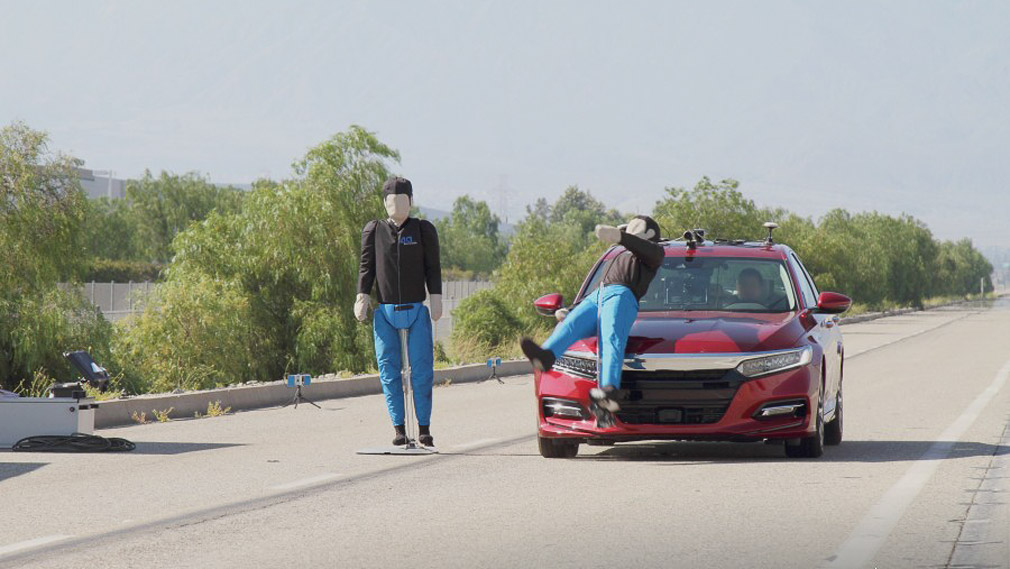
New research just published by AAA finds that automatic emergency braking systems with pedestrian detection perform inconsistently, and can be completely ineffective after dark when most pedestrian hits occur. The systems AAA tested were also challenged by real-world situations like a vehicle turning right into the path of a pedestrian. AAA’s testing found that in this simulated scenario, the systems did not react at all—the car hit the adult pedestrian target every time.
On average, nearly 6,000 pedestrians are hit and killed in American traffic every year, accounting for 16% of all traffic deaths—a percentage that has steadily grown since 2010.
“Pedestrian fatalities are on the rise, proving how important the safety impact of these systems could be when further developed, but our research found that current systems are far from perfect and still require an engaged driver behind the wheel”, says AAA Director of Automotive Engineering and Industry Relations Greg Brannon.
AAA’s latest study found that vehicle speed affected system performance as well, with results varying between testing performed at 30 and 50 km/h.
AAA evaluated the performance of four midsize sedans equipped with automatic emergency braking with pedestrian detection. Testing was conducted on a closed course using simulated pedestrian targets for the following scenarios:
- An adult crossing in front of a vehicle traveling at 30 and at 50 km/h during the day and 40 km/h at night;
- A child darting out from between two parked cars in front of a vehicle traveling at 30 and at 50 km/h;
- A vehicle turning right onto an adjacent road with an adult crossing at the same time, and
- Two adults standing along the side of the road with their backs to traffic, with a vehicle approaching at 30 and at 50 km/h.
Overall, the systems performed best in the instance of the adult crossing in front of a vehicle traveling at 30 km/h during the day. In that case the systems avoided a collision 40% of the time. But at 50 km/h most systems failed to avoid a collision with the simulated pedestrian target, and at night none of the systems detected or reacted to the adult pedestrian.
The other scenarios largely foiled the systems, too. When encountering a child darting from between two cars, with the vehicle traveling at 30 km/h, a collision occurred 89% of the time. Immediately following a right turn, all of the test vehicles collided with the adult pedestrian. When approaching two adults standing alongside the road, with the vehicle traveling at 30 km/h, a collision occurred 80% of the time. In general, the systems were ineffective in all scenarios when the vehicle was traveling at 50 km/h.
AAA’s Brannon
comments: “The rise in pedestrian deaths is a major concern and automakers
are on the right path with the intent of these systems. Our goal with this
testing is to identify where the gaps exist to help educate consumers and share
these findings with manufacturers to work to improve their functionality”.


