Economies of scale, lower development costs, faster times to market and the ability to build multiple cars on one line are some of the benefits of megaplatforms.
Automakers are increasingly prioritising these benefits as they strive for production efficiencies and jockey for position in the global sales race—a mirror of the intra-industry race to devise the most efficient megaplatform.
VW Group have been working at it; their MQB megaplatform puts them years ahead when it comes to the next evolutionary stage of mass car production.
European competitors such as Renault-Nissan and PSA Peugeot-Citroën are running to catch up, shifting to a largely modular approach.
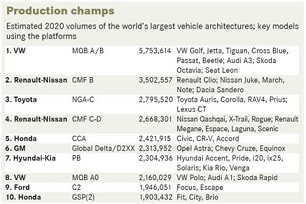 Source IHS Automotive |
So far, Renault-Nissan are aiming for 70% of their vehicles to be based on three common module family (CMF) platforms by 2020. PSA Peugeot-Citroën seek to reduce their platform count from seven to two by 2022, and launch 11 models and build 1.5 million cars off the modular platform EMP2 by 2018.
Unlike other management principles such as Toyota’s Kaizen wherein a company continuously improves existing best practices on an incremental basis, modular production initially requires a total overhaul of everything from design and engineering to production, logistics and procurement.


