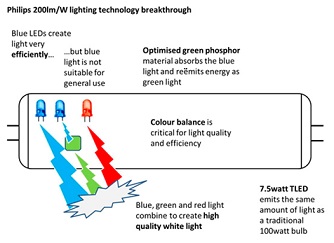
Philips have announced a new type of tubular LED (“TLED”) lamp producing “high quality” white light with unprecedented efficacy of around 200 lumens per watt. It’s being done with an interesting new variant on conventional RGB approaches. Instead of red-, green-, and blue-chip LEDs, there are only red and blue ones.
There’s also a phosphor-converted green LED with a blue-emitting chip. Present-production direct-emitting green LEDs tend to give efficacy of around 100 Lm/W, but a PC-green LED can do much better: nearly 400 Lm/W. What makes the new TLED’s high efficacy particularly noteworthy is that it is said to be achieved at relatively low CCTs of 3000K to 4500K. Higher CCTs are usually used to give elevated efficacy, but the blue-white light is not well liked for many applications, particularly in domestic and architectural lighting. And lower CCTs may be technically preferable in some vehicular applications, as well, such as interior illumination. Two press releases, a technically-orientated one and a more consumer-orientated one with a video emphasising energy savings, discuss the new lights. While this particular development might not apply directly to headlamps, it is highly intriguing to see how new techniques like this can kick efficacy rapidly upward. Clearly we are still zooming along the left (upward) side of the development curve in LED lighting!
TLED 200 will be on sales in 2015.


