Driving Vision News: Professor, could you first introduce yourself, and tell us about your education, your career and your hobbies and interests?
Prof. Amnon Shashua. My education includes Bsc and Msc in mathematics and computer science at Israeli universities and Phd (1993) in computational neuroscience at M.I.T. Currently, I hold the Sachs chair in computer science at the Hebrew University of Jerusalem in Israel
DVN: Please tell us about your company. When did you create the company?
Why? And what can you tell us about your sales, your people, and your
business results?
A.S.: Mobileye was founded in 1999 by my partner Ziv Aviram and me.
Ziv is the president and CEO of the company and I am the chairman of the board, but generally we both run the company. My focus is looking after the development and product roadmaps.
The Mobileye idea was motivated from my research in computer vision and machine learning. We both understood that the automotive market would be heavily drawn into sensor-based active safety and that a camera is the ultimate sensor without which a driving assistance system is not complete. Our unique angle to the field was that we could perform all the required functionalities using a monocular (single camera) approach – a direction which went against the common wisdom at the time.
Today we have around 200 employees covering the disciplines of algorithms, application software, hardware engineering, chip design and embedded programming. Our products have been launched worldwide through a number of OEMs including BMW, GM, and Volvo with many more launches planned in the coming few years. In addition to OEM launches we have aftermarket activity where we launched the AWS driving assistance system in 2007.
DVN: Coming back to the products. Could you talk about Eye Q, and its main functionalities?
A.S.: Our first-generation system-on-chip, the EyeQ1, was launched in 2007.
It was LDW and vehicle detection in a radar-fusion system. The EyeQ1 is used in the AWS running LDW and vehicle-detection technologies for Forward Collision Alert
(FCA) and Headway Alert features.
The EyeQ1 is also used in the forthcoming system of LDW + Adaptive Headlight Control + Traffic Sign Recognition to be launched by a major European OEM in August this year.
The EyeQ1 is a system-on-chip designed to cater the type of computations one faces in visual interpretation tasks. In computer vision one starts with a “low level” computation phase by scanning the image in a systematic manner to identify “candidates” for further in-depth processing.
The low-level phase is ideally suited to a DSP architecture of applying a fixed local computation (like a convolution) everywhere in the image.
The second “high level” phase processes each candidate area in a manner ideally suited for a CPU architecture. Therefore the ideal microprocessor is one that combines both the DSP and the CPU architectures.
DVN: In May, you announced that with STMicroelectronics, you have successfully demonstrated the second generation of EyeQ. What are its new functionalities and features?
A.S.: The EyeQ2 is our second-generation system-on-chip. It follows the same design principles of the EyeQ1 with a number of important differences: it is around 8 times more powerful than EyeQ1, it has additional cores of a general purpose nature allowing flexibility in integrating third-party functionalities, it has extensive video-out capabilities, and it can handle high resolution cameras.
The EyeQ2 is designed to run all the functions simultaneously, LDW, AHC, Vehicle detection features, TSR and Pedestrian detection and will be launched in 2010 by a major European OEM running LDW, vehicle detection, and pedestrian detection. A number of additional programs with EyeQ2 are in the production-win phases.
DVN: How do you market and sell your products? Do you sell directly to automakers, or do you go through Tier 1 suppliers?
A.S.: We sell our product — the EyeQ chip with the customer-specified functions — to the Tier-1s. We work with Conti through their acquisition of Siemens VDO, Delphi, Kostal, and Magna Electronics, and we are in the process of expanding our Tier-1 base with new programs.
We also work directly with the OEMs in pre-development programs – when those reach maturity the Tier-1 enters and the activity turns into a series level process where the Tier-1 takes the lead. In the aftermarket we sell a complete system through distributors. We have distribution channels in Israel, Japan, a number of European countries and Chile. We are expanding the distribution to additional countries.
DVN: What OEMs presently use Mobileye products?
A.S.: BMW, GM, and Volvo. Additional wins have been made to include the existing OEMs in expanded programs and a number of new OEMs with launches from 2008 through 2012.
DVN: Mobileye is known for vehicle and lane detection. Your works on pedestrian Detection and intelligent headlamp control are not known. What can you tell us about those areas of work? How about pedestrian protection?
A.S.: Our headlight control (AHC) is about to be launched in 2 months with a major European OEM. What is special about our AHC — compared to Gentex, for example — is that our AHC runs together with additional functions like LDW and TSR, using the same camera and microprocessor resources.
The technical challenge is very high compared to a standalone AHC because the requirements from the camera control are conflicting – an AHC function requires an image which highlights light spots, while LDW requires an image which highlights the road markings and TSR requires an image which highlights the traffic sign details to detect and read the signs.
 A combined system must run at a higher frame rate than a standalone system and must share images (frames) among the different customer functions.
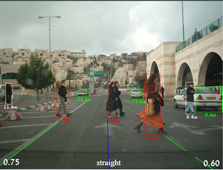
Our pedestrian detection technologies are in series development and are to be launched (using EyeQ2) by a major European OEM — not the same one as mentioned above — in 2010.
DVN: Automatic beam switching is already developed by several Tier 1 suppliers. On the Audi A4, A5 and Q7, as well as various North American vehicles, Gentex have released their SmartBeam automatic headlamp beam selector. What do you bring to compete with systems like SmartBeam? Why is yours better?
A.S.: The combined system has the advantage of reducing the overall system cost. Rather than purchasing the SmartBeam from Gentex and an LDW from another supplier and a TSR from a third supplier and cramming the windshield area with multiple systems, our approach of a combined system allows a single sensor system to perform all the functions. This without doubt will be the norm in the future roadmap of OEMs. Standalone systems would find it hard to survive as this trend unfolds.
DVN: Mobileye is now more and more known by Driver Assistance community.
What do you expect from which segments of the automotive industry? What are your next targets?
A.S.: We have series development and launches planned for all the features mentioned above. Our future target is to use the monocular approach for ACC distance control functions. We know it can be done and have concept vehicles running ACC with our vehicle detection technologies by a number of major OEMs. We feel the time is right to have the ACC capability turn into a series development activity. With the introduction of EyeQ2 this task is within reach.


