The ‘Family Truckster’, as discussed earlier in the Design Lounge, has evolved over the years into the 7-seat SUV available today. Though many makers have evolved into this solution, some models—such as the Hyundai Palisade and Kia Telluride—are newcomers that have made a significant impact without the historical background.
This week we look at these twins and their design impact and placement.
Hyundai Palisade


The Hyundai Palisade is targeted as a ‘near-luxury’ family vehicle placed just below their new Genesis brand of premium/luxury vehicles. As such it does offer many of the luxury materials seen in the Genesis line of vehicles such as diamond stitched and perforated leather along with matt-open pore wood inserts.
Also, the drivers display/cluster and center display units are integrated into a single horizontal unit that is similar in theme to what Hyundai used in their new Ioniq 5 BEV.

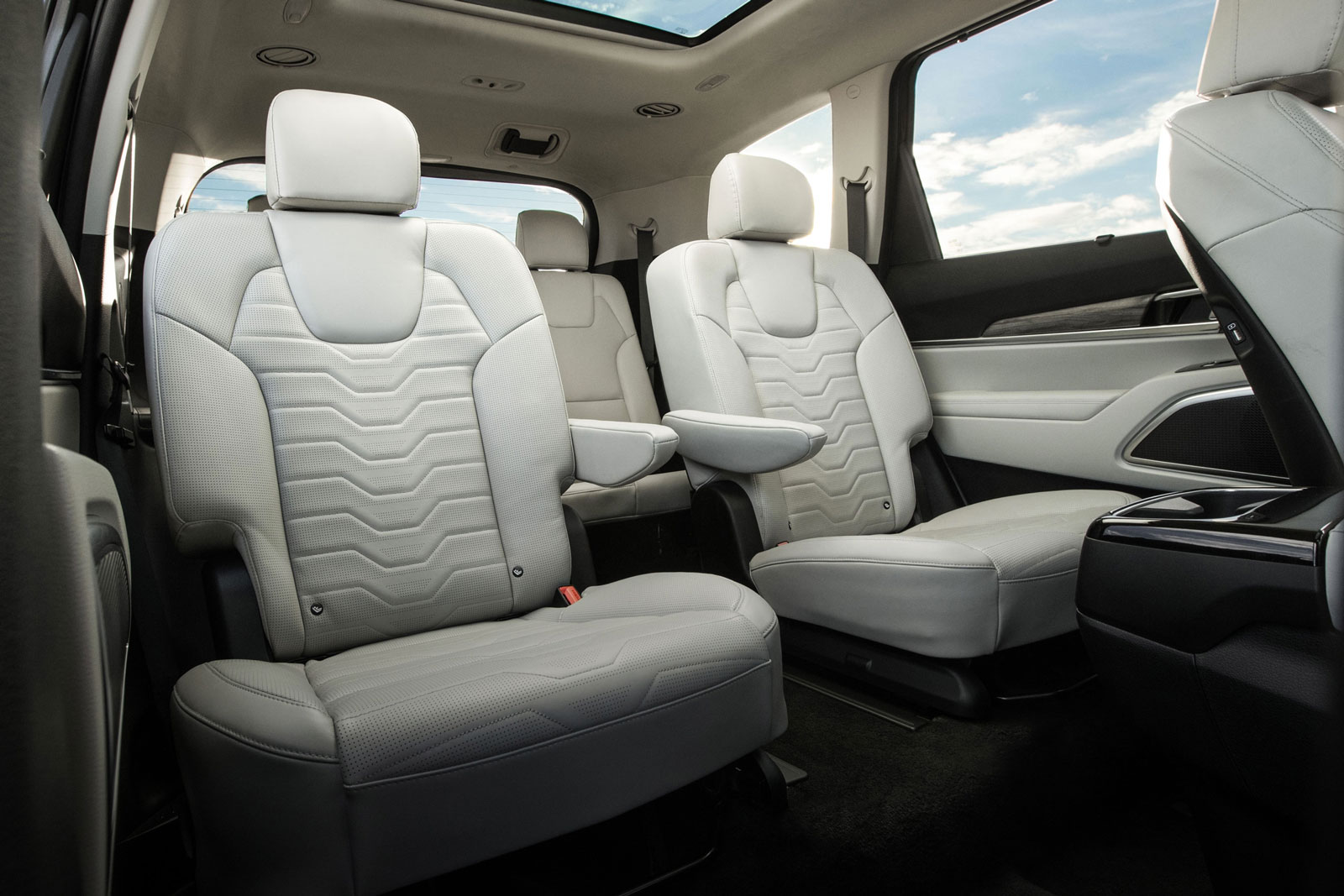
Hyundai’s Palisade localized the use of diamond and perforated leather onto the upper seats creating a luxury ‘focal point’ for their clean interior feeling.

Two display units are integrated, but not into a horizontal single plane, as seen in the Ioniq 5.


A full digital cluster with camera lane displays and a HUD is used on both the Hyundai Palisade and Kia Telluride.


In the center/floor console, there’s a pushbutton gear selector (everything old is new again!), creating a very clean low profile approach for their switchgear. This enhances the Palisades near-luxury target by minimizing and protrusions toward the driver or passenger in the front compartment.


Storage and utility are a critical functional aspect of the 7-passenger SUV, with cubbies and bins available in and under the armrest. This separation of hidden vs. visible storage further enhances the near-luxury placement of the Palisade for Hyundai.


Of particular note, the grouping and integration of the 2nd and 3rd row folding switches into a single panel accessed from the rear creates a very clear, clean and functional aesthetic. Other automakers have this feature but place these switches where the traditional manually operated levers would be (left and right-side panels). Grouping them together creates a more convenient experience for the user.


Matte-finished, open-pore finished wood trim that integrated the door panels and instrument panels and the diamond stitched/perforated leather trim is used in all 3 rows of the vehicle…


…while also enabling the functionality required for 7 passengers and their stuff.
Kia Telluride


Kia, with its very different market positioning, has placed the Telluride as a more adventurous near-off-road vehicle with an aggressive/blocky aesthetic along with a more traditional approach to materials and functions.
The digital cluster and center display are separate elements along with a traditional binnacle and soft instrument panel cover.
This contrasts with the Palisade by having the matt-open pore wood trim in its traditional placement integrating the HVAC ducts while the Palisade incorporates it behind its displays and into the door panels.


Another key differentiator is the floor/tunnel console. With a more ‘off-road’ focused theme, the console uses a traditional protruding gear selector lever while also incorporating large grab handles for both the driver and passenger instead of the smooth integrated execution seen in the Palisade.
This use of protruding elements can be seen in the center display executions and four-wheel drive switching.


Storage solutions are also not hidden as in the Palisade. Accessibility is prioritized for the Telluride which include charging points, hooks and pockets for electronic devices.


Trim cover solutions also have their unique decorative element but do not carry over to the 3rd row thematically showing the cost/function priority of the Telluride over the Palisade.
These corporate twins have now become the state-of-the-art target vehicles for the 7-passenger SUV in 2021.


