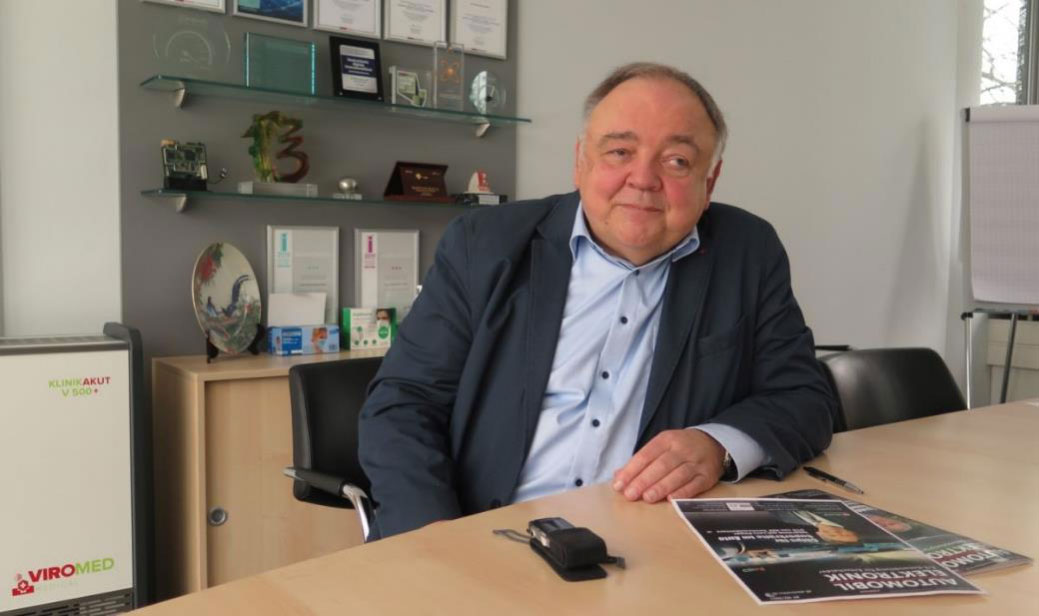
Robert Kraus is CEO of Inova Semiconductors, and Chair of the ISELED alliance. He kindly granted this DVN-Interior exclusive interview.
DVN-Interior: How are Inova and the ISELED alliance getting along together?
Robert Kraus: We started the ISELED Alliance together with four other companies so the question “how getting along together” does not arise, we are just part of it.
DVN-I: What is special about ISELED?
RK: Among other things, ISELED eliminates the binning problem with the LEDs and enables smart digital control of the basically analog component LED. ISELED reduces system costs because the RGB LEDs and our driver-controller IC are assembled together in a very small SiP (System in Package). Calibration of the smart mini-LED module is already carried out during manufacture of the SiP, which can then be operated like a digital component. The LEDs—theoretically thousands can be cascaded—are controlled via a lean protocol with a data rate of 2 Mbps, since only the address, color, and brightness value have to be transmitted. This is why ISELED is also called a “digital LED”.
DVN-I: What is the importance of the ISELED alliance?
RK: The ISELED alliance is an open industry consortium whose members share a common goal: the development of a comprehensive, fully coordinated ecosystem around ISELED. In addition to LED manufacturers, microcontroller suppliers are also represented, as are major automotive tier-1s in the lighting sector from around the world, but also smaller, highly innovative development companies and test equipment manufacturers. When it was founded in 2016, just five companies laid the foundation for the ISELED Alliance. It has since grown to 38 members. Alps Alpine, Grammer, the Chinese LED manufacturer Harvatek, Osram Continental and Yanfeng just recently have joined. This already covers the entire value chain in the automotive lighting sector. And we already have some more inquiries underlining the ever-growing momentum around ISELED.
DVN-I: Which vehicles will be launched with ISELED technology?
RK: In the summer of 2020, the Chinese manufacturer FAW was the first automaker in the world to install ISELED in a vehicle, the premium Hongqi H9 model. There are further models that we, as a tier-3, are not all aware of. In Asia in particular, the market is developing very dynamically. In this first year in full production, we already are selling chips in the double-digit million range which is about five times the forecast we were given still in 3Q20. And already for first applications outside the automotive segment, e.g. in the area of industrial digital signage. From 2023, unit sales will increase enormously, the figure of a billion is on the horizon already for 2025/2026. And ILaS (ISELED Light and Sensor Network), a new bus for the car, will be added from 2025. I have the impression that the major automakers are taking a very proactive approach to the topic of interior lighting effects. Not only premium makers are now installing 40 per cent more light-emitting elements than in the previous generation of their vehicles. Because customers want to have a lighting experience in their cars, the trend is moving away from classic on/off to transition with dynamic effects. This means that the classic architectures, for example with the LIN bus, are reaching their limits with the ever-increasing number of LEDs and the simultaneous dynamization of light. Today, lighting control is often simply attached to the existing on-board electronics, but this is no way to support all the possibilities of the new technology. To ensure that it is nevertheless efficient and cost-effective, this requires a new lighting architecture
DVN-I: What do you mean by a new lighting architecture, and what does it have to do?
RK: The aim is to make the lighting world of tomorrow also possible in the car, hundreds of LEDs, and the whole thing dynamic or even functional. Classic lighting architectures with the LIN or CAN bus cannot achieve this due to their limitations in terms of scalability and the maximum number of clients. This is where our ILaS comes into play, the “ISELED Light and Sensor Network”, a new field bus in the vehicle that can integrate sensors and actuators into the network in addition to the ISELED light elements—up to 4097 units.

DVN-I: What does it mean for the LIN bus that ILaS gets its place in the car?
RK: There will be no technology leap to an exclusive ILaS/ISELED architecture in the vehicle, because there is rarely such a disruption in the car. There will be a coexistence of buses for some time. For example, the first ISELED systems will still be docked to the current lighting systems via LIN hubs. However, a major semiconductor manufacturer is already working on the direct connection of the ILaS bus to the ethernet on-board network via an ethernet-to-ILaS bridge chip. Over time, ISELED/ILaS will also become established in volume models, we are quite sure of that. In any case, we are working intensively on our first ILaS bus node device, which we will sample in the middle of the year. Also, the concept for ISELED 2.0 with additional features requested by many customers is ready; we want to have the first samples in 4Q21. A decisive factor for the rapid roll-out of ISELED/ILaS will be that there is soon a broad portfolio of attractive products. To this end, we have a number of semiconductor manufacturers in the ranks of the ISELED Alliance who are already working on corresponding products, e.g. Microchip and NXP on controller components that already support the ISELED protocol. With APIX, our legacy Gbps automotive pixel link, we started in 2008 and to date have more than 150 million nodes installed in cars around the world, we practically had a blueprint of how important ecosystems are for new technologies.
DVN-I: How do you gain confidence that automakers’ assembly lines will not stand still because of Inova?
RK: We are already thinking about a proper strategy when we ramp up to very large volumes. Already when APIX was designed in 2005, it was a clear requirement to digitize the Gbps physical layer, which is a classic analog function, to the greatest possible extent. Today devices with APIX interface are produced by several licensees in different baseline technology nodes and in foundries all over the world. For ISELED and ILaS, where the quantities will be of a completely different order of magnitude, the topic of availability and safeguarding is already at the top of our priorities today.
DVN-I: Are you impacted by the present chip shortage?
RK: We are in the pleasant situation that we can currently meet our delivery obligations and commitments in full. After the slump last year—automakers did not build any cars for weeks—we have a sporty growth plan for 2021 and are already ahead of schedule in the first quarter of 2021. We have already had to revise our forecast to the fabs, which we gave last year, upwards again— and this at a time when the foundries actually have no more capacity. That is a real challenge.
DVN-I: As a small German fabless semiconductor manufacturer, how do you manage to get into new designs?
RK: In the beginning, it was certainly an immense leap of faith from our first customer, premium automaker BMW, to use our APIX immediately in their flagship, the 7 Series (F01). With APIX we had a technically brilliant solution right from the start, and a great team that is still very innovative after 20 years. Over time we have built up credibility—a small, highly innovative semiconductor manufacturer that can “do automotive”—in terms of quality, service and reliability. The numerous awards show that we are really at the forefront of technology; such as recently the “Digital Innovator 2021” award by the PC magazine Chip.
DVN-I: What is the situation with APIX4?
RK: The premium manufacturers are planning to install even larger, higher-resolution displays in the future: After full HD and 4k, there are already plans to use 8k displays in cars as well. We are therefore already thinking specifically about an APIX4 with native 24 Gbps. There are several ways of realization, such as brute force with a lot of computing power, expensive process nodes and other disadvantages. We have almost 30 years of experience in the development of gigabit SerDes [serializer/deserializer] components and are pursuing a different approach here—the best of both worlds, so to speak.
DVN-I: What’s next for Inova Semiconductors?
RK: The next logical step is to bring APIX and lighting together by using the broad APIX data highway to transmit not only display but also lighting information together. In some cases, this could eliminate the need for entire control units. In any case, the trend in vehicles is toward centralized, very powerful domain architectures; Tesla has led the way. This opens up many interesting applications, of which the dynamic backlight is just the beginning. Because the topic of display and light is increasingly becoming hyped, we are currently very busy with APIX, ISELED and ILaS. Now we just have to show customers what this new world of visualization can look like; it’s all already working in our lab.


