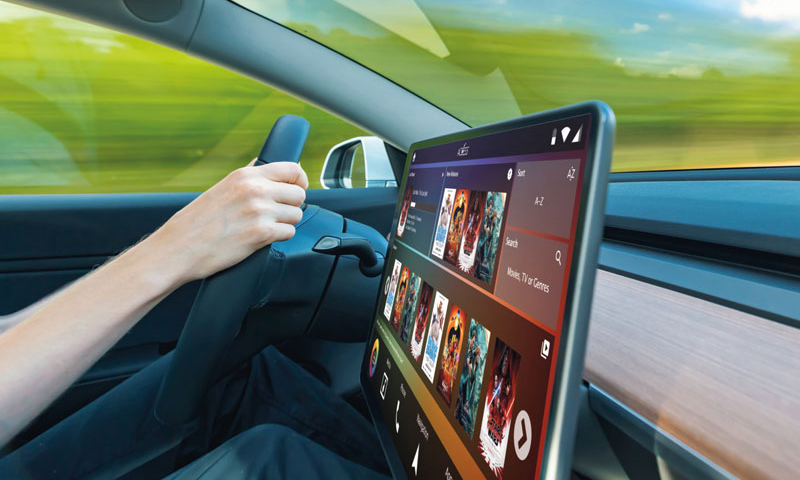
The rise of EVs and AVs, together with the increased connectivity afforded by 5G, offers a foundation for the automotive industry to realign its offering to capitalize on exciting new opportunities and recurring-revenue business models.
Streaming media content—video, gaming, satellite radio, services, etc—is expected to serve car occupant as more autonomous drives, especially on boring motorways, will allow even the driver to be entertained during long trips. And not just while the car is in motion; a new use case being described by several automakers is to keep EV occupants occupied while parked and charging!
Car and mobility brands can begin to capture behavioral signals in the car through driver and occupant identification and monitoring and voice interactions. Occupant behavior information, merged with customer data from other channels, will drive truly personalized experiences and new in-car digital services, opening up new revenue sources.

Then there is the untapped potential for rear seat entertainment (“RSE”). It’s been stagnant for almost 25 years since first introduction of video screens in the late ’90s within headrests or headliners, as on the Opel Zafira and others. The growing adoption of RSE will accelerate across increasing numbers of vehicle types and classes.
From a technology standpoint, IP, cloud computing, software technologies, voice activation systems, self-driving technology and infotainment all combine to create an additional layer fed with external content already available at home or at the office. Music and video streaming has largely replaced CDs and DVDs—85% of music content is now streamed—so it’s a natural evolution to get the same business model in cars.
Of course, in-car content for both drivers and passengers must come without further negatively affecting safety. Videogames, movies, and other such content must not be available to the driver when driving; nor must overly-bright screens and displays be allowed to distract the driver.
Maintenance types of services and access to social media are whole other oceans of opportunity for RSE, perhaps the subject of another article soon. In the meantime, let’s have a look at recently announced initiatives targeting new content in vehicles.
Polestar Points the Way with In-Cab Video App

Polestar has developed their own video streaming app for the Polestar 2. The beta app, now available in Europe, brings web-based streaming content from various providers directly to the central display screen in the car.
Content includes news services and national TV broadcasts where available, as well as a video playlist curated by Polestar. At launch, the app includes feeds from SVT in Sweden, TV2 in Norway, and GOPlay and RTBF in Belgium. All European markets also receive feeds from BBC Ideas, Al Jazeera English, and Germany’s Tagesschau. Additional feeds specific to other markets will be added over time.
The video app can only be used when the car is not in motion. However, when streaming and shifting out of Park, audio continues in the background, allowing occupants to continue to follow the broadcast. Data consumed by the app is included in the car’s data plan, meaning no extra costs for owners—though probably with caps and limitations.
Polestar’s decision to adopt the Android Automotive OS is cited as one of the main reasons they were able to develop their bespoke app with comparative ease. As customer needs and desires evolve, so can the services and solutions the app provides—without the typical long lead times demanded by the traditional car industry.
Toyota and AT&T bring TV and movie streaming into the car

Toyota North America and telecommunications provider AT&T have rolled out the WarnerMedia Ride App, which enables Toyota and Lexus owners to connect up to five compatible devices to browse, stream, and share content while on the road. Passengers will be able to view a rotating selection of live and on-demand content, including TV shows and movies, while also accessing services such as Cartoon Network, CNN, and HBO.
“Customers are hungry for access to new experiences with integrated, everywhere connectivity, whether they’re on a long road trip or short commute,” said Joe Mosele, Mobility & IoT VP at AT&T Business. “Looney Tunes, Tom & Jerry, and The Jetsons are some of our most watched content.”
XPeri HD Radio & TV content

DVN Interior already presented Xperi (DVN-I 7 April 2021) with their broadcaster-focused solutions: HD Radio, TiVo®, AIM® (all in media), and Arctic Palm®, provide radio companies with the tools necessary to deliver the best experiences to listeners, using DTS AutoStage™, a global hybrid solution that combines linear broadcast with IP-delivered content for a richer, more personalized in-cabin infotainment experience.
Access decentralized control of content

Access has removed all the stumbling blocks around content deals, so that one single service can be provided across all of an automaker’s markets.
Access Twine™ for Cars (“Twine4Car”) is a white label in-car app store and content solution for in-vehicle-infotainment. It enables automakers and suppliers to provide entertainment services including video, audio, live TV and games on the car head unit, rear seat entertainment devices, and on occupants’ own devices. Twine4Car is a flexible solution that will work across a variety of OSs including Android, Linux, and QNX-based systems.
Twine4Car connects the in-car infotainment system components seamlessly with occupants’ devices via the in-car Wi-Fi network. It provides a decentralized control of content that enables a multi-device user experience far beyond common single device streaming applications or screen mirroring technologies.
Related technology to foster in-vehicle content
Recent Shanghai Motorshow gave a good picture of what is happening in China, around in car technology enabling interaction with added value content.
Operating Systems

Chinese automotive HMI systems most commonly use Geely GKUI, BYD DiLink, GAC ADiGO, SAIC Banma, Chery Lion, NextEV NIO OS, or Xpeng Xmart OS for their connected ecosystems. These HMI operating systems can support the advanced features users expect. The GKUI Geely Smart Ecosystem is one of China’s fastest-growing intelligent-connected in-car systems. Since its launch in 2018, it has been installed in more than 22 Geely-branded models and has 1 million active users.
Tencent Auto Intelligence (TAI), launched in 2018, is an IoV (internet of vehicles) ecosystem that can support Android and Linux. Last year saw the release of version 3.0, which includes the in-car user interface and supports a number of Tencent apps and functions. It also provides location-based services to provide a more personalized driving experience.
Intelligent assistant to copilot content
Many models come with intelligent in-car assistants that owners can’t wait to show off to their friends. The best assistants, though, are more than a neat party trick; they add true value to the driving experience, and to interact with media content.
To accelerate adoption of these tools, manufacturers are strategically choosing designs and branding strategies that earn user trust. They often chose anthropomorphic words to describe the technology, such as companion or guardian to encourage emotional connection and quell fears drivers may have about new technologies.

Examples include Nio’s NOMI (it will also take a selfie and will countdown from three so users can get ready!); Hozon U’s AI assistant named Xiao You; Aiways’ Intelligent Companion Technology, Ideal One’s voice assistant Wiki, Enovate’s AI, Changan Uni-T, XPeng’s Xiao-P (or Lil-P) voice assistant, and more.
Entertainment Options

The BYD Han comes with a wireless microphone. Zotye Traum Meet 3 comes with a built-in karaoke system as part of its OnlyMic infotainment system. OnlyMic includes an 8″ touchscreen, 12-speaker Pioneer sound system, and Traum-branded wireless microphone. Users can add their favorite songs using USB or Bluetooth.
The Changan UNI-T’s shift handle, which resembles the joystick of a spaceship, features a selfie button user can push to easily snap pictures.
The MG HS infotainment system allows users to upload pictures and video for display. It also includes an ambient lighting feature that allows you to choose custom colors that adapt to your driving mode.

Weltmeister, the EV brand owned by WM Motor Technology in Shanghai, has an in-car assistant called Xiaowei. It offers “Date Night Mode,” in which it sets romantic music and mood lighting, and “Cinema Mode” to make the car interior feel like a movie theatre.
Last December, Huawei launched their in-car smart screen for all models. It is the first in-car smart screen equipped with distributed technology in China, as well as the first after-mounted in-car product supported by Huawei HiCar. It also includes a camera and can support smartphone video calls and Huawei cloud conference functions.
Conclusion
Once connected, automakers can use communications technology to start building stronger relationships with drivers and passengers, to increase brand loyalty.
Offering a branded, value-added app, tied to each vehicle, creates a direct-touch communication path which is directly in the control of the automaker. This means the automaker can reach every car owner, globally, with localized content.
Value of this new market is huge; if the automotive industry does not embrace it, someone else will. And that would be either the internet giants like Apple, Google, Facebook, Amazon, and Baidu, or the entertainment giants like Disney, Netflix, CCTV, and Bambu—or both.
Thanks to Star and Access for their recent research reports used to document this in-depth.
Star is a global strategy, design & engineering service company based in Silicon Valley, with focus on HMI, from production-ready HMIs to futuristic concepts and robotic companions. They create holistic mobility journeys through user centered design and omni-channel digital experiences.
Access, with headquarters in Tokyo, is a company providing a variety of software for connected and mobile devices, such as mobile phones, PDAs, video game consoles and set top boxes. They were founded in the 1980s, when the Internet was just starting to take off in Japan. Their vision is: “Connecting Everything over the Internet”.


